Q:
A:
UN Millennium Declaration Nationalisation process should be concluded by end of year
Belgrade,
23 October 2006
State Secretary at the Serbian Ministry of Labour, Employment and Social Policy Vesna Piperski-Tucakov said today that the realisation of the UN Millennium Goals in Millennium Declaration signatory countries should be completed by 2015, and that Serbia, in the current phase, will harmonise all eight goals of this declaration with its own development projects.
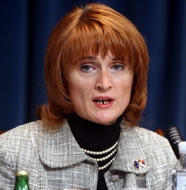
Vesna Piperski-Tucakov at today's press conference
Piperski-Tucakov, who is chairperson of the working group for supervising the realisation of the Millennium Goals, said at the presentation of the nationalisation process of the Millennium Development Goals in Serbia that this work should be finished by the end of this year.
She recalled that some of the Millennium Goals, accepted by all UN member states including Serbia, are eradicating poverty and hunger, realisation of a universal system for primary education, child fatality rate, fight against HIV/AIDS and tuberculosis.
An expert in the working group Mirosinka Dinkic, pointed to the fact that the specific goals of Serbia are above all to reduce poverty in rural areas, increase activities in the labour market and raising the employment rate.
Director of the Serbian EU Integration Office Tanja Miscevic said that the aim of the working group is to implement internal reforms in Serbia and to achieve sustainable economic development. According to Miscevic, that is important for Serbia in order to realise the Millennium Goals and at the same time advance EU integration.
Coordinator of the United Nations Development Programme in Serbia Lance Clark said that the most vulnerable social groups in Serbia are Roma, refugees, old persons and those with disabilities.
Clark stated that these are high risk groups, due to lack of health care, education, poverty and unemployment, and added that their problems must be resolved, so that Serbia can continue to develop.
She recalled that some of the Millennium Goals, accepted by all UN member states including Serbia, are eradicating poverty and hunger, realisation of a universal system for primary education, child fatality rate, fight against HIV/AIDS and tuberculosis.
An expert in the working group Mirosinka Dinkic, pointed to the fact that the specific goals of Serbia are above all to reduce poverty in rural areas, increase activities in the labour market and raising the employment rate.
Director of the Serbian EU Integration Office Tanja Miscevic said that the aim of the working group is to implement internal reforms in Serbia and to achieve sustainable economic development. According to Miscevic, that is important for Serbia in order to realise the Millennium Goals and at the same time advance EU integration.
Coordinator of the United Nations Development Programme in Serbia Lance Clark said that the most vulnerable social groups in Serbia are Roma, refugees, old persons and those with disabilities.
Clark stated that these are high risk groups, due to lack of health care, education, poverty and unemployment, and added that their problems must be resolved, so that Serbia can continue to develop.
-
 Belgrade/Brussels, 3 July 2026
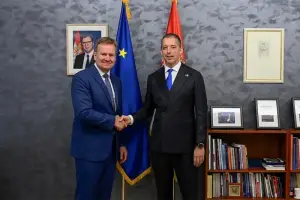
Belgrade committed to continuing constructive dialogue with Priština
-
 Belgrade/Brussels, 3 July 2026
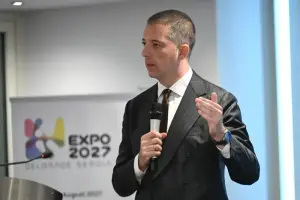
Serbia’s European integration guarantees regional stability
-
.webp) Belgrade, 3 July 2026
Belgrade, 3 July 2026Continued strengthening of Serbia-Spain defence cooperation
-
 Belgrade, 2 July 2026
Great potential for strengthening cooperation with Slovenia in agriculture
-
 Belgrade, 1 July 2026
Joint infrastructure projects of strategic importance for Serbia, Republika Srpska
-
 Belgrade, 30 June 2026
Scientific diplomacy one of strategic instruments of Serbian foreign policy
-
 Belgrade/Vienna, 30 June 2026
Continuous Austrian support for Serbia’s European integration
-
 Belgrade, 30 June 2026
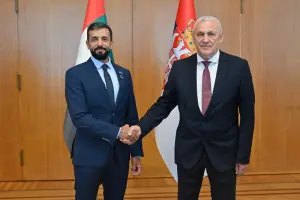
Deepening scientific, technological cooperation between Serbia, UAE
-
 Pasuljanske Livade, 28 June 2026
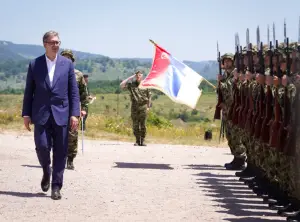
Successful live-fire exercise conducted using SAF combat equipment, weapons systems