
Q:
A:
Construction of flats for war invalids begins in Zemun
Belgrade,
16 November 2006
Serbian Minister of Labour, Employment and Social Policy Slobodan Lalovic, Japanese Ambassador to Serbia Tadashi Nagai and Belgrade Mayor Nenad Bogdanovic laid the corner stone in Kamendin, a residential area in Zemun, where 50 flats for war invalids and their families will be built.
Lalovic specified that a row of 23 blocks of flats will be built, each of which will comprise 26 single-room flats, 23 single-and-half-room flats and one three-room flat. The total surface of the flats will be 2,200 square metres.
He recalled that on July 7, 2005, the Ministry of International Economic Relations and the Japanese embassy in Belgrade signed a document that initiated the realisation of the project themed "Social Housing for War Invalids" in 11 municipalities and towns in Serbia, among which are Kikinda, Novi Sad, Indjija, Pancevo, Belgrade, Smederevo, Loznica, Kragujevac, Nis and Leskovac.
According to Lalovic, blocks of flats will be built in 10 out of 11 municipalities by end-2006, as well as technically prepared and ready for distribution, whereas in early-2007 the project will be concluded. In around 20 days, first flats will be completed in Indjija and Kikinda, and the last ones in Belgrade and Pancevo.
Lalovic stressed that the Japanese government's donation of RSD 324 million helped realise this project, adding that construction of flats was planned for 203 families of war invalids and the flats will be adjusted to meet the specific requirements of invalids.
The Minister explained that this prompted the government to finance the continuation of the project next year from the National Investment Plan and for that purpose set aside around €4.5 million to build 220 flats in 13 Serbian towns.
Lalovic said the flats will be let for a period of up to 10 years with the possibility of extending the period because under the existing regulations state-owned flats cannot be bought.
He recalled that on July 7, 2005, the Ministry of International Economic Relations and the Japanese embassy in Belgrade signed a document that initiated the realisation of the project themed "Social Housing for War Invalids" in 11 municipalities and towns in Serbia, among which are Kikinda, Novi Sad, Indjija, Pancevo, Belgrade, Smederevo, Loznica, Kragujevac, Nis and Leskovac.
According to Lalovic, blocks of flats will be built in 10 out of 11 municipalities by end-2006, as well as technically prepared and ready for distribution, whereas in early-2007 the project will be concluded. In around 20 days, first flats will be completed in Indjija and Kikinda, and the last ones in Belgrade and Pancevo.
Lalovic stressed that the Japanese government's donation of RSD 324 million helped realise this project, adding that construction of flats was planned for 203 families of war invalids and the flats will be adjusted to meet the specific requirements of invalids.
The Minister explained that this prompted the government to finance the continuation of the project next year from the National Investment Plan and for that purpose set aside around €4.5 million to build 220 flats in 13 Serbian towns.
Lalovic said the flats will be let for a period of up to 10 years with the possibility of extending the period because under the existing regulations state-owned flats cannot be bought.
-
 Belgrade, 2 July 2026
Great potential for strengthening cooperation with Slovenia in agriculture
-
 Belgrade, 1 July 2026
Joint infrastructure projects of strategic importance for Serbia, Republika Srpska
-
 Belgrade, 30 June 2026
Scientific diplomacy one of strategic instruments of Serbian foreign policy
-
 Belgrade/Vienna, 30 June 2026
Continuous Austrian support for Serbia’s European integration
-
 Belgrade, 30 June 2026
Deepening scientific, technological cooperation between Serbia, UAE
-
 Pasuljanske Livade, 28 June 2026
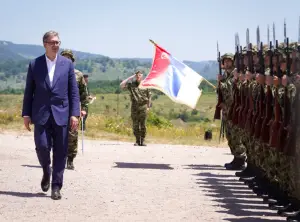
Successful live-fire exercise conducted using SAF combat equipment, weapons systems
-
 Belgrade/Brasília, 26 June 2026
Serbia, Brazil committed to strengthening cooperation across numerous fields
-
 Kraljevo/Čačak, 26 June 2026
Section of Adrani-Preljina motorway ceremonially opened
-
 Belgrade/Nicosia, 26 June 2026
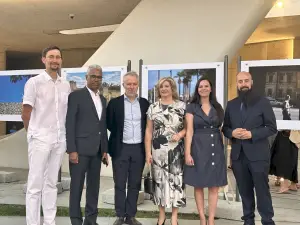
Exhibition "Applied Nostalgia: Belgrade-Nicosia" opens in Cyprus