
Q:
A:
Compromise solution for Kosovo of crucial importance
Belgrade/Washington DC,
13 July 2006
Serbian Prime Minister Vojislav Kostunica said last night in Washington that during his meeting with US Vice President Richard Cheney he reiterated how important it is to find a compromise solution for Kosovo.
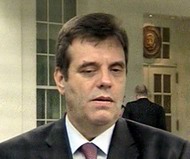
Vojislav Kostunica addresses the media after talks with Richard Cheney
Author:
Radio Television of Serbia (RTS)
After the meeting with Cheney, Kostunica said that talks with the White House's second man were very interesting and constructive. The talks focused on relations between Serbia and the US and on the issue of Kosovo-Metohija.
I repeated once more how important a compromise solution is, and it is perfectly clear which solution that is and what its advantages are, Kostunica said and highlighted the fact that the sustainability of such a solution can be verified in practice, which is not the case with the other, extreme and radical solution, Kosovo’s independence, which cannot be corrected.
Kostunica said that in the talks with Cheney and all other US officials in Washington he pointed to possible consequences of both solutions to the stability and peace in the region, which is "of special importance for the US Vice President and the entire Washington administration which is so concerned for stability in the world."
I repeated once more how important a compromise solution is, and it is perfectly clear which solution that is and what its advantages are, Kostunica said and highlighted the fact that the sustainability of such a solution can be verified in practice, which is not the case with the other, extreme and radical solution, Kosovo’s independence, which cannot be corrected.
Kostunica said that in the talks with Cheney and all other US officials in Washington he pointed to possible consequences of both solutions to the stability and peace in the region, which is "of special importance for the US Vice President and the entire Washington administration which is so concerned for stability in the world."
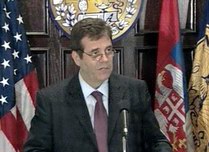
Vojislav Kostunica talks with journalists at the National Press Club in Washington
Author:
RTS
The Serbian Prime Minister also talked today with journalists at the National Press Club in Washington, at a very well attended press conference. He pointed out that the essence of Serbia's compromise, European and democratic solution for Kosovo-Metohija can be put into two words - a better future.
It is sure that Serbia's solution can bring about a better and safer future for the entire region.
He explained that the aim of his visit to Washington, after a tour of European capitals which are members of the Contact Group, is to present his collocutors all the advantages of the Serbian proposal, which entails a substantial, the widest possible autonomy. But, I also want to point to all disadvantages of the second proposal, which is Kosovo's independence, Kostunica said.
The Serbian Prime Minister reiterated that international law must be respected without exception, which means in the resolution of the Kosovo problem as well.
Underlining the European standard of solving problems of minorities by granting different levels of autonomy, Kostunica said that the possible independence of Kosovo would mean violating international law and bringing into question European and democratic values.
In all the talks I had, I have tried to get an answer to one question - what are the arguments for giving independence to Kosovo? I have not received a single answer to that, Kostunica said.
Commenting on the six rounds of negotiations in Vienna, Kostunica said that those negotiations were not successful.
Recalling that according to the UN Security Council Resolution 1244, Kosovo-Metohija is part of Serbia, the Serbian Prime Minister pointed out that that province constitutes 15% of Serbia's territory and that snatching away a part of that territory would be a very dangerous precedent.
The possible independence of Kosovo would be a dangerous, potentially explosive solution, and the consequences to stability, democracy and peace in the region would be very serious.
Kostunica said that during the Serbian diplomatic offensive he got the impression that the awareness of foreign partners of the complexity of Kosovo's problem has risen in recent months.
That is precisely the reason why Serbia believes that a deadline must not be a crucial factor when resolving such a complex problem, Kostunica said.
Answering the question as to whether the Serbian government believes that the presence of NATO forces in Kosovo is effective, Kostunica recalled that the number of international troops in the province has been increased, but in the meantime we have witnessed a large number of attacks on Serbs and their property.
A fact that cannot be concealed is that in spite of the international community's presence in the province, people in one part of Europe cannot move freely. The life of Serbs in a ghetto is worse than life in prison, Kostunica stressed.
It is sure that Serbia's solution can bring about a better and safer future for the entire region.
He explained that the aim of his visit to Washington, after a tour of European capitals which are members of the Contact Group, is to present his collocutors all the advantages of the Serbian proposal, which entails a substantial, the widest possible autonomy. But, I also want to point to all disadvantages of the second proposal, which is Kosovo's independence, Kostunica said.
The Serbian Prime Minister reiterated that international law must be respected without exception, which means in the resolution of the Kosovo problem as well.
Underlining the European standard of solving problems of minorities by granting different levels of autonomy, Kostunica said that the possible independence of Kosovo would mean violating international law and bringing into question European and democratic values.
In all the talks I had, I have tried to get an answer to one question - what are the arguments for giving independence to Kosovo? I have not received a single answer to that, Kostunica said.
Commenting on the six rounds of negotiations in Vienna, Kostunica said that those negotiations were not successful.
Recalling that according to the UN Security Council Resolution 1244, Kosovo-Metohija is part of Serbia, the Serbian Prime Minister pointed out that that province constitutes 15% of Serbia's territory and that snatching away a part of that territory would be a very dangerous precedent.
The possible independence of Kosovo would be a dangerous, potentially explosive solution, and the consequences to stability, democracy and peace in the region would be very serious.
Kostunica said that during the Serbian diplomatic offensive he got the impression that the awareness of foreign partners of the complexity of Kosovo's problem has risen in recent months.
That is precisely the reason why Serbia believes that a deadline must not be a crucial factor when resolving such a complex problem, Kostunica said.
Answering the question as to whether the Serbian government believes that the presence of NATO forces in Kosovo is effective, Kostunica recalled that the number of international troops in the province has been increased, but in the meantime we have witnessed a large number of attacks on Serbs and their property.
A fact that cannot be concealed is that in spite of the international community's presence in the province, people in one part of Europe cannot move freely. The life of Serbs in a ghetto is worse than life in prison, Kostunica stressed.

Author:
RTS
Answering the question if Washington has mitigated its position a bit and if there is a difference in the reactions to the Serbian proposal between the US and European countries, the Serbian Prime Minister pointed to the fact that Ahtisaari and members of his team very often speak referring to the international community, but in fact they speak on behalf of the Contact Group.
He said that the international community is more aware of the potential consequences of an independent Kosovo and Serbia's reaction to it.
Asked by reporters how Serbia plans to integrate 2 million ethnic Albanians from Kosovo, Kostunica responded that Serbs and ethnic Albanians in Kosovo have a very long and complex common history.
At the same time, he recalled that the substantial autonomy proposed by Serbia envisages solutions that will allow Kosovo to have ties with international financial institutions.
I urge that a chance be given to a compromise, that is, to a solution that can be checked in practice and corrected if necessary, as opposed to possible independence which would be a final outcome that cannot be changed, Kostunica said.
He stressed that it should not be taken for granted that Serbs and ethnic Albanians cannot live together and pointed out that Serbs in Kosovo practically live outside the law, so he asked why the Serbian government should not take care of them when it comes to education, health care and similar matters.
Asked by reporters how many Serbs there are in Kosovo, he said that currently there are 100,000 Serbs in Kosovo, and that more than 200,000 of them have been expelled.
A small number have returned to their homes. But it should be borne in mind that the policy of UNMIK is that Serbs should return to the places they fled. However that is practically impossible because their houses were pulled down and because they are not safe, the Serbian Prime Minister said, reminding the reporters that UN Special Envoy for implementation of standards in Kosovo Kai Eide pointed to the same fact.
He said that the international community is more aware of the potential consequences of an independent Kosovo and Serbia's reaction to it.
Asked by reporters how Serbia plans to integrate 2 million ethnic Albanians from Kosovo, Kostunica responded that Serbs and ethnic Albanians in Kosovo have a very long and complex common history.
At the same time, he recalled that the substantial autonomy proposed by Serbia envisages solutions that will allow Kosovo to have ties with international financial institutions.
I urge that a chance be given to a compromise, that is, to a solution that can be checked in practice and corrected if necessary, as opposed to possible independence which would be a final outcome that cannot be changed, Kostunica said.
He stressed that it should not be taken for granted that Serbs and ethnic Albanians cannot live together and pointed out that Serbs in Kosovo practically live outside the law, so he asked why the Serbian government should not take care of them when it comes to education, health care and similar matters.
Asked by reporters how many Serbs there are in Kosovo, he said that currently there are 100,000 Serbs in Kosovo, and that more than 200,000 of them have been expelled.
A small number have returned to their homes. But it should be borne in mind that the policy of UNMIK is that Serbs should return to the places they fled. However that is practically impossible because their houses were pulled down and because they are not safe, the Serbian Prime Minister said, reminding the reporters that UN Special Envoy for implementation of standards in Kosovo Kai Eide pointed to the same fact.

-
 Belgrade, 24 September 2026
Improving quality, international visibility of Serbian universities
-
 Belgrade, 23 September 2026
Serbia aims to become regional hub for high tech, innovation
-
 Belgrade, 23 September 2026
150 decisions awarded to mothers for purchase of first home
-
 Belgrade, 22 September 2026
Significant scope for expanding cooperation with Austria
-
 Belgrade, 22 September 2026
Preparations for European U-21 Football Championship progressing as planned
-
 Belgrade, 22 September 2026
German investments important for development of Serbian economy
-
 Belgrade/Višegrad, 21 September 2026
Serbia continues to build bridges of cooperation with Republika Srpska
-
 Belgrade, 21 September 2026
Serbia ready to successfully host top-tier international events
-
 Belgrade, 19 September 2026
Belgrade masterclass important for education of young endocrinologists
-
 Belgrade, 17 September 2026
Firefighters-rescuers vital pillar in protecting citizens’ lives, property