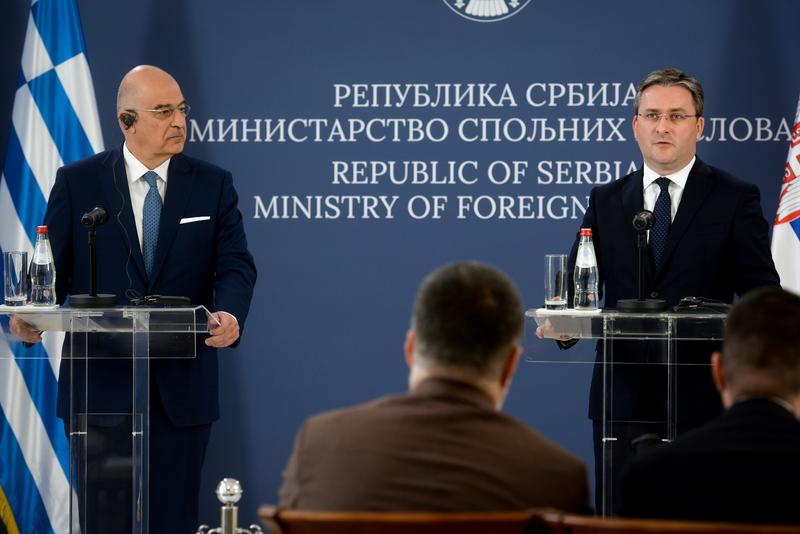
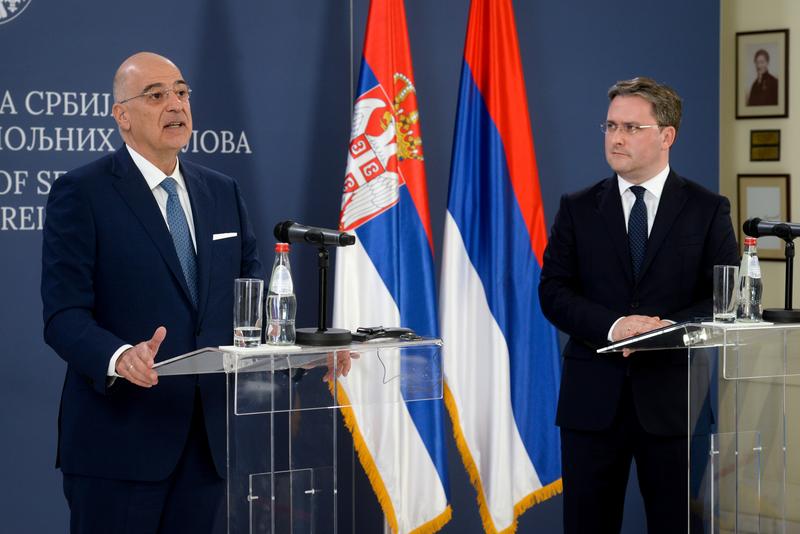
Minister of Foreign Affairs Nikola Selakovic stated today, after a meeting with his Greek counterpart Nikos Dendias, that Serbia highly appreciates Greece's principled position and its active commitment to further EU enlargement and integration of the Western Balkans.

Q:
A:
Serbia, Greece committed to deepening cooperation
Belgrade,
3 June 2022
Speaking at a joint press conference with Dendias at the Ministry of Foreign Affairs, Selakovic underlined that the two countries remain consistent in their mutual support on key issues of state and national interest.
Selakovic said that membership in the EU is a strategic commitment and interest for Serbia and that support in the process of European integration is very important to her.
He conveyed that in the talks with Dendias, the relationship between the traditional friendship, closeness and solidarity of the two fraternal peoples, Serbian and Greek, and the two friendly countries, Serbia and Greece, was confirmed.
The Serbian Minister of Foreign Affairs expressed gratitude of Serbia and the Serbian people for the support that Greece provides to the territorial integrity and sovereignty of Serbia on the issue of Kosovo and Metohija, which is a first-class state and political issue.
Selakovic added that he also discussed the Belgrade-Pristina dialogue with the Greek Foreign Minister, affirming support for dialogue as the only reasonable means of finding a solution to the Kosovo and Metohija issue. We showed that we are committed to achieving a sustainable, lasting and compromise solution based on respect and fulfilment of interests of both Serbs and Albanians in Kosovo and Metohija.
For us, the support of EU Member States that did not recognise independence of Kosovo is precious, Selakovic said.
He underlined that Serbia remains consistent in the support to territorial integrity of Greece on land and at sea, which is inseparable from respect for international public law.
Selakovic pointed out that preservation of peace and stability is of first-class importance for Serbia, noting that in this sense Serbia and Greece share the identical opinion that the preservation of peace and stability has no reasonable alternative.
The head of Serbian diplomacy pointed to the importance of the established trilateral format of Serbia, Greece and Cyprus and expressed hope that those meetings would continue soon, but also a quadrilateral format like the one that Serbia and Greece have with Bulgaria and Romania.
He stated that he presented the Open Balkans Initiative to Minister Dendias once more and voiced hope that Greece will support the format, which is not only on the Serbia-North Macedonia-Albania line, but that everyone in the Western Balkans is invited to participate in it.
I am convinced that Greece can find its place there, not only through support, but through concrete participation, he said.
Selakovic invited Greek investors to invest in Serbia, which has been among the world top countries in terms of foreign direct investment for three years in a row.
He also said that the two countries are interested in strengthening cooperation in the field of energy, especially when it comes to diversification and supply of important energy sources such as gas or liquefied gas.
After a meeting between Serbian President Aleksandar Vucic and Greek Prime Minister Kyriakos Mitsotakis in Alexandroupolis, where the LNG terminal was opened, we are convinced that by building an interconnector between Serbia and Bulgaria, we will get gas from Alexandroupolis, i.e., through Greece and Bulgaria, said Selakovic.
He thanked Greece for its efforts during its presidency of the South-East European Cooperation Process and expressed satisfaction with Serbia’s participation in the upcoming Summit of the South-East European Cooperation Process to be held in Thessaloniki.
Greek Minister of Foreign Affairs Nikos Dendias said that the future of the Western Balkans is in the European Union and that it is the only path to prosperity and stability in the region.
Dendias said Greece gives political support to bring Serbia closer to the EU and to membership in it.
I understand that there is fatigue and frustration due to the slow process of joining the EU, but we believe that this is the only way for the prosperity and stability of the region, Dendias said.
The head of Greek diplomacy stated that he is on visit to Belgrade as part of a tour of the Western Balkans ahead of the South-East European Cooperation Summit, to be held next week in Thessaloniki, 20 years after the Thessaloniki Summit at which the Agenda for the Western Balkans was launched.
Dendias added that the region should stay away from false promises and those who want to turn back the region's clock and who are trying to redraw the map of the Balkans, emphasising that this cannot be allowed and that the whole region needs to look to the common future, not the past.
He underlined that Serbia is a key partner of the EU and called on Belgrade to continue the process of reforms and harmonisation with the EU's foreign policy.
The head of Greek diplomacy said that he also talked with Selakovic about Kosovo and Metohija, stating that it is necessary to see progress in the dialogue between Belgrade and Pristina in order to reach a comprehensive legal basis agreement in accordance with international law.
Speaking about the situation in the region, Dendias pointed out that the change of borders in Bosnia and Herzegovina is not the way to go ahead, which he stated during his visit to Sarajevo.
We should try to help overcome differences and build regional stability and prosperity in order to improve regional cooperation, said the Greek Minister of Foreign Affairs.
Dendias stressed that Greece remains committed to further strengthening bilateral ties with friendly Serbia, which is an important partner to the Greek business community, noting that Greek investors have invested nearly three billion euros in Serbia and that Greek companies created nearly 25,000 jobs.
He welcomed Serbia’s intention to open a tourist office in Athens, noting that Greece remains one of the most popular destinations for Serbian tourists.
The head of Greek diplomacy added that he talked with Selakovic about interconnectivity in the field of transport and logistics, the pan-European corridor, as well as energy cooperation, emphasising that the LNG terminal in Alexandroupolis is a big step towards regional cooperation in that area.
Dendias also referred to Turkey's decision to suspend negotiations with Greece on resolving the problems in the Mediterranean and other bilateral issues, saying that Greece remains firm in protecting its interests in accordance with international law and the UN Charter.
-
 Belgrade, 15 February 2026
Serbia, Azerbaijan sign seven cooperation documents
-
 Belgrade/Munich, 15 February 2026
Great importance of Germany’s continued development assistance to Serbia
-
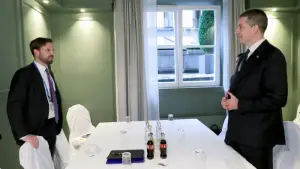 Belgrade/Munich, 14 February 2026
Strategic partnership with US one of Serbia’s priority goals
-
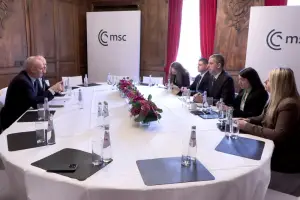 Belgrade/Munich, 14 February 2026
Serbia NATO’s reliable, predictable partner
-
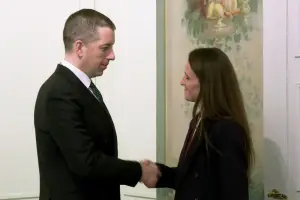 Belgrade/Munich, 14 February 2026
Regional cooperation among Serbia’s key foreign policy priorities
-
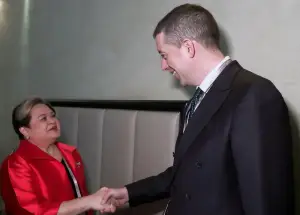 Belgrade/Munich, 14 February 2026
Further strengthening of bilateral relations with Philippines
-
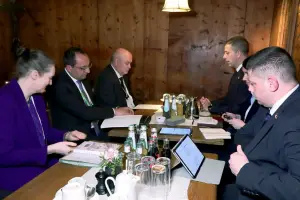 Belgrade/Munich, 13 February 2026
Serbia’s consistent commitment to principles of sovereignty, territorial integrity
-
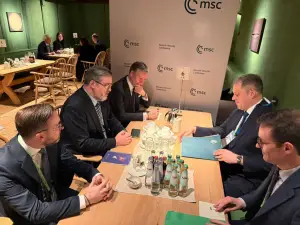 Belgrade/Munich, 13 February 2026
Government fully committed to meeting obligations in EU accession process
-
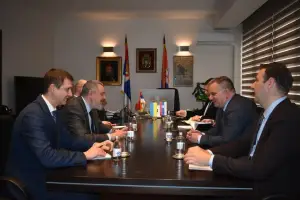 Belgrade, 11 February 2026
Ample space for advancing cooperation with Ukraine in field of education
-
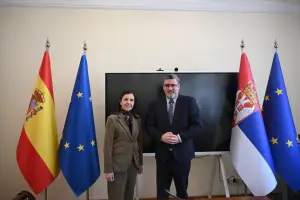 Belgrade, 11 February 2026
Spain’s support for Serbia’s European path