Minister of Foreign Affairs Nikola Selakovic addressed today via video link the 49th session of the United Nations Human Rights Council and said that Serbia is committed to cooperation with all UN bodies in the field of protection and strengthening of human rights.

Q:
A:
Serbia cooperating intensively with UN in field of human rights protection
Belgrade,
28 February 2022
Selakovic said that Serbia is sincerely committed to fulfilling the obligations undertaken by ratifying UN human rights treaties, and added that our country regularly submits reports to treaty bodies, continuously works on the implementation of accepted recommendations, but also cooperates well with the Office of UN High Commissioner for Human Rights Michelle Bachelet.
"Serbia is striving in the best faith to contribute to the realisation of lasting reconciliation through constructive positioning in resolving all open issues and commitment to strengthening regional cooperation," the Minister said, emphasising that our country pays special attention to determining the fate of missing persons.
He specified that, according to the data of the International Committee of the Red Cross from the previous year, 9,925 people are still listed as missing in the region, out of which 1,621 in the Autonomous Province of Kosovo and Metohija, 1,964 in Croatia and 6,340 in Bosnia and Herzegovina.
According to him, Serbia has been pointing for many years to the importance of finding a permanent and sustainable solution for long-term displaced persons, for refugees from Croatia and Bosnia and Herzegovina, as well as internally displaced persons from Kosovo and Metohija.
Serbia is among the countries with the largest number of internally displaced persons in Europe - these are persons of Serbian and other non-Albanian nationalities, who were forced to leave their homes in Kosovo and Metohija, the Minister explained.
He noted that the rate of sustainable return is estimated at less than three percent, primarily due to security pressures on returnees.
The Minister said that the migrant crisis further highlights the interdependence of human rights and humanitarian issues, but also pointed out that Serbia, as a country on the Balkan route, approached with the greatest humanity in providing shelter to migrants, while providing international protection, in accordance with the principle of non-discrimination.
-
 Author: msp.gov.rs
-
 Belgrade, 15 February 2026
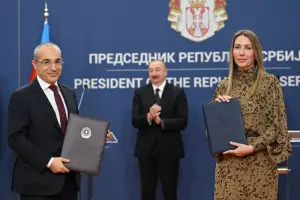
Serbia, Azerbaijan sign seven cooperation documents
-
 Belgrade/Munich, 15 February 2026
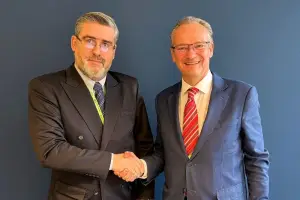
Great importance of Germany’s continued development assistance to Serbia
-
 Belgrade/Munich, 14 February 2026
Strategic partnership with US one of Serbia’s priority goals
-
 Belgrade/Munich, 14 February 2026
Serbia NATO’s reliable, predictable partner
-
 Belgrade/Munich, 14 February 2026
Regional cooperation among Serbia’s key foreign policy priorities
-
 Belgrade/Munich, 14 February 2026
Further strengthening of bilateral relations with Philippines
-
 Belgrade/Munich, 13 February 2026
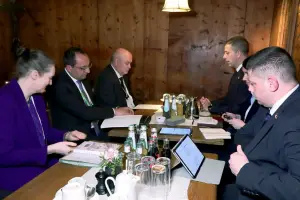
Serbia’s consistent commitment to principles of sovereignty, territorial integrity
-
 Belgrade/Munich, 13 February 2026
Government fully committed to meeting obligations in EU accession process
-
 Belgrade, 11 February 2026
Ample space for advancing cooperation with Ukraine in field of education
-
 Belgrade, 11 February 2026
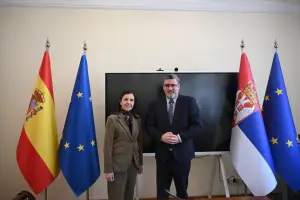
Spain’s support for Serbia’s European path