
Q:
A:
Programme for starting up production in underdeveloped communities to be prepared by end of February
Belgrade,
8 February 2010
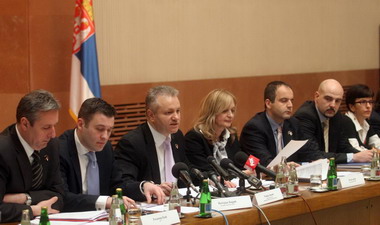
Deputy Prime Minister and Minister of Economy and Regional Development Mladjan Dinkic said today that a programme for starting up production in underdeveloped communities should be prepared by the end of February and that more than €100 million will be set aside for that purpose.
Author:
Fonet
At a meeting between the Business Council and Serbian businessmen, Dinkic called on companies which have secure export markets and that can sell their goods to take part in this programme and assist in the development of underdeveloped areas.
The Deputy Prime Minister explained that the programme provides long-term loans through the Development Fund and that it also includes two sub-programmes.
The first sub-programme is intended for companies from active industries which would obtain loans from the Development Fund. The loans would be favourable in the sense that 50% of funds from the loan should be covered by a mortgage.
The second sub-programme is intended for very poor municipalities like Kursumlija, Merosina and others. A mortgage will not be needed for loans, but only collateral for equipment that will be purchased with the loan, the Minister said.
Dinkic explained that any bigger domestic or foreign renowned company can apply for the programme, as well as those wanting to build more capacity.
He underlined that this is not privatisation, but starting up production in underdeveloped municipalities and creating jobs.
The Deputy Prime Minister said that lower exports and poor domestic demand are problems that are still present in Serbia’s economy.
Last year exports dropped by over 20% in relation to 2008, while imports dropped by 28%.
However, he said that exports of semi-finished goods and raw materials increased by 10% and of durable consumer goods by almost 9% in relation to 2008.
Dinkic said that a hard year is behind us and that according to economic indicators, Serbia will already get out of recession by the first quarter of the year. He voiced hope that economic growth this year will be bigger than 1.5%.
The Minister stressed that Serbia’s public debt stands at 32% of GDP, which is still much lower than the EU’s average public debt of around 73% of GDP.
Except for the loans for several infrastructure projects and factories of strategic interest for Serbia, the state should not get into any further debt, he said.
The state will take loans for the real sector and its large exporting companies, the first of them being the mining and smelting complex RTB Bor, to which the state has already issued a guarantee for a €135 million loan. These funds are to be invested in a new smelting facility and a sulphuric acid factory, the Minister explained.
Dinkic added that the second company is the petrochemical producer Petrohemija, announcing that talks will be held with the European Investment Bank regarding a loan to help increase the company’s competitiveness and energy efficiency.
The Deputy Prime Minister noted that a programme for purchasing Serbian buses with state subsidies will be initiated this week.
Dinkic said that the programme for purchasing Ikarbus and Neobus buses envisages allocating over RSD 1 billion from the state budget for the purpose of public transport in Serbian cities, as well as the private sector.
He stressed that both companies and private individuals will be allowed to purchase the buses with a 20% discount for those with a Euro 4 diesel engine and 30% for LPG powered buses.
The programme will help to produce and sell over 200 buses made in Serbia in 2010, Dinkic noted.
The Deputy Prime Minister explained that the programme provides long-term loans through the Development Fund and that it also includes two sub-programmes.
The first sub-programme is intended for companies from active industries which would obtain loans from the Development Fund. The loans would be favourable in the sense that 50% of funds from the loan should be covered by a mortgage.
The second sub-programme is intended for very poor municipalities like Kursumlija, Merosina and others. A mortgage will not be needed for loans, but only collateral for equipment that will be purchased with the loan, the Minister said.
Dinkic explained that any bigger domestic or foreign renowned company can apply for the programme, as well as those wanting to build more capacity.
He underlined that this is not privatisation, but starting up production in underdeveloped municipalities and creating jobs.
The Deputy Prime Minister said that lower exports and poor domestic demand are problems that are still present in Serbia’s economy.
Last year exports dropped by over 20% in relation to 2008, while imports dropped by 28%.
However, he said that exports of semi-finished goods and raw materials increased by 10% and of durable consumer goods by almost 9% in relation to 2008.
Dinkic said that a hard year is behind us and that according to economic indicators, Serbia will already get out of recession by the first quarter of the year. He voiced hope that economic growth this year will be bigger than 1.5%.
The Minister stressed that Serbia’s public debt stands at 32% of GDP, which is still much lower than the EU’s average public debt of around 73% of GDP.
Except for the loans for several infrastructure projects and factories of strategic interest for Serbia, the state should not get into any further debt, he said.
The state will take loans for the real sector and its large exporting companies, the first of them being the mining and smelting complex RTB Bor, to which the state has already issued a guarantee for a €135 million loan. These funds are to be invested in a new smelting facility and a sulphuric acid factory, the Minister explained.
Dinkic added that the second company is the petrochemical producer Petrohemija, announcing that talks will be held with the European Investment Bank regarding a loan to help increase the company’s competitiveness and energy efficiency.
The Deputy Prime Minister noted that a programme for purchasing Serbian buses with state subsidies will be initiated this week.
Dinkic said that the programme for purchasing Ikarbus and Neobus buses envisages allocating over RSD 1 billion from the state budget for the purpose of public transport in Serbian cities, as well as the private sector.
He stressed that both companies and private individuals will be allowed to purchase the buses with a 20% discount for those with a Euro 4 diesel engine and 30% for LPG powered buses.
The programme will help to produce and sell over 200 buses made in Serbia in 2010, Dinkic noted.
-
 Belgrade/Saint Petersburg, 5 June 2026
Serbia, Russia remain reliable partners in energy sector
-
 Belgrade/Saint Petersburg, 4 June 2026
Building long-term energy security through cooperation with Russia
-
 Belgrade/Saint Petersburg, 3 June 2026
Commitment to ensuring supply of oil derivatives to domestic market
-
 Belgrade, 29 May 2026
Diversification of gas supply routes priority for Serbia
-
 Belgrade, 23 May 2026
Direct Belgrade-Toronto flight important step for economy, diaspora
-
 Belgrade, 7 May 2026
Contract signed for construction of Vožd Karađorđe expressway
-
 Belgrade, 6 May 2026
Serbia receives support from IMF to continue reforms
-
 Kragujevac, 30 April 2026
State Data Centre in Kragujevac receives new supercomputer
-
 Belgrade, 24 April 2026
Stability of oil derivatives supply maintained
-
 Belgrade, 21 April 2026
Construction key driver of Serbia’s development