Q:
A:
Historical injustice inflicted on Serbia by recognising illegal act by Kosovo Albanians
Belgrade/New York,
27 February 2008
Serbian Minister of Foreign Affairs Vuk Jeremic highlighted that by recognising the unilateral declaration of Kosovo’s independence legitimises the act of unilateral secession from Serbia.
In a contributor’s article published in the New York Times today, Jeremic wrote that the way forward lies in coming together and securing an agreement for the future status of Kosovo and noted that by recognising the unilateral act of independence, the right to self-determination transforms into an avowed right to independence and legitimises the forced partition of internationally recognised, sovereign states.
The case against recognition is based not only on UN Security Council Resolution 1244 reaffirming Serbia’s sovereignty over Kosovo, but also founded on the view that the international system has, as a result of this hostile act by the Kosovo Albanians, become more unstable, more insecure and more unpredictable, the Minister commented.
According to Jeremic, recognising the unilateral declaration of Kosovo’s independence from Serbia legitimises the doctrine of imposing solutions to ethnic conflicts. It violates the commitment to the peaceful and consensual resolution of disputes in Europe. It supplies any ethnic or religious group that has a grievance against its capital with a playbook on how to achieve its ends.
He recalled that this illegal act has, unfortunately, been recognised by the US and some European countries, including UK, France and Germany.
Others in Europe – including Greece, Romania and Spain – have withheld recognition, as have most other leading global and regional players, including Brazil, China, Egypt, India, Israel, Russia and South Africa, said Jeremic.
According to him, as things stand, the number of countries that will recognise an independent Kosovo will plateau at around 40, leaving it unrecognised by a vast majority of close to 200 members of the UN, which of course includes Serbia.
A historical injustice is being imposed on a European country that has overcome more obstacles since 2000 than most other nations have in a much longer time, Jeremic recalled.
It is time to take a step back and examine the damage done, he said noting that if we can find a creative way to step back from the abyss that is Kosovo’s unilateral declaration of independence, we could not only salvage the credibility of the international system, but even strengthen it through a re-commitment to its basic principles, Jeremic said.
The Minister also mentioned a peaceful demonstration of close to half a million people in Belgrade last week who condemned this act of illegal secession and added that unfortunately, a few hundred hooligans attacked several embassies, which the Serbian government condemned.
The way forward lies in coming together and securing an agreement between the two parties: a negotiated, compromise solution to Kosovo’s future status that addresses the legitimate right to broad self-governance for Kosovo’s Albanians, while preserving a democratic Serbia that is whole and free, integrated into Europe, and engaged with a world set aright through prudent statecraft, the Minister concluded.
The case against recognition is based not only on UN Security Council Resolution 1244 reaffirming Serbia’s sovereignty over Kosovo, but also founded on the view that the international system has, as a result of this hostile act by the Kosovo Albanians, become more unstable, more insecure and more unpredictable, the Minister commented.
According to Jeremic, recognising the unilateral declaration of Kosovo’s independence from Serbia legitimises the doctrine of imposing solutions to ethnic conflicts. It violates the commitment to the peaceful and consensual resolution of disputes in Europe. It supplies any ethnic or religious group that has a grievance against its capital with a playbook on how to achieve its ends.
He recalled that this illegal act has, unfortunately, been recognised by the US and some European countries, including UK, France and Germany.
Others in Europe – including Greece, Romania and Spain – have withheld recognition, as have most other leading global and regional players, including Brazil, China, Egypt, India, Israel, Russia and South Africa, said Jeremic.
According to him, as things stand, the number of countries that will recognise an independent Kosovo will plateau at around 40, leaving it unrecognised by a vast majority of close to 200 members of the UN, which of course includes Serbia.
A historical injustice is being imposed on a European country that has overcome more obstacles since 2000 than most other nations have in a much longer time, Jeremic recalled.
It is time to take a step back and examine the damage done, he said noting that if we can find a creative way to step back from the abyss that is Kosovo’s unilateral declaration of independence, we could not only salvage the credibility of the international system, but even strengthen it through a re-commitment to its basic principles, Jeremic said.
The Minister also mentioned a peaceful demonstration of close to half a million people in Belgrade last week who condemned this act of illegal secession and added that unfortunately, a few hundred hooligans attacked several embassies, which the Serbian government condemned.
The way forward lies in coming together and securing an agreement between the two parties: a negotiated, compromise solution to Kosovo’s future status that addresses the legitimate right to broad self-governance for Kosovo’s Albanians, while preserving a democratic Serbia that is whole and free, integrated into Europe, and engaged with a world set aright through prudent statecraft, the Minister concluded.
-
 Belgrade, 28 August 2026
Church broken into, ransacked in Bušince village in Kosovska Kamenica
-
 Belgrade, 27 August 2026
Remembrance of suffering of Serb civilians in village of Klečka
-
 Belgrade, 30 July 2026
Continued illegal demolition of Serb-owned buildings near Lake Gazivode
-
 Belgrade, 29 July 2026
Works in Special Protective Zone of Visoki Dečani Monastery must be halted
-
 Belgrade, 23 July 2026
Priština continues with unilateral, illegal moves
-
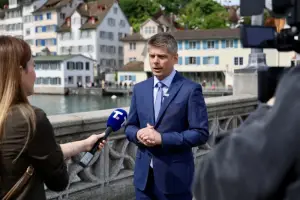 Belgrade/Zurich, 4 June 2026
Exhibition in Zurich on position of Serbs in Kosovo and Metohija
-
 Belgrade/Brussels, 12 May 2026
Belgrade seeking concrete steps towards establishment of Community of Serb Municipalities
-
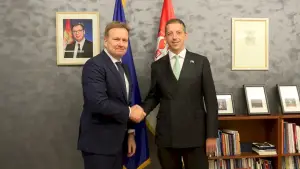 Belgrade/Brussels, 11 May 2026
Belgrade-Priština dialogue not dialogue on mutual recognition
-
 Belgrade, 10 April 2026
Serbian health centres closed in villages of Suvo Grlo, Banje