Q:
A:
Serbia ready to continue negotiations on future status of Kosovo-Metohija
New York,
16 January 2008
Serbian President Boris Tadic called upon the United Nations Security Council (SC) today to bring the decision to continue negotiations on the issue of the future status of Kosovo-Metohija.
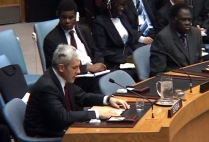
Boris Tadic addresses the United Nations Security Council
Author:
Fonet
Speaking at the SC session held to discuss the report by UNMIK Chief Joachim Rucker on the situation in the southern Serbian province, Tadic stressed that Serbia is ready to continue negotiations instantly.
He said that Serbia is completely ready and has the good will to participate, as partner to the SC, in the process of seeking a lasting solution based on compromise which will secure long term peace and stability in the Balkans and a better life for all its peoples.
The solution to the Kosovo status issue must be reached within the SC and any change in the civil and military missions in the province must be approved by it, said the Serbian President.
According to Tadic, Serbian citizens are firm in their policy to safeguard the territorial integrity and sovereignty of their country, as well as for continued European integration for a better life and economic prosperity.
During the previous two years, Serbia constructively took part in negotiations on the issue of the future status of the province, recalled Tadic, and added that the Serbian delegation presented a number of proposals which advocated widest possible autonomy as the best solution for Kosovo-Metohija.
It was proved that substantial autonomy, in various forms, is a functional, viable and successful solution. It was shown that such solutions are in accordance with international law and the only way to find a compromise in conflicts similar to the Kosovo problem, said Tadic.
He said that through analysis of examples such as Hong Kong, Macao and the Oland Islands, the argument was presented that substantial autonomy could be implemented in the southern Serbian province as well.
In each of these examples, he said, we can find something new which would pave the way to a solution which could be acceptable to all sides, and European history in the past 50 years gives many unique examples which show that sovereignty can be harmonised with self-governance.
At the same time, Tadic expressed regret over the fact that negotiations led by the international troika did not lead to a compromise. He said that Pristina attempted to force talks on the issue of relations between two independent states, in order to escape the clearly established aim of the negotiations, and is responsible for the failure of negotiations.
According to Tadic, the only argument which Pristina used is that Slobodan Milosevic and his regime were guilty for the situation in Kosovo-Metohija and that due to mistakes made by former regimes, Kosovo-Metohija, allegedly, deserves independence.
He recalled that Serbia and her peoples survived tough years during the last part of the 20th century, and consequences of bad and irresponsible policies culminated in unjust punishment handed out to Serbs in the spring of 1999, during three months of air attacks.
Today, Serbia, which has been a democratic and peaceful country for the past eight years and which consistently participated in negotiations, offers solutions, offers compromise. There is not a single just cause, not one legal argument for unjustly punishing Serbia and her peoples now, nearly a decade later, because of the wrong policies of one bad regime, stressed Tadic.
The Serbian President said that, if 50 years ago a community of European nations was created for the sake of lasting peace and to resolve all problems through dialogue, then today it is necessary that these great values of civilization are upheld also in the Balkans.
He said that we should not regret the effort needed to make sure that conflicts in this part of Europe too are resolved solely in a peaceful manner through dialogue and agreement, and by no means through unilateral moves.
A unilateral recognition of Kosovo's independence would be a precedent, Tadic warned and added that no one has the right to destabilise Serbia and the Balkans with hasty and unilateral decisions that would have immeasurable consequences that would affect other regions with the problem of ethnic separatism as well.
He said that the common aim of all peoples of the region is finding a solution that will prepare us for EU future.
That is why we believe that it is necessary to make additional efforts to find a mutually acceptable solution so that a substantial functional self-government could be secured, in line with Resolution 1244, which would guarantee all rights to Kosovo Albanians. Such a solution is possible and there is room for it, the Serbian President said.
At the same time, Tadic said that Serbia is ready to take a constructive and responsible part in the continuation of negotiations, which could be organised in Belgrade, Pristina or any other place in the world, in a form recommended by the UN SC.
I want to underline once more here in the UN SC that the UN Charter guarantees the principle of sovereignty and territorial integrity of the internationally recognised states, including Serbia as well, he reiterated.
According to him, if a part of territory of a legitimate democracy is taken away from it by force, that would be a violation of the UN Charter which would challenge the credibility of this world organisation and shake the foundations of international law on which the entire world is based.
The Serbian President called on UN SC member states not to encourage and allow the adoption of a unilateral act on Kosovo's independence and the violation of Resolution 1244 and the UN Charter.
Serbia will never recognise Kosovo's independence and it will preserve its territorial integrity and sovereignty by all democratic means available, legal arguments and diplomacy, Tadic said and added that Serbia will not resort to violence and war.
However, in case that violence takes place in Kosovo-Metohija and KFOR is not able to respond in an appropriate manner and protect the Serbs, Serbia is willing to offer help and protect the endangered population, with the previous approval of competent international institutions.
Speaking about the report of the Special Representative of the UN Secretary-General Joachim Rucker on the situation and implementation of standards in Kosovo-Metohija, the Serbian President said that that report does not depict the real state of affairs in the province.
The basic human right to freedom of movement, as he said, is denied to members of the ethnically discriminated communities in Kosovo-Metohija, while the process of return of refugees is a field in which interim Kosovo institutions and UNMIK have made no progress.
That is the main indicator that multiethnic society is not being created in Kosovo-Metohija, Tadic said and recalled that 250,000 people have been expelled from the province.
A continuous violation of human rights, together with limited freedom of movement for members of the Serbian and other ethnically discriminated communities, also exist in the province, while intimidation of Serbs and attacks to their property and cultural and religious heritage are an everyday occurrence, Tadic said.
He said that since the arrival of UNMIK and KFOR in 1999 until January 2007 there were more than 7,000 ethnically motivated attacks, and that 581 Serbs and 104 members of other ethnically discriminated communities were killed.
The Serbian President specified that 841 Serbs were kidnapped, 960 people were heavily wounded, while some 18,000 houses were destroyed and another 18,000 plundered. He concluded that these facts, together with many others, speak about the real situation in Kosovo-Metohija.
He said that Serbia is completely ready and has the good will to participate, as partner to the SC, in the process of seeking a lasting solution based on compromise which will secure long term peace and stability in the Balkans and a better life for all its peoples.
The solution to the Kosovo status issue must be reached within the SC and any change in the civil and military missions in the province must be approved by it, said the Serbian President.
According to Tadic, Serbian citizens are firm in their policy to safeguard the territorial integrity and sovereignty of their country, as well as for continued European integration for a better life and economic prosperity.
During the previous two years, Serbia constructively took part in negotiations on the issue of the future status of the province, recalled Tadic, and added that the Serbian delegation presented a number of proposals which advocated widest possible autonomy as the best solution for Kosovo-Metohija.
It was proved that substantial autonomy, in various forms, is a functional, viable and successful solution. It was shown that such solutions are in accordance with international law and the only way to find a compromise in conflicts similar to the Kosovo problem, said Tadic.
He said that through analysis of examples such as Hong Kong, Macao and the Oland Islands, the argument was presented that substantial autonomy could be implemented in the southern Serbian province as well.
In each of these examples, he said, we can find something new which would pave the way to a solution which could be acceptable to all sides, and European history in the past 50 years gives many unique examples which show that sovereignty can be harmonised with self-governance.
At the same time, Tadic expressed regret over the fact that negotiations led by the international troika did not lead to a compromise. He said that Pristina attempted to force talks on the issue of relations between two independent states, in order to escape the clearly established aim of the negotiations, and is responsible for the failure of negotiations.
According to Tadic, the only argument which Pristina used is that Slobodan Milosevic and his regime were guilty for the situation in Kosovo-Metohija and that due to mistakes made by former regimes, Kosovo-Metohija, allegedly, deserves independence.
He recalled that Serbia and her peoples survived tough years during the last part of the 20th century, and consequences of bad and irresponsible policies culminated in unjust punishment handed out to Serbs in the spring of 1999, during three months of air attacks.
Today, Serbia, which has been a democratic and peaceful country for the past eight years and which consistently participated in negotiations, offers solutions, offers compromise. There is not a single just cause, not one legal argument for unjustly punishing Serbia and her peoples now, nearly a decade later, because of the wrong policies of one bad regime, stressed Tadic.
The Serbian President said that, if 50 years ago a community of European nations was created for the sake of lasting peace and to resolve all problems through dialogue, then today it is necessary that these great values of civilization are upheld also in the Balkans.
He said that we should not regret the effort needed to make sure that conflicts in this part of Europe too are resolved solely in a peaceful manner through dialogue and agreement, and by no means through unilateral moves.
A unilateral recognition of Kosovo's independence would be a precedent, Tadic warned and added that no one has the right to destabilise Serbia and the Balkans with hasty and unilateral decisions that would have immeasurable consequences that would affect other regions with the problem of ethnic separatism as well.
He said that the common aim of all peoples of the region is finding a solution that will prepare us for EU future.
That is why we believe that it is necessary to make additional efforts to find a mutually acceptable solution so that a substantial functional self-government could be secured, in line with Resolution 1244, which would guarantee all rights to Kosovo Albanians. Such a solution is possible and there is room for it, the Serbian President said.
At the same time, Tadic said that Serbia is ready to take a constructive and responsible part in the continuation of negotiations, which could be organised in Belgrade, Pristina or any other place in the world, in a form recommended by the UN SC.
I want to underline once more here in the UN SC that the UN Charter guarantees the principle of sovereignty and territorial integrity of the internationally recognised states, including Serbia as well, he reiterated.
According to him, if a part of territory of a legitimate democracy is taken away from it by force, that would be a violation of the UN Charter which would challenge the credibility of this world organisation and shake the foundations of international law on which the entire world is based.
The Serbian President called on UN SC member states not to encourage and allow the adoption of a unilateral act on Kosovo's independence and the violation of Resolution 1244 and the UN Charter.
Serbia will never recognise Kosovo's independence and it will preserve its territorial integrity and sovereignty by all democratic means available, legal arguments and diplomacy, Tadic said and added that Serbia will not resort to violence and war.
However, in case that violence takes place in Kosovo-Metohija and KFOR is not able to respond in an appropriate manner and protect the Serbs, Serbia is willing to offer help and protect the endangered population, with the previous approval of competent international institutions.
Speaking about the report of the Special Representative of the UN Secretary-General Joachim Rucker on the situation and implementation of standards in Kosovo-Metohija, the Serbian President said that that report does not depict the real state of affairs in the province.
The basic human right to freedom of movement, as he said, is denied to members of the ethnically discriminated communities in Kosovo-Metohija, while the process of return of refugees is a field in which interim Kosovo institutions and UNMIK have made no progress.
That is the main indicator that multiethnic society is not being created in Kosovo-Metohija, Tadic said and recalled that 250,000 people have been expelled from the province.
A continuous violation of human rights, together with limited freedom of movement for members of the Serbian and other ethnically discriminated communities, also exist in the province, while intimidation of Serbs and attacks to their property and cultural and religious heritage are an everyday occurrence, Tadic said.
He said that since the arrival of UNMIK and KFOR in 1999 until January 2007 there were more than 7,000 ethnically motivated attacks, and that 581 Serbs and 104 members of other ethnically discriminated communities were killed.
The Serbian President specified that 841 Serbs were kidnapped, 960 people were heavily wounded, while some 18,000 houses were destroyed and another 18,000 plundered. He concluded that these facts, together with many others, speak about the real situation in Kosovo-Metohija.
-
 Belgrade, 28 August 2026
Church broken into, ransacked in Bušince village in Kosovska Kamenica
-
 Belgrade, 27 August 2026
Remembrance of suffering of Serb civilians in village of Klečka
-
 Belgrade, 30 July 2026
Continued illegal demolition of Serb-owned buildings near Lake Gazivode
-
 Belgrade, 29 July 2026
Works in Special Protective Zone of Visoki Dečani Monastery must be halted
-
 Belgrade, 23 July 2026
Priština continues with unilateral, illegal moves
-
 Belgrade/Zurich, 4 June 2026
Exhibition in Zurich on position of Serbs in Kosovo and Metohija
-
 Belgrade/Brussels, 12 May 2026
Belgrade seeking concrete steps towards establishment of Community of Serb Municipalities
-
 Belgrade/Brussels, 11 May 2026
Belgrade-Priština dialogue not dialogue on mutual recognition
-
 Belgrade, 10 April 2026
Serbian health centres closed in villages of Suvo Grlo, Banje