Q:
A:
Serbia will not accept Kosovo independence
Belgrade/Baden,
28 November 2007
Serbian President Boris Tadic and Prime Minister Vojislav Kostunica stated today that the three-day talks between the Serbian state negotiating team and representatives of Kosovo Albanians in Baden marked the end of the final round of negotiations on the future status of Kosovo-Metohija under the umbrella of the Contact Group’s mediating troika, noting that no agreement was reached.
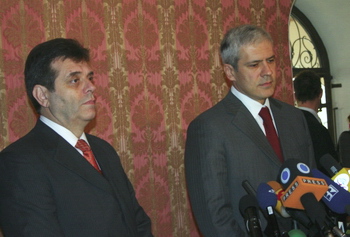
Vojislav Kostunica and Boris Tadic
Author:
Tanjug
Tadic said that for Serbia this does not mean a compromise is impossible to attain and stressed that in their closing arguments Serbian representatives clearly stated their intention to continue the dialogue and intensive work on finding a compromise solution to ensure development, peace and stability in the whole of Serbia and to all of its citizens – Serbs, Albanians and members of other ethnic communities.
According to Tadic, during the four months the Serbian delegation had an opportunity to present its full proposal on substantial autonomy for the province while the negotiating process led by the troika of envoys was much better conducted than the previous one, mediated by Martti Ahtisaari.
He recalled that the Serbian delegation presented its proposal on substantial autonomy, as well as gave certain examples in support of it, such as the models of Hong Kong, the Oland Islands and some other models which are effective today in the world and which show that a complex country, that is, a country in which one ethnic community has special demands, can function without having to disintegrate the country or question its sovereignty in any way.
Serbia will not accept independence for Kosovo-Metohija as it would destabilise Serbia and because it is also in contravention of international law and the essential principles the international community is founded on. Serbia will not accept such a solution because it is dysfunctional, introduces new instability, leads to a domino effect in the Balkans and beyond and destabilises Europe itself, warned Tadic.
He voiced hope that officials from international institutions bear in mind the proposals Serbia has made and reiterated that Serbia will reject any act of independence.
Our stance is that we do not accept the independence of Kosovo, as well as reject any act of unilateral declaration of independence. Serbia will always find an answer to such acts and that answer will always be in accordance with international law, international legal standards and European standards, said Tadic.
The Serbian President underlined that Serbia does not want violence and will not resort to it, but will use all legal and diplomatic means to respond to unilateral acts regarding Kosovo status and recalled that during the talks the Serbian state team pointed out that from one unilateralism another one will spring.
We do not want to use violence and we will not do that. We want to defend our legitimate national and state interest in a legal way, said the Serbian President.
Serbian Prime Minister Vojislav Kostunica said that Serbia has done everything to offer various solutions on substantial autonomy of Kosovo-Metohija and stressed that a proclamation of independence would be a violation of international law.
He emphasised that the “other side” did not want to take part in the talks and recalled that in the past two years the Serbian side has done its best to offer different variants – both abstract and concrete models of substantial autonomy – in order to reach a compromise solution which at the same time abides by international law.
Kostunica said that the other side did not really participate in the talks, that it was unprepared and encouraged in that, and added that the fact that representatives of Kosovo Albanians did not wish to talk must not be disregarded.
According to Kostunica, the Albanian side was also encouraged when it comes to its programme and insisted on one thing only – independence of Kosovo. Such an attitude has an immense and essential flaw. It implies the breach of the UN Charter and international law.
He said that the status talks were facilitated by the facts that there was a firm framework and borders the talks should cross, coordinates in which it should move.
The first coordinate is something fully defined and unquestionable and that is international law and the principle of territorial integrity and sovereignty in the UN Charter, Resolution 1244 and the Helsinki Final Act. This first coordinate is mentioned in Resolution 1244, said Kostunica adding that substantial autonomy is the second coordinate.
Thus it was said – a solution to the future status of Kosovo should be sought with the respect of international law, which means the principle of territorial integrity, and an appropriate form of substantial autonomy should be found on which the Serbian and Albanian sides would agree, recalled the Prime Minister.
He said that in the course of the talks there were digressions and attempts to raise issues other than the status ones, such as the so-called neutral status of relations between Serbia and Kosovo as independent states.
There was word of the German Agreement form 1972. There were many such ideas. Naturally, all were in contravention of the UN Charter and Resolution 1244. Besides, they were also flawed in that they were procedurally invalid. They were not proposed by the troika as a whole, because, naturally, a troika is composed of three members, not two. If all three members of the troika had come up with such a stance, which they did not, we would have discussed it, said Kostunica.
According to him, a question was raised at the end of the talks on what to do next if no agreement is reached.
The answer is simple. Let me go back to the beginning, the talks were led within Resolution 1244, which is fully valid. The entire process began at the Security Council and must conclude there, stressed the Prime Minister.
He reiterated that Serbia is an internationally recognised, sovereign and democratic country and will in no way consent to having its status brought into question through unilateral declaration of independence, which some countries might support, nor will it agree to be made an example to the general rule according to which all states are protected within their existing borders.
Any act or idea to make such an illegal and outlaw creation will be immediately declared legally void and inexistent by our institutions and all the necessary steps will be taken in case that transpires. But, once again, the road is still ahead of us, stressed Kostunica. He said that after December 10 and after the troika submits its report, a debate will be held at the Security Council and reiterated that the process must end where it began – in the Security Council.
Until a new resolution is passed, Resolution 1244 will remain effective, that is, the current state of affairs, concluded the Prime Minister.
According to Tadic, during the four months the Serbian delegation had an opportunity to present its full proposal on substantial autonomy for the province while the negotiating process led by the troika of envoys was much better conducted than the previous one, mediated by Martti Ahtisaari.
He recalled that the Serbian delegation presented its proposal on substantial autonomy, as well as gave certain examples in support of it, such as the models of Hong Kong, the Oland Islands and some other models which are effective today in the world and which show that a complex country, that is, a country in which one ethnic community has special demands, can function without having to disintegrate the country or question its sovereignty in any way.
Serbia will not accept independence for Kosovo-Metohija as it would destabilise Serbia and because it is also in contravention of international law and the essential principles the international community is founded on. Serbia will not accept such a solution because it is dysfunctional, introduces new instability, leads to a domino effect in the Balkans and beyond and destabilises Europe itself, warned Tadic.
He voiced hope that officials from international institutions bear in mind the proposals Serbia has made and reiterated that Serbia will reject any act of independence.
Our stance is that we do not accept the independence of Kosovo, as well as reject any act of unilateral declaration of independence. Serbia will always find an answer to such acts and that answer will always be in accordance with international law, international legal standards and European standards, said Tadic.
The Serbian President underlined that Serbia does not want violence and will not resort to it, but will use all legal and diplomatic means to respond to unilateral acts regarding Kosovo status and recalled that during the talks the Serbian state team pointed out that from one unilateralism another one will spring.
We do not want to use violence and we will not do that. We want to defend our legitimate national and state interest in a legal way, said the Serbian President.
Serbian Prime Minister Vojislav Kostunica said that Serbia has done everything to offer various solutions on substantial autonomy of Kosovo-Metohija and stressed that a proclamation of independence would be a violation of international law.
He emphasised that the “other side” did not want to take part in the talks and recalled that in the past two years the Serbian side has done its best to offer different variants – both abstract and concrete models of substantial autonomy – in order to reach a compromise solution which at the same time abides by international law.
Kostunica said that the other side did not really participate in the talks, that it was unprepared and encouraged in that, and added that the fact that representatives of Kosovo Albanians did not wish to talk must not be disregarded.
According to Kostunica, the Albanian side was also encouraged when it comes to its programme and insisted on one thing only – independence of Kosovo. Such an attitude has an immense and essential flaw. It implies the breach of the UN Charter and international law.
He said that the status talks were facilitated by the facts that there was a firm framework and borders the talks should cross, coordinates in which it should move.
The first coordinate is something fully defined and unquestionable and that is international law and the principle of territorial integrity and sovereignty in the UN Charter, Resolution 1244 and the Helsinki Final Act. This first coordinate is mentioned in Resolution 1244, said Kostunica adding that substantial autonomy is the second coordinate.
Thus it was said – a solution to the future status of Kosovo should be sought with the respect of international law, which means the principle of territorial integrity, and an appropriate form of substantial autonomy should be found on which the Serbian and Albanian sides would agree, recalled the Prime Minister.
He said that in the course of the talks there were digressions and attempts to raise issues other than the status ones, such as the so-called neutral status of relations between Serbia and Kosovo as independent states.
There was word of the German Agreement form 1972. There were many such ideas. Naturally, all were in contravention of the UN Charter and Resolution 1244. Besides, they were also flawed in that they were procedurally invalid. They were not proposed by the troika as a whole, because, naturally, a troika is composed of three members, not two. If all three members of the troika had come up with such a stance, which they did not, we would have discussed it, said Kostunica.
According to him, a question was raised at the end of the talks on what to do next if no agreement is reached.
The answer is simple. Let me go back to the beginning, the talks were led within Resolution 1244, which is fully valid. The entire process began at the Security Council and must conclude there, stressed the Prime Minister.
He reiterated that Serbia is an internationally recognised, sovereign and democratic country and will in no way consent to having its status brought into question through unilateral declaration of independence, which some countries might support, nor will it agree to be made an example to the general rule according to which all states are protected within their existing borders.
Any act or idea to make such an illegal and outlaw creation will be immediately declared legally void and inexistent by our institutions and all the necessary steps will be taken in case that transpires. But, once again, the road is still ahead of us, stressed Kostunica. He said that after December 10 and after the troika submits its report, a debate will be held at the Security Council and reiterated that the process must end where it began – in the Security Council.
Until a new resolution is passed, Resolution 1244 will remain effective, that is, the current state of affairs, concluded the Prime Minister.
-
 Belgrade, 28 August 2026
Church broken into, ransacked in Bušince village in Kosovska Kamenica
-
 Belgrade, 27 August 2026
Remembrance of suffering of Serb civilians in village of Klečka
-
 Belgrade, 30 July 2026
Continued illegal demolition of Serb-owned buildings near Lake Gazivode
-
 Belgrade, 29 July 2026
Works in Special Protective Zone of Visoki Dečani Monastery must be halted
-
 Belgrade, 23 July 2026
Priština continues with unilateral, illegal moves
-
 Belgrade/Zurich, 4 June 2026
Exhibition in Zurich on position of Serbs in Kosovo and Metohija
-
 Belgrade/Brussels, 12 May 2026
Belgrade seeking concrete steps towards establishment of Community of Serb Municipalities
-
 Belgrade/Brussels, 11 May 2026
Belgrade-Priština dialogue not dialogue on mutual recognition
-
 Belgrade, 10 April 2026
Serbian health centres closed in villages of Suvo Grlo, Banje