Q:
A:
Results of reconstruction after March pogrom in Kosovo-Metohija devastating
Belgrade,
3 May 2007
Coordinator of the state team for talks on Kosovo-Metohija’s future status Slobodan Samardzic stated today that results of the reconstruction works on Serbian Orthodox churches and monasteries, damaged and destroyed during the March 17 pogrom in 2004, are devastating.
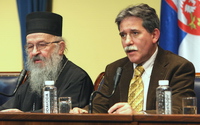
Bishop Artemije, left, and Slobodan Samardzic
Samardzic told a press conference that according to data on the extent of the inflicted damage, 35 Serbian culture monuments were destroyed in March 2004 alone.
He said that it was only after this took place that representatives of international authorities in the province began to be more engaged in organisation and preparations, as well as the actual reconstruction works on churches and monasteries.
Serbia monitored these activities and was dissatisfied with how the entire affair was organised since there was a tendency on behalf of the international community in the field these, as well as some international organisations, to exclude Serbia from this process and only include the Serbian Orthodox Church, said Samardzic.
A committee was formed to monitor the entire process but today we only have poor and discouraging results, he added and recalled that in the course of talks in Vienna last year, the issue of church and monastery reconstruction was discussed and one annex in UN Special Envoy Martti Ahtisaari’s proposal is devoted to it.
According to Samardzic, the state negotiating team submitted a number of amendments to this annex since they were displeased with how Ahtisaari saw the future of the Serbian Orthodox Church’s cultural and spiritual heritage in Kosovo-Metohija.
Bishop Artemije stressed that our negotiating team grasped the essence of the problem in Vienna and took the stance that the reconstruction of our sacred shrines on principles proposed by the international community is unsustainable.
“This does not mean that we are opposed to the reconstruction, but that there are two kinds of the reconstruction process – that which aims to restore the churches and monasteries to their original state, and that which has a political goal and that is to show that Kosovo-Metohija is ready for a democratic and independent society”, he said.
Between June 1999 and March 17, 2004 a total of 150 churches and other sacred shrines were destroyed in the province, whereas in the March pogrom 35 more churches and monasteries suffered heavy damages, said Bishop Artemije and pointed out that attacks on churches did not stop even after March 17, although they were not as strong.
What we want is to establish the reconstruction process on different, healthier grounds and have no one but the owner of these facilities, and that is the Serbian Orthodox church and the Serbian people who built them throughout history, make any decisions regarding them.
All others may assist in the reconstruction process and cooperate with us, but only in line with the principles set up by the Serbian negotiating team in cooperation with the Serbian Orthodox Church.
He said that it was only after this took place that representatives of international authorities in the province began to be more engaged in organisation and preparations, as well as the actual reconstruction works on churches and monasteries.
Serbia monitored these activities and was dissatisfied with how the entire affair was organised since there was a tendency on behalf of the international community in the field these, as well as some international organisations, to exclude Serbia from this process and only include the Serbian Orthodox Church, said Samardzic.
A committee was formed to monitor the entire process but today we only have poor and discouraging results, he added and recalled that in the course of talks in Vienna last year, the issue of church and monastery reconstruction was discussed and one annex in UN Special Envoy Martti Ahtisaari’s proposal is devoted to it.
According to Samardzic, the state negotiating team submitted a number of amendments to this annex since they were displeased with how Ahtisaari saw the future of the Serbian Orthodox Church’s cultural and spiritual heritage in Kosovo-Metohija.
Bishop Artemije stressed that our negotiating team grasped the essence of the problem in Vienna and took the stance that the reconstruction of our sacred shrines on principles proposed by the international community is unsustainable.
“This does not mean that we are opposed to the reconstruction, but that there are two kinds of the reconstruction process – that which aims to restore the churches and monasteries to their original state, and that which has a political goal and that is to show that Kosovo-Metohija is ready for a democratic and independent society”, he said.
Between June 1999 and March 17, 2004 a total of 150 churches and other sacred shrines were destroyed in the province, whereas in the March pogrom 35 more churches and monasteries suffered heavy damages, said Bishop Artemije and pointed out that attacks on churches did not stop even after March 17, although they were not as strong.
What we want is to establish the reconstruction process on different, healthier grounds and have no one but the owner of these facilities, and that is the Serbian Orthodox church and the Serbian people who built them throughout history, make any decisions regarding them.
All others may assist in the reconstruction process and cooperate with us, but only in line with the principles set up by the Serbian negotiating team in cooperation with the Serbian Orthodox Church.
-
 Belgrade, 28 August 2026
Church broken into, ransacked in Bušince village in Kosovska Kamenica
-
 Belgrade, 27 August 2026
Remembrance of suffering of Serb civilians in village of Klečka
-
 Belgrade, 30 July 2026
Continued illegal demolition of Serb-owned buildings near Lake Gazivode
-
 Belgrade, 29 July 2026
Works in Special Protective Zone of Visoki Dečani Monastery must be halted
-
 Belgrade, 23 July 2026
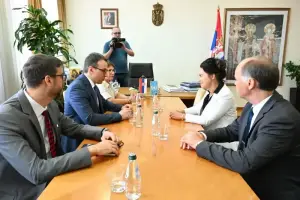
Priština continues with unilateral, illegal moves
-
 Belgrade/Zurich, 4 June 2026
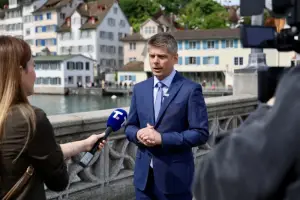
Exhibition in Zurich on position of Serbs in Kosovo and Metohija
-
 Belgrade/Brussels, 12 May 2026
Belgrade seeking concrete steps towards establishment of Community of Serb Municipalities
-
 Belgrade/Brussels, 11 May 2026
Belgrade-Priština dialogue not dialogue on mutual recognition
-
 Belgrade, 10 April 2026
Serbian health centres closed in villages of Suvo Grlo, Banje