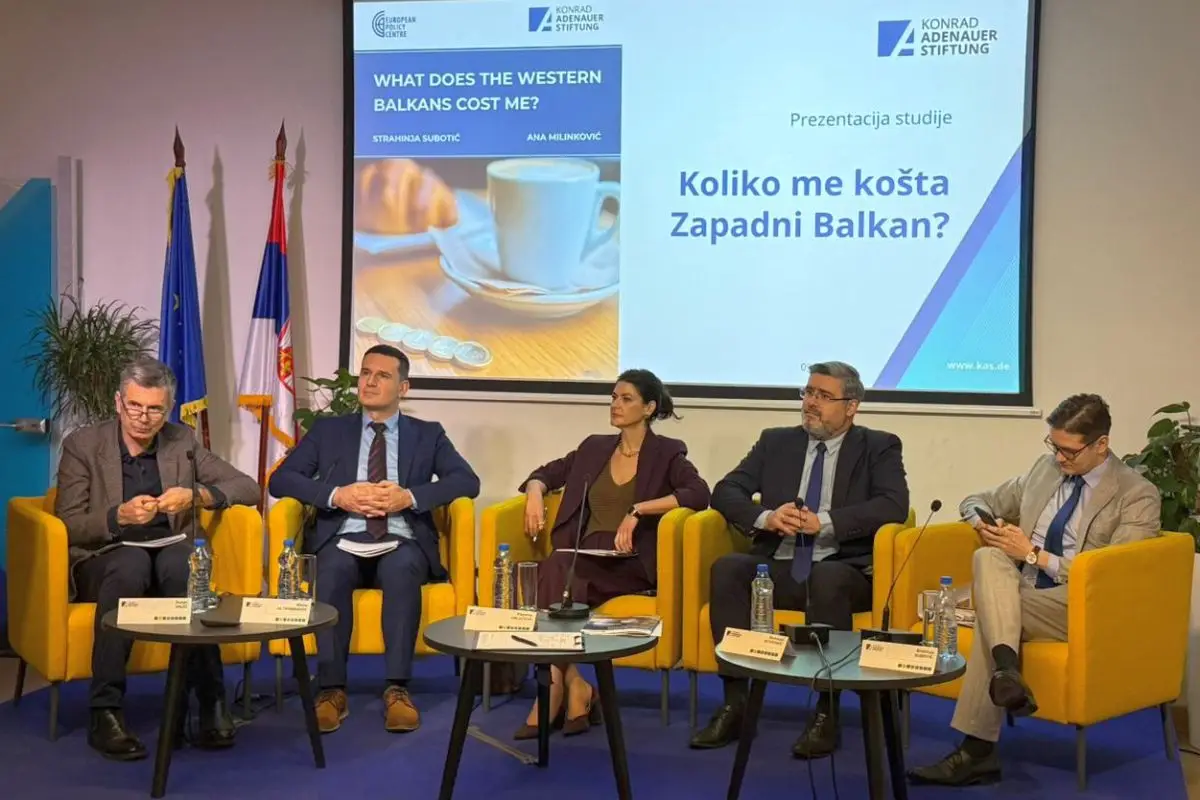
Minister of European Integration Nemanja Starović stressed today that analyses are important because they contribute to understanding the European Union enlargement process based on facts and concrete data and enable complex issues to be discussed in a reasoned and responsible manner, both in Serbia and in EU member states.

Q:
A:
EU enlargement to Western Balkans strategic investment in stability, development
Belgrade,
22 December 2025
At the conference “What does the Western Balkans cost me?”, organised at Europe House in Belgrade by the Konrad Adenauer Foundation Serbia and Montenegro, Starović assessed that analyses represent a very useful basis not only for informing the public, but also for making informed political decisions.
A study was presented at the conference that deals with the financial aspects of European Union enlargement to the Western Balkans, with the aim of basing the debate on facts.
The analysis shows that the cost of enlargement for the average EU citizen would be approximately €5.29 per year, which indicates that finances are not a fundamental obstacle to this process, but rather a matter of political decision-making.
A special part of the study refers to Serbia, as the largest country and economy in the region, which, in the event of membership, would also be the largest single beneficiary of European funds.
The calculations show that Serbia would have almost €21 billion available over the seven-year budget cycle, with an obligation to pay almost €750 million per year to the EU budget.
It also points to the importance of the state’s capacity to use these funds efficiently, bearing in mind that the future European funds increasingly depend on the development of democracy, the rule of law and institutional preparedness.
The study concludes that European Union enlargement represents a strategic investment in the stability, security and economic development not only of the Western Balkans, but also of the EU itself.
-
 Author: MEI
-
 Belgrade, 11 October 2026
Best wines, brandies at "Wine Vision by Open Balkan" announced
-
 Belgrade, 10 October 2026
“Wine Vision by Open Balkan” gathers producers from over 30 countries
-
 Belgrade, 9 October 2026
Further strengthening of traditionally good relations with Venezuela
-
 Belgrade/Moscow, 9 October 2026
Harnessing potential of AI for economic, social development
-
 Belgrade, 9 October 2026
Further strengthening Serbia-China partnership in agriculture
-
 Belgrade, 8 October 2026
Co-financing European Territorial Cooperation projects
-
 Belgrade, 8 October 2026
Strengthening alliances for political, economic empowerment of women
-
 Belgrade/Baku, 7 October 2026
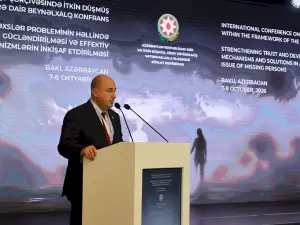
Serbia attaches great importance to resolving issue of missing persons
-
.webp) Belgrade, 7 October 2026
Belgrade, 7 October 2026Agricultural cooperation with Slovakia to be raised to higher level
-
 Belgrade, 6 October 2026
Regular political, economic dialogue solid foundation for strengthening cooperation with Switzerland