
Q:
A:
Adoption of spatial plan to introduce order into construction, urban planning
Belgrade,
4 June 2010
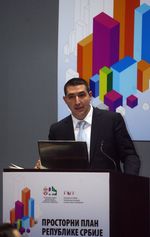
Minister of Environment and Spatial Planning Oliver Dulic said today that by the end of the year, 100% of Serbia’s territory will be covered by spatial plan documents that will enable quick issuance of building permits and clear information on what can be built at which location.
Author:
Tanjug
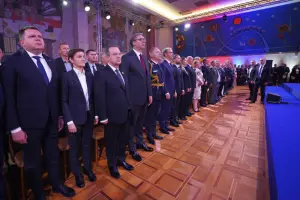
Presenting the draft spatial plan of Serbia at an event at the Sava Centre, attended by Serbian President Boris Tadic, Prime Minister Mirko Cvetkovic, ministers and representatives of the expert public, Dulic said that together with the Law on planning and construction, this document is the most important step in regulating the situation in the fields of construction and urban planning.
The adoption of strategic and spatial planning documents will enable sight of clear information on what can be built at which location, the Minister outlined and pointed out that Serbia has the necessary level of political stability and seriousness to be able to bring order to this field.
Serbian President Boris Tadic emphasised that Serbia’s spatial plan for the 2010-2021 period is a basis for all future development plans, without which no political or economic idea can be grounded in reality.
In the last 20 years, Serbia has been developing according to improvisation, and not in line with clear goals and having no strong connection between politics and the country’s reality.
The adoption of this document is a precondition for bringing politics down to reality, which is why this plan is a political document as well, Tadic confirmed.
An ageing population and depopulation are major problems for Serbia, the President warned and underlined that they can be addressed only with serious strategic plans.
Our reality is that people are moving from rural areas to cities, where the population is getting older. These are facts which have certain security and economic consequences, he stated.
Our response must be a new population policy and measures to encourage a revival of the population, stressed Tadic, adding that the state must make every effort to stop the trend of population reduction and aging, and to make this process go in the opposite direction.
Director of the Spatial Planning Agency Borislav Stojkov declared that the spatial plan establishes a long term of vision of Serbia’s development and the path to a spatially well regulated country has opened up.
The spatial plan has five main aims, he highlighted, explaining that these are balanced regional development, improved social cohesion, regional competition and accessibility, sustainable resources and a protected and improved environment.
Other goals include well regulated and sustainable utilization of the natural and cultural heritage and a spatially functional integration of neighbouring countries, concluded Stojkov.
The adoption of strategic and spatial planning documents will enable sight of clear information on what can be built at which location, the Minister outlined and pointed out that Serbia has the necessary level of political stability and seriousness to be able to bring order to this field.
Serbian President Boris Tadic emphasised that Serbia’s spatial plan for the 2010-2021 period is a basis for all future development plans, without which no political or economic idea can be grounded in reality.
In the last 20 years, Serbia has been developing according to improvisation, and not in line with clear goals and having no strong connection between politics and the country’s reality.
The adoption of this document is a precondition for bringing politics down to reality, which is why this plan is a political document as well, Tadic confirmed.
An ageing population and depopulation are major problems for Serbia, the President warned and underlined that they can be addressed only with serious strategic plans.
Our reality is that people are moving from rural areas to cities, where the population is getting older. These are facts which have certain security and economic consequences, he stated.
Our response must be a new population policy and measures to encourage a revival of the population, stressed Tadic, adding that the state must make every effort to stop the trend of population reduction and aging, and to make this process go in the opposite direction.
Director of the Spatial Planning Agency Borislav Stojkov declared that the spatial plan establishes a long term of vision of Serbia’s development and the path to a spatially well regulated country has opened up.
The spatial plan has five main aims, he highlighted, explaining that these are balanced regional development, improved social cohesion, regional competition and accessibility, sustainable resources and a protected and improved environment.
Other goals include well regulated and sustainable utilization of the natural and cultural heritage and a spatially functional integration of neighbouring countries, concluded Stojkov.
-
 Belgrade/Saint Petersburg, 4 June 2026
Readiness to improve cooperation with Russia in areas of mutual interest
-
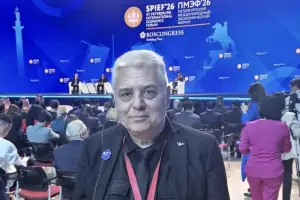 Belgrade/Saint Petersburg, 4 June 2026
Strengthening Serbia’s position in contemporary digital environment
-
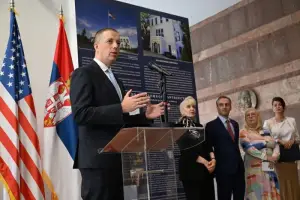 Belgrade, 4 June 2026
Serbia, US building partnership aimed at future, shared prosperity
-
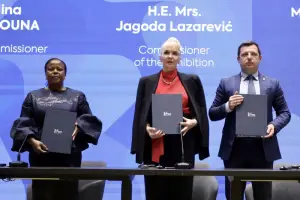 Belgrade, 3 June 2026
Contract on Gabon’s participation in Expo 2027 signed
-
 Belgrade/Helsinki, 3 June 2026
Serbia stands for peace, cooperation, respect for international law
-
 Belgrade/Helsinki, 2 June 2026
Great potential for strengthening economic ties with Finland
-
 Belgrade/Helsinki, 2 June 2026
Finland confirms strong support for Serbia’s European future
-
 Belgrade, 1 June 2026
Coordination of services to reduce risks from extreme weather events
-
 Belgrade, 31 May 2026
Ceremonial academy held to mark Ministry of the Interior Day, Police Day
-
 Belgrade/Bratislava, 30 May 2026
High level of partnership, trust between Serbia, Slovakia