Q:
A:
Serbia will continue to cooperate with international organisations that act in line with Security Council decisions
Belgrade,
28 January 2010
Minister of the Republic of Serbia Vuk Jeremic said in an interview with today's edition of the daily Politika that Serbia will continue close cooperation with international organisations operating in Kosovo-Metohija in accordance with the decisions of the Security Council, but noted that the International Civilian Office is not one of them.
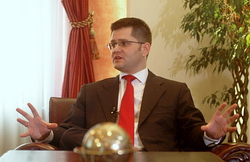
File photo of Vuk Jeremic
Author:
Tanjug
The official website of the Serbian government brings excerpts from the interview.
On the maltreatment to which Serbs and some senior state officials of Serbia were exposed in Kosovo-Metohija:
“It is more than obvious that there is a growing anxiety in Pristina as regards to the outcome of the process before the International Court of Justice. At this moment the most important thing is to remain composed and not respond to attempts abruptly to provocations no matter how painful for us they are.
Unfortunately, I expect that this will be happening in the future as well. What we can do is protest harshly in relevant international forums every time Resolution 1244 is violated, which also brings into question basic values of civilisation, such as the right to freedom of movement. What followed after Serbia intervened in the Security Council on Friday on the occasion of announcement of the Chief of the International Civilian Office Pieter Feith about plans to integrate the north of Kosovo-Metohija was EU’s formal announcement that it does not stand behind these plans. We were witnesses to a de facto withdrawal of key stakeholders in this regard.
Serbia will continue close cooperation with international organisations operating in Kosovo-Metohija in accordance with the decisions of the Security Council, but the International Civilian Office is not one of them.“
If the EU is not behind Feith, who is?
“The problem started with the appointment of Pieter Feith, because he was simultaneously given two different functions. One is special envoy of the EU, and the other is director of the International Civilian Office. One is legal, the other is not. He gave that statement acting as director of the International Civilian Office. We have pointed out from the beginning that him holding two positions can lead to complications, and this is exactly what happened.”
Will 2010 be the year of opportunities for finding a political solution for Kosovo-Metohija?
“By all means, there are only a few months until the International Court of Justice will state its position whether the unilateral declaration of independence was in accordance with international law.
We have reasons to be optimistic, and when the court’s attitude is said, I think that will create a new quality, a new reality, in political sense. I believe that after that there will no increase in the number of countries recognising Kosovo-Metohija, that is, it would not be possible to exert pressure on countries that have hitherto resisted, and that support Pristina. Likewise, it will be relatively easy to stop any possible application of Kosovo-Metohija for membership in international organisations. It will become obvious that it is necessary to find a solution acceptable to all parties.
We expect that the opinion of the court to create a blockade on the road, which temporary institutions in Kosovo-Metohija pursued so far, the so-called new reality proclaimed on February 17, 2008.
In any case, I expect that conditions will be created to show that there is no alternative to continuation of a dialogue.”
On the report by UN Secretary General calling on Belgrade and Pristina to put aside the debate on the status for the sake of improving regional cooperation:
“What the Secretary General said was that we should search for flexible solutions that would not stop regional cooperation. Serbia has so far been very constructive in this regard, and we will continue to behave like that. We do not want to prevent the participation of the provisional institutions in regional meetings, but we only accept the format established in 1999 when the resolution of the Security Council was adopted, which states that the delegation from Pristina can sit behind the label ‘UNMIK – Kosovo’ in the presence of representatives of the UN. So far we have insisted on that, and we will continue likewise in the future. Pristina’s policy to refuse to participate under such circumstances unfortunately only leads to self-isolation.”
On the maltreatment to which Serbs and some senior state officials of Serbia were exposed in Kosovo-Metohija:
“It is more than obvious that there is a growing anxiety in Pristina as regards to the outcome of the process before the International Court of Justice. At this moment the most important thing is to remain composed and not respond to attempts abruptly to provocations no matter how painful for us they are.
Unfortunately, I expect that this will be happening in the future as well. What we can do is protest harshly in relevant international forums every time Resolution 1244 is violated, which also brings into question basic values of civilisation, such as the right to freedom of movement. What followed after Serbia intervened in the Security Council on Friday on the occasion of announcement of the Chief of the International Civilian Office Pieter Feith about plans to integrate the north of Kosovo-Metohija was EU’s formal announcement that it does not stand behind these plans. We were witnesses to a de facto withdrawal of key stakeholders in this regard.
Serbia will continue close cooperation with international organisations operating in Kosovo-Metohija in accordance with the decisions of the Security Council, but the International Civilian Office is not one of them.“
If the EU is not behind Feith, who is?
“The problem started with the appointment of Pieter Feith, because he was simultaneously given two different functions. One is special envoy of the EU, and the other is director of the International Civilian Office. One is legal, the other is not. He gave that statement acting as director of the International Civilian Office. We have pointed out from the beginning that him holding two positions can lead to complications, and this is exactly what happened.”
Will 2010 be the year of opportunities for finding a political solution for Kosovo-Metohija?
“By all means, there are only a few months until the International Court of Justice will state its position whether the unilateral declaration of independence was in accordance with international law.
We have reasons to be optimistic, and when the court’s attitude is said, I think that will create a new quality, a new reality, in political sense. I believe that after that there will no increase in the number of countries recognising Kosovo-Metohija, that is, it would not be possible to exert pressure on countries that have hitherto resisted, and that support Pristina. Likewise, it will be relatively easy to stop any possible application of Kosovo-Metohija for membership in international organisations. It will become obvious that it is necessary to find a solution acceptable to all parties.
We expect that the opinion of the court to create a blockade on the road, which temporary institutions in Kosovo-Metohija pursued so far, the so-called new reality proclaimed on February 17, 2008.
In any case, I expect that conditions will be created to show that there is no alternative to continuation of a dialogue.”
On the report by UN Secretary General calling on Belgrade and Pristina to put aside the debate on the status for the sake of improving regional cooperation:
“What the Secretary General said was that we should search for flexible solutions that would not stop regional cooperation. Serbia has so far been very constructive in this regard, and we will continue to behave like that. We do not want to prevent the participation of the provisional institutions in regional meetings, but we only accept the format established in 1999 when the resolution of the Security Council was adopted, which states that the delegation from Pristina can sit behind the label ‘UNMIK – Kosovo’ in the presence of representatives of the UN. So far we have insisted on that, and we will continue likewise in the future. Pristina’s policy to refuse to participate under such circumstances unfortunately only leads to self-isolation.”
-
 Belgrade, 28 August 2026
Church broken into, ransacked in Bušince village in Kosovska Kamenica
-
 Belgrade, 27 August 2026
Remembrance of suffering of Serb civilians in village of Klečka
-
 Belgrade, 30 July 2026
Continued illegal demolition of Serb-owned buildings near Lake Gazivode
-
 Belgrade, 29 July 2026
Works in Special Protective Zone of Visoki Dečani Monastery must be halted
-
 Belgrade, 23 July 2026
Priština continues with unilateral, illegal moves
-
 Belgrade/Zurich, 4 June 2026
Exhibition in Zurich on position of Serbs in Kosovo and Metohija
-
 Belgrade/Brussels, 12 May 2026
Belgrade seeking concrete steps towards establishment of Community of Serb Municipalities
-
 Belgrade/Brussels, 11 May 2026
Belgrade-Priština dialogue not dialogue on mutual recognition
-
 Belgrade, 10 April 2026
Serbian health centres closed in villages of Suvo Grlo, Banje