Q:
A:
Tadic urges UN members not to recognise unilaterally declared Kosovo
Belgrade/New York,
25 September 2009
Serbian President Boris Tadic called on UN member states that have not recognised the unilaterally declared state of Kosovo not to do so, by which they will oppose one of the biggest threats to the system which was established by the founding of the UN.
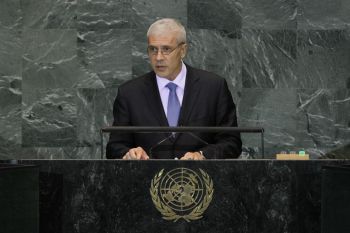
Boris Tadic addresses the 64th United Nations General Assembly
Author:
Fonet
Addressing the 64th session of the UN General Assembly in New York today, Tadic stressed that those states who continue to support Serbia’s territorial integrity will give their contribution to the International Court of Justice (ICJ) making a decision on the legality of the independence, thus creating an atmosphere that is deprived of political pressures.
No doubt, the opinion of this court will be a strong legal precedent that will have effect on the whole system of the UN, and the outcome will either avert other separatist movements from attempts to carry out their intentions or will encourage them to take a similar road. Simply put, if this unilateral declaration of independence is disputed, it will open the doors for disputing territorial integrity of any UN member state, the Serbian President warned.
He called on all UN member states to respect the fact that the ICJ is dealing with this issue and that the court’s decisions must not be prejudiced and its work must not be disrupted.
The process of making the advisory opinion must go according to a regular procedure, with no political pressures on the side, such as new recognitions of the province’s independence. Tadic stated that even though there are attempts to present Kosovo as a unique case, it is an undisputed fact that this is a common attempt of a violent breaking of an UN member against its own will and despite the opposition by the UN Security Council.
The Serbian President said that Serbia is resolute to solve the Kosovo issue in a peaceful way by insisting on international law, but at the same time wanting to take an active role in solving concrete, everyday problems of the province’s citizens.
I am calling on all responsible stakeholders in the process of creating the future of Kosovo to cooperate closely with the Serbian government in implementing the six-item plan by the UN Secretary General, which was also supported by the Security Council, Tadic said.
He stressed that Serbia is the pillar of stability in the Western Balkans and offering a key contribution to a democratic transformation of the region, insisting on the strengthening of the regional cooperation and guaranteeing territorial integrity of its neighbours. Tadic stressed that Serbia's main strategic goal is EU membership, adding that the EU enlargement process must not be blocked before Western Balkan countries join the EU.
On the eve of the 20th anniversary of the fall of the Berlin Wall, we must not forget that the process of gathering together all European nations has not finished yet. There is still a lot of work to do and we must not allow a new European reality hamper the EU enlargement process.
As for Serbia's foreign policy, the President said that apart from Serbia's four foreign policy pillars, Brussels, Moscow, Washington and Beijing, officials in Belgrade are trying to improve relations with the Non-Aligned Movement.
Serbia's efforts to develop relations with non-aligned countries is not only based on its necessity to respect tradition and strengthen old friendships, but also on its belief that stability and prosperity cannot be achieved without taking into consideration a majority opinion of the world family of nations, explained Tadic.
Talking about the current political and economic situation in the world, President Tadic pointed out that the old order based on the political and economic domination of some countries must be replaced with a new one based on equality.
The Serbian President said that this is the only way to improve dialogue between different civilisations, make multilateralism more efficient, secure development and root out poverty.
He stressed that this is also the only way to efficiently tackle terrorism and cross border organised crime and make progress in the process of nuclear disarmament.
He pointed to the importance of the fight against climate changes, noting that during its two-year presidency over the UN Environment Programme (UNEP), Serbia will make efforts to maintain greener economic policy.
President Tadic suggested that a regional centre for monitoring climate changes be set up in Belgrade, adding that the implementation of the UN Charter, the respect for international and human rights, even economic development and sustainable environmental protection are the main preconditions for the development of international relations.
No doubt, the opinion of this court will be a strong legal precedent that will have effect on the whole system of the UN, and the outcome will either avert other separatist movements from attempts to carry out their intentions or will encourage them to take a similar road. Simply put, if this unilateral declaration of independence is disputed, it will open the doors for disputing territorial integrity of any UN member state, the Serbian President warned.
He called on all UN member states to respect the fact that the ICJ is dealing with this issue and that the court’s decisions must not be prejudiced and its work must not be disrupted.
The process of making the advisory opinion must go according to a regular procedure, with no political pressures on the side, such as new recognitions of the province’s independence. Tadic stated that even though there are attempts to present Kosovo as a unique case, it is an undisputed fact that this is a common attempt of a violent breaking of an UN member against its own will and despite the opposition by the UN Security Council.
The Serbian President said that Serbia is resolute to solve the Kosovo issue in a peaceful way by insisting on international law, but at the same time wanting to take an active role in solving concrete, everyday problems of the province’s citizens.
I am calling on all responsible stakeholders in the process of creating the future of Kosovo to cooperate closely with the Serbian government in implementing the six-item plan by the UN Secretary General, which was also supported by the Security Council, Tadic said.
He stressed that Serbia is the pillar of stability in the Western Balkans and offering a key contribution to a democratic transformation of the region, insisting on the strengthening of the regional cooperation and guaranteeing territorial integrity of its neighbours. Tadic stressed that Serbia's main strategic goal is EU membership, adding that the EU enlargement process must not be blocked before Western Balkan countries join the EU.
On the eve of the 20th anniversary of the fall of the Berlin Wall, we must not forget that the process of gathering together all European nations has not finished yet. There is still a lot of work to do and we must not allow a new European reality hamper the EU enlargement process.
As for Serbia's foreign policy, the President said that apart from Serbia's four foreign policy pillars, Brussels, Moscow, Washington and Beijing, officials in Belgrade are trying to improve relations with the Non-Aligned Movement.
Serbia's efforts to develop relations with non-aligned countries is not only based on its necessity to respect tradition and strengthen old friendships, but also on its belief that stability and prosperity cannot be achieved without taking into consideration a majority opinion of the world family of nations, explained Tadic.
Talking about the current political and economic situation in the world, President Tadic pointed out that the old order based on the political and economic domination of some countries must be replaced with a new one based on equality.
The Serbian President said that this is the only way to improve dialogue between different civilisations, make multilateralism more efficient, secure development and root out poverty.
He stressed that this is also the only way to efficiently tackle terrorism and cross border organised crime and make progress in the process of nuclear disarmament.
He pointed to the importance of the fight against climate changes, noting that during its two-year presidency over the UN Environment Programme (UNEP), Serbia will make efforts to maintain greener economic policy.
President Tadic suggested that a regional centre for monitoring climate changes be set up in Belgrade, adding that the implementation of the UN Charter, the respect for international and human rights, even economic development and sustainable environmental protection are the main preconditions for the development of international relations.
-
 Belgrade, 28 August 2026
Church broken into, ransacked in Bušince village in Kosovska Kamenica
-
 Belgrade, 27 August 2026
Remembrance of suffering of Serb civilians in village of Klečka
-
 Belgrade, 30 July 2026
Continued illegal demolition of Serb-owned buildings near Lake Gazivode
-
 Belgrade, 29 July 2026
Works in Special Protective Zone of Visoki Dečani Monastery must be halted
-
 Belgrade, 23 July 2026
Priština continues with unilateral, illegal moves
-
 Belgrade/Zurich, 4 June 2026
Exhibition in Zurich on position of Serbs in Kosovo and Metohija
-
 Belgrade/Brussels, 12 May 2026
Belgrade seeking concrete steps towards establishment of Community of Serb Municipalities
-
 Belgrade/Brussels, 11 May 2026
Belgrade-Priština dialogue not dialogue on mutual recognition
-
 Belgrade, 10 April 2026
Serbian health centres closed in villages of Suvo Grlo, Banje