Q:
A:
Protection of endangered cultural sites one of Serbia’s priorities
Paris/Belgrade,
21 April 2009
Serbian Minister of Foreign Affairs Vuk Jeremic today stated that one of Serbia’s priorities is the protection of endangered cultural sites, particularly in Kosovo-Metohija.
Author:
Fonet
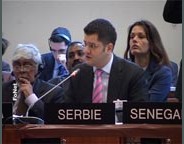
Addressing the participants of the 181st plenary session of the UNESCO Executive Board, taking place in Paris, Jeremic said that Serbian citizens want to resolve all disputes and live in peace with their neighbours, adding that any attempt to use culture as a weapon would bring no good.
The Minister pointed to Belgrade’s leading role when it comes to the development of regional cooperation and voiced his appreciation to UNESCO and all other donators who have agreed to help reconstruct cultural and religious heritage in Kosovo-Metohija.
Jeremic noted that UNESCO has recently agreed to provide $5.5 million in order to help repair Serbian Orthodox churches and monasteries demolished on March 17, 2004.
Minister Jeremic recalled that during the past 10 years Albanian terrorists have destroyed more than 150 churches and monasteries, 35 of which were demolished during the March pogrom.
Jeremic pointed out that the reconstruction of Serbian churches and monasteries would encourage Serbs to return to Kosovo-Metohija, adding that UNMIK and EULEX must provide security in that part of Serbian territory, otherwise Serbian Orthodox churches and monasteries will gradually become museums.
He said the need to preserve the Serbian heritage of Kosovo-Metohija, which is of universal character and importance, has increased after the decision by Pristina’s secessionist authorities to unilaterally declare independence on March 17 of last year.
The Minister said that the World Heritage Committee put off making a decision on medieval monuments in Kosovo-Metohija because of pressure to artificially separate this founding part of the Serbian heritage from other parts of Serbia.
Jeremic thanked UNESCO for helping to prevent the issue of cultural heritage from becoming a political one, stressing that thanks to international law and the practices of this organisation it is clear that such breaches of the rules can only lead to useless divisions.
He stressed that Pristina’s claims that the Serbian medieval heritage in fact belongs to Kosovo Albanians are an attempt to change history and must be condemned in the most determined way, emphasising that the international community and UNESCO must not remain passive.
In that context the Minister invited the international community to oppose this cultural ethnic cleansing of the province, as well as elsewhere in the world.
The protection of mankind’s cultural heritage is a huge challenge, which lies before all of us, stressed Jeremic, concluding that it is high time we turned our attention to this lofty goal once more.
The Minister pointed to Belgrade’s leading role when it comes to the development of regional cooperation and voiced his appreciation to UNESCO and all other donators who have agreed to help reconstruct cultural and religious heritage in Kosovo-Metohija.
Jeremic noted that UNESCO has recently agreed to provide $5.5 million in order to help repair Serbian Orthodox churches and monasteries demolished on March 17, 2004.
Minister Jeremic recalled that during the past 10 years Albanian terrorists have destroyed more than 150 churches and monasteries, 35 of which were demolished during the March pogrom.
Jeremic pointed out that the reconstruction of Serbian churches and monasteries would encourage Serbs to return to Kosovo-Metohija, adding that UNMIK and EULEX must provide security in that part of Serbian territory, otherwise Serbian Orthodox churches and monasteries will gradually become museums.
He said the need to preserve the Serbian heritage of Kosovo-Metohija, which is of universal character and importance, has increased after the decision by Pristina’s secessionist authorities to unilaterally declare independence on March 17 of last year.
The Minister said that the World Heritage Committee put off making a decision on medieval monuments in Kosovo-Metohija because of pressure to artificially separate this founding part of the Serbian heritage from other parts of Serbia.
Jeremic thanked UNESCO for helping to prevent the issue of cultural heritage from becoming a political one, stressing that thanks to international law and the practices of this organisation it is clear that such breaches of the rules can only lead to useless divisions.
He stressed that Pristina’s claims that the Serbian medieval heritage in fact belongs to Kosovo Albanians are an attempt to change history and must be condemned in the most determined way, emphasising that the international community and UNESCO must not remain passive.
In that context the Minister invited the international community to oppose this cultural ethnic cleansing of the province, as well as elsewhere in the world.
The protection of mankind’s cultural heritage is a huge challenge, which lies before all of us, stressed Jeremic, concluding that it is high time we turned our attention to this lofty goal once more.
-
 Belgrade, 28 August 2026
Church broken into, ransacked in Bušince village in Kosovska Kamenica
-
 Belgrade, 27 August 2026
Remembrance of suffering of Serb civilians in village of Klečka
-
 Belgrade, 30 July 2026
Continued illegal demolition of Serb-owned buildings near Lake Gazivode
-
 Belgrade, 29 July 2026
Works in Special Protective Zone of Visoki Dečani Monastery must be halted
-
 Belgrade, 23 July 2026
Priština continues with unilateral, illegal moves
-
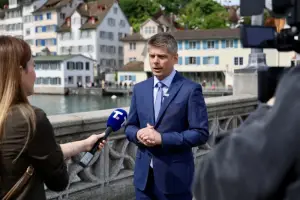 Belgrade/Zurich, 4 June 2026
Exhibition in Zurich on position of Serbs in Kosovo and Metohija
-
 Belgrade/Brussels, 12 May 2026
Belgrade seeking concrete steps towards establishment of Community of Serb Municipalities
-
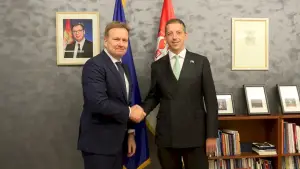 Belgrade/Brussels, 11 May 2026
Belgrade-Priština dialogue not dialogue on mutual recognition
-
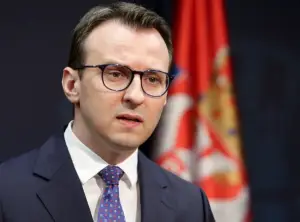 Belgrade, 10 April 2026
Serbian health centres closed in villages of Suvo Grlo, Banje