Q:
A:
Serbia’s European orientation good basis for improving Roma position
Belgrade,
4 September 2008
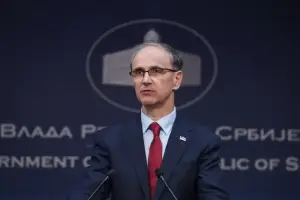
Serbian Prime Minister Mirko Cvetkovic stated that Serbia’s European orientation and the steps towards EU entry it has taken so far are a good basis for increasing its involvement in the resolution of the problems of Roma integration in the country and region.
Author:
Fonet
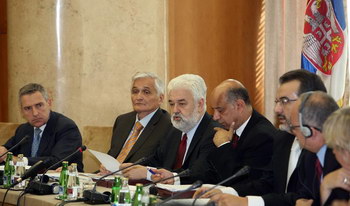
At the opening of the 14th meeting of the International Executive Board, taking part within the "Decade of Roma Inclusion 2005–2015", Cvetkovic said that the Law on the rights and freedoms of national minorities acknowledged the national minority status to the Roma in 2002.
Thus a basis was created for their access to rights which other minorities have, said the Prime Minister and added that in accordance with the European Charter on Regional and Minority Languages Serbia acknowledged the Roma language.
Cvetkovic said that while solving their problems, the state treat the Roma as a marginalised group, but as a national minority.
Chairman of the meeting is head of the Secretariat for the Roma National Strategy at the Ministry for Human and Minority Rights Ljuan Koka and the rapporteur is representative from the Budapest Institute for Open Society Gabor Daroci.
The meeting will concern priorities during Serbia’s presidency over the Roma Decade, such as legalisation of Roma residential areas, suppression of discrimination in education, European policy on the Roma and access to European funds, possible ways of monitoring and evaluating activities at the regional and national levels.
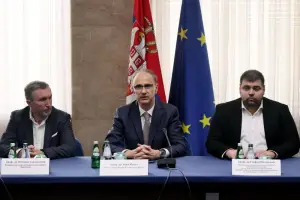
Following the meeting, Serbian Minister for Human and Minority Rights Svetozar Ciplic and Chairman of the Council of Ministers of Bosnia-Herzegovina Nikola Spiric signed the Declaration on the accession of Bosnia-Herzegovina to the Decade of Roma Inclusion.
Ciplic said that thus the family of states that wish to improve the position of their Roma nationals has been expanded.
According to him, Serbia is honoured to get another state member and partner during this year’s presidency of the Roma Decade. Spiric stressed that Bosnia-Herzegovina is dedicated to providing highest standards to national minorities like the ones in democratically developed and European states.
He added that Bosnia-Herzegovina will do everything to implement its own action plan to solve the problem of the Roma population.
Thus a basis was created for their access to rights which other minorities have, said the Prime Minister and added that in accordance with the European Charter on Regional and Minority Languages Serbia acknowledged the Roma language.
Cvetkovic said that while solving their problems, the state treat the Roma as a marginalised group, but as a national minority.
Chairman of the meeting is head of the Secretariat for the Roma National Strategy at the Ministry for Human and Minority Rights Ljuan Koka and the rapporteur is representative from the Budapest Institute for Open Society Gabor Daroci.
The meeting will concern priorities during Serbia’s presidency over the Roma Decade, such as legalisation of Roma residential areas, suppression of discrimination in education, European policy on the Roma and access to European funds, possible ways of monitoring and evaluating activities at the regional and national levels.
Following the meeting, Serbian Minister for Human and Minority Rights Svetozar Ciplic and Chairman of the Council of Ministers of Bosnia-Herzegovina Nikola Spiric signed the Declaration on the accession of Bosnia-Herzegovina to the Decade of Roma Inclusion.
Ciplic said that thus the family of states that wish to improve the position of their Roma nationals has been expanded.
According to him, Serbia is honoured to get another state member and partner during this year’s presidency of the Roma Decade. Spiric stressed that Bosnia-Herzegovina is dedicated to providing highest standards to national minorities like the ones in democratically developed and European states.
He added that Bosnia-Herzegovina will do everything to implement its own action plan to solve the problem of the Roma population.
-
 Belgrade, 5 June 2026
Government dedicated to further improving higher education system
-
 Belgrade, 5 June 2026
Deepening economic partnership between Serbia, Republic of Korea
-
 Belgrade, 5 June 2026
Additional strengthening of bilateral relations between Serbia, Switzerland
-
 Belgrade, 4 June 2026
Support for regular, stable water supply in underdeveloped municipalities
-
 Belgrade, 4 June 2026
Successfully implemented projects with UAE confirm good bilateral relations
-
 Belgrade, 2 June 2026
Serbia committed to political empowerment of women
-
 Belgrade, 2 June 2026
Intensifying activities to meet obligations from Reform Agenda
-
 Belgrade, 2 June 2026
Macut hands resolutions to support development of traditional, artistic crafts
-
 Niš, 1 June 2026
State a partner that listens to citizens, solves their problems