
Q:
A:
€170m agreement on EU’s financial assistance signed
Belgrade,
4 April 2008
Serbian Deputy Prime Minister Bozidar Djelic and Head of the European Commission Delegation to Serbia Josep Lloveras signed an agreement on EU’s financial assistance to Serbia within the framework of IPA funds worth nearly €170 million.
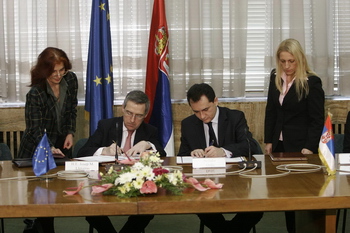
Josep Lloveras, left, and Bozidar Djelic
Author:
Fonet
Djelic said after the signing, which was also attended by Director for Western Balkans in the European Commission’s Directorate General Pierre Mirel, that this is Serbia’s first drawdown from the IPA which amounts in total to €1 billion from 2007 to 2011.
The assistance of €170 million will be distributed for use in 36 projects that will directly assist in making a better life for Serbian citizens, said Djelic.
According to him, around €40 million will be used for sustainable local and regional economic development, especially in underdeveloped areas, whereas €10 million will be used to support refugees and IDPs.
Reform of the ambulance service will receive €10 million, information systems on the Danube €11 million, whereas €12 million will go towards reducing gas emissions from the thermo-electric power plant Nikola Tesla, he said.
He said that certain funds will also be used for strengthening public administration capacities, improving conditions in prisons, reforms of secondary vocational education, improving border control standards and many other projects.
Djelic stated that the first portion of funds is expected to arrive during the summer and in September, and that work is already underway on the preparation of the 2008 IPA agreement, which will be signed in the upcoming months, whereas by the end of the year preparations for the 2009 IPA agreement should be completed.
He also noted that in its report the European Commission gave encouraging assessments regarding the fight against organised crime and corruption in Serbia, which will have huge importance in the process of abolishing visas for Serbian citizens. The first step in that direction should be to make visas for EU countries free-of-charge, he added.
Mirel explained that this is not a loan, but non-repayable assistance which is to help prospective EU candidates to implement reforms, to transform themselves and prepare for membership.
Lloveras recalled that since 2000, the EU has provided Serbia with over €2 billion, excluding bilateral assistance from member countries, assistance to Kosovo to the amount of €1.4 billion, loans from the European Investment Bank of €1.3 billion and assistance from the European Bank for Reconstruction and Development.
He added that based on the amount of the EU’s assistance per capita, Serbia is among the top ranked countries, which confirms that the EU’s commitment to Serbia is long-term and stable.
The assistance of €170 million will be distributed for use in 36 projects that will directly assist in making a better life for Serbian citizens, said Djelic.
According to him, around €40 million will be used for sustainable local and regional economic development, especially in underdeveloped areas, whereas €10 million will be used to support refugees and IDPs.
Reform of the ambulance service will receive €10 million, information systems on the Danube €11 million, whereas €12 million will go towards reducing gas emissions from the thermo-electric power plant Nikola Tesla, he said.
He said that certain funds will also be used for strengthening public administration capacities, improving conditions in prisons, reforms of secondary vocational education, improving border control standards and many other projects.
Djelic stated that the first portion of funds is expected to arrive during the summer and in September, and that work is already underway on the preparation of the 2008 IPA agreement, which will be signed in the upcoming months, whereas by the end of the year preparations for the 2009 IPA agreement should be completed.
He also noted that in its report the European Commission gave encouraging assessments regarding the fight against organised crime and corruption in Serbia, which will have huge importance in the process of abolishing visas for Serbian citizens. The first step in that direction should be to make visas for EU countries free-of-charge, he added.
Mirel explained that this is not a loan, but non-repayable assistance which is to help prospective EU candidates to implement reforms, to transform themselves and prepare for membership.
Lloveras recalled that since 2000, the EU has provided Serbia with over €2 billion, excluding bilateral assistance from member countries, assistance to Kosovo to the amount of €1.4 billion, loans from the European Investment Bank of €1.3 billion and assistance from the European Bank for Reconstruction and Development.
He added that based on the amount of the EU’s assistance per capita, Serbia is among the top ranked countries, which confirms that the EU’s commitment to Serbia is long-term and stable.
-
 Belgrade, 22 July 2026
New opportunities for expanding economic cooperation between Serbia, China
-
 Belgrade, 20 July 2026
Cooperation in field of interior affairs important segment of relations with Germany
-
 Belgrade, 16 July 2026
Expo 2027 opportunity to further strengthen international partnerships
-
 Belgrade/Bratislava, 16 July 2026
Serbia, Slovakia continue to strengthen political, economic cooperation
-
 Belgrade, 14 July 2026
Serbia bilaterally resolves problems arising from EES implementation
-
 Gradina/Kalotina, 9 July 2026
Improving border cooperation between Serbia, Bulgaria
-
 Belgrade, 7 July 2026
Further strengthening economic cooperation between Serbia, Italy
-
 Belgrade, 6 July 2026
Serbia serious, responsible partner in fight against crime
-
 Kać, 3 July 2026
Additional foreign investment confirms confidence in Serbia
-
 Belgrade, 3 July 2026
Serbia, Hungary reliable partners in maintaining security