
Q:
A:
New regulations to provide stability of local self-government units
Belgrade,
25 March 2008
Serbian Minister of Public Administration and Local Self-Government Milan Markovic stated today that new regulations will provide stability and efficiency for local self-government.
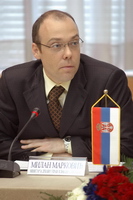
Milan Markovic
Author:
Fonet
Markovic recalled that local self-government units had problems functioning, thus bringing into question the purpose of their existence.
Unlike cities, whose functioning was described as good in the previous period, one-third of municipalities were more or less blocked, i.e., over 50 local self-government units recorded irregularities, which resulted in 12 municipal assemblies being dissolved, the Minister said.
He explained that the changes are required not only by the new Constitution, but by life itself as none of the problems would have occurred had this set of laws been in force.
According to him, the new solutions should bring stability over the next eight years, which is the equivalent of two electoral cycles.
Markovic also noted that it is very important that 19 municipalities will become cities, setting a good framework for continuing decentralisation and transferring jurisdictions from a central to a local level of authority.
Head of the OSCE to Serbia Hans Ola Urstad said that the OSCE Mission hails all efforts of the Ministry of Public Administration and Local Self-Government to strengthen the democratic processes at the level of local administration, which was done in the previous six years through the adoption of a new legal framework.
Urstad also added that local authorities are among the main pillars of every democratic state.
Deputy of the special representative of the Secretary-General of the Council of Europe in Serbia Nadia Cuk said that decentralisation is a condition for the democratisation of society and democratic integration of the country.
The round table “Rights and Obligations of Cities” was organised by the Ministry of Public Administration and Local Self-Government in cooperation with the CoE. The event was attended by mayors, representatives of city municipalities and other officials from Serbian cities.
Unlike cities, whose functioning was described as good in the previous period, one-third of municipalities were more or less blocked, i.e., over 50 local self-government units recorded irregularities, which resulted in 12 municipal assemblies being dissolved, the Minister said.
He explained that the changes are required not only by the new Constitution, but by life itself as none of the problems would have occurred had this set of laws been in force.
According to him, the new solutions should bring stability over the next eight years, which is the equivalent of two electoral cycles.
Markovic also noted that it is very important that 19 municipalities will become cities, setting a good framework for continuing decentralisation and transferring jurisdictions from a central to a local level of authority.
Head of the OSCE to Serbia Hans Ola Urstad said that the OSCE Mission hails all efforts of the Ministry of Public Administration and Local Self-Government to strengthen the democratic processes at the level of local administration, which was done in the previous six years through the adoption of a new legal framework.
Urstad also added that local authorities are among the main pillars of every democratic state.
Deputy of the special representative of the Secretary-General of the Council of Europe in Serbia Nadia Cuk said that decentralisation is a condition for the democratisation of society and democratic integration of the country.
The round table “Rights and Obligations of Cities” was organised by the Ministry of Public Administration and Local Self-Government in cooperation with the CoE. The event was attended by mayors, representatives of city municipalities and other officials from Serbian cities.
-
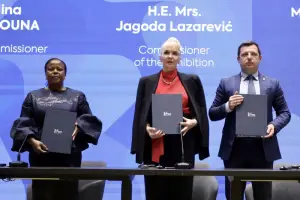 Belgrade, 3 June 2026
Contract on Gabon’s participation in Expo 2027 signed
-
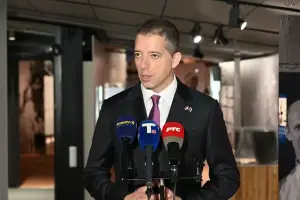 Belgrade/Helsinki, 3 June 2026
Serbia stands for peace, cooperation, respect for international law
-
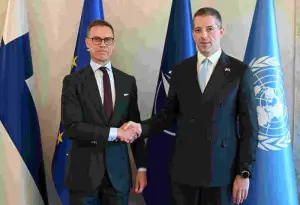 Belgrade/Helsinki, 2 June 2026
Great potential for strengthening economic ties with Finland
-
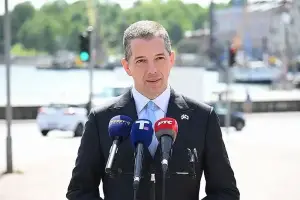 Belgrade/Helsinki, 2 June 2026
Finland confirms strong support for Serbia’s European future
-
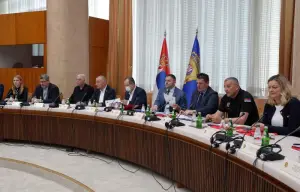 Belgrade, 1 June 2026
Coordination of services to reduce risks from extreme weather events
-
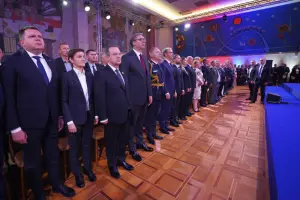 Belgrade, 31 May 2026
Ceremonial academy held to mark Ministry of the Interior Day, Police Day
-
 Belgrade/Bratislava, 30 May 2026
High level of partnership, trust between Serbia, Slovakia
-
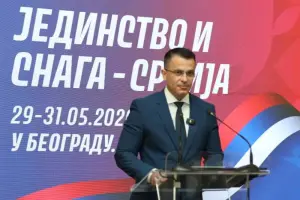 Belgrade, 30 May 2026
Vidovdan Assembly “Unity and Strength – Serbia” opens
-
 Belgrade, 29 May 2026
Serbia significantly strengthened its international position
-
 Belgrade/Bratislava, 29 May 2026
Serbia, Slovakia dedicated to strengthening cooperation in defence sector