
Q:
A:
Council for Competitiveness to improve Serbia’s position in international market
Belgrade,
27 February 2008
Serbian Deputy Prime Minister Bozidar Djelic stated today that the main goal of the Council for Competitiveness is to increase Serbia’s competitiveness in the international market and enable it to become the economic hub in south-eastern Europe.
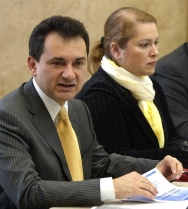
Bozidar Djelic, left, and State Secretary for International Economic Relations Jasna Matic
Author:
Fonet
At the first session of the newly-formed Council, Djelic said that this will eventually lead to better salaries and pensions, as well as improve the quality of work positions and halve unemployment. He also noted that out of 133 countries in the Global Competitiveness Report, composed by the World Economic Forum in Davos, Serbia holds the 91st position, and its aim is to climb to 25th place in three years.
He recalled that in the past few year, Serbia’s competitiveness improved and its overall grade went up from 3.23 to 3.78; however, other countries improved even faster, which caused Serbia’s fall from 77th position in 2003 to the current 91st.
According to Djelic, regardless of the difficult political time for Serbia, it will not renounce EU accession, and the formation of the Council shows that it does not want to stay in isolation either.
Djelic, who is also president of the Council for Competitiveness, said that the increase of exports is the basic competitiveness factor in the international market, and announced that as soon as next week the Council will contemplate a draft strategy for improving exports.
When it comes to countries in transition, the only ones lagging behind us in the Global Competitiveness Report are Macedonia, Bosnia-Herzegovina and Albania. Serbia’s health and primary education sectors and technological readiness received the best grades, whereas goods and labour market efficiency received the lowest grades, specified Djelic.
He pointed out that Serbia was also poorly graded for excessive bureaucracy and overregulation, the protection of minority shareholders and efficiency of anti-monopoly protection.
According to him, the Council will deal primarily with key competitiveness factors, the development of small and medium-sized enterprises, infrastructure, business environment, financial market and the growth of industrial capital.
The Deputy Prime Minister scheduled the second session for March 3, at which the Governor of the National Bank of Serbia will be present, as well as representatives of the Serbian Chamber of Commerce and Serbian ministers.
The council’s task will be to submit to the government semi-annual reports on Serbia’s progress regarding its competitiveness, as well as to suggest measures, determine priorities and coordinate activities of state institutions aimed at increasing competitiveness.
He recalled that in the past few year, Serbia’s competitiveness improved and its overall grade went up from 3.23 to 3.78; however, other countries improved even faster, which caused Serbia’s fall from 77th position in 2003 to the current 91st.
According to Djelic, regardless of the difficult political time for Serbia, it will not renounce EU accession, and the formation of the Council shows that it does not want to stay in isolation either.
Djelic, who is also president of the Council for Competitiveness, said that the increase of exports is the basic competitiveness factor in the international market, and announced that as soon as next week the Council will contemplate a draft strategy for improving exports.
When it comes to countries in transition, the only ones lagging behind us in the Global Competitiveness Report are Macedonia, Bosnia-Herzegovina and Albania. Serbia’s health and primary education sectors and technological readiness received the best grades, whereas goods and labour market efficiency received the lowest grades, specified Djelic.
He pointed out that Serbia was also poorly graded for excessive bureaucracy and overregulation, the protection of minority shareholders and efficiency of anti-monopoly protection.
According to him, the Council will deal primarily with key competitiveness factors, the development of small and medium-sized enterprises, infrastructure, business environment, financial market and the growth of industrial capital.
The Deputy Prime Minister scheduled the second session for March 3, at which the Governor of the National Bank of Serbia will be present, as well as representatives of the Serbian Chamber of Commerce and Serbian ministers.
The council’s task will be to submit to the government semi-annual reports on Serbia’s progress regarding its competitiveness, as well as to suggest measures, determine priorities and coordinate activities of state institutions aimed at increasing competitiveness.
-
 Belgrade, 22 July 2026
New opportunities for expanding economic cooperation between Serbia, China
-
 Belgrade, 20 July 2026
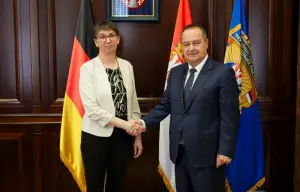
Cooperation in field of interior affairs important segment of relations with Germany
-
 Belgrade, 16 July 2026
Expo 2027 opportunity to further strengthen international partnerships
-
 Belgrade/Bratislava, 16 July 2026
Serbia, Slovakia continue to strengthen political, economic cooperation
-
 Belgrade, 14 July 2026
Serbia bilaterally resolves problems arising from EES implementation
-
 Gradina/Kalotina, 9 July 2026
Improving border cooperation between Serbia, Bulgaria
-
 Belgrade, 7 July 2026
Further strengthening economic cooperation between Serbia, Italy
-
 Belgrade, 6 July 2026
Serbia serious, responsible partner in fight against crime
-
 Kać, 3 July 2026
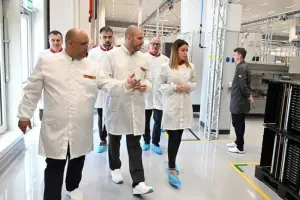
Additional foreign investment confirms confidence in Serbia
-
 Belgrade, 3 July 2026
Serbia, Hungary reliable partners in maintaining security