
Q:
A:
Serbia expects support of Council of Europe in resolution of future status of Kosovo-Metohija
Belgrade/Strasbourg,
2 October 2007
Serbian Prime Minister Vojislav Kostunica said today in an address to the Parliamentary Assembly of the Council of Europe that Serbia is fully committed to finding a democratic solution for the future status of Kosovo-Metohija, which will be based on the same three pillars on which Europe itself is based - human rights, democracy and the rule of law.
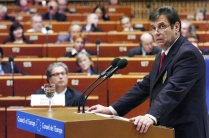
Vojislav Kostunica delivers a speech to the Parliamentary Assembly of the Council of Europe
Author:
AP
The Serbian government's website brings the speech in full:
Mr President, Honourable Members of the Parliamentary Assembly, Mr Secretary General, Ladies and gentlemen,
I wish to express thanks to President of the Parliamentary Assembly of the Council of Europe Renee van der Linden for the honour granted to me to address you as Prime Minister of Serbia at the time when my country is holding the chairmanship of the Committee of Ministers of the Council of Europe.
Serbia took over the Chairmanship of the Committee of Ministers in May and decided to focus primarily on the fundamental values of the Council of Europe – human rights, democracy and the rule of law – as the three pillars that are the foundations of European societies. This is why the slogan of Serbia’s Chairmanship “One Europe – Our Europe” expresses our belief that all the European states and all peoples wish Europe to be one and to speak with a single voice in showing full respect for the mentioned three crucial values.
In my today’s address, honourable Members of the Parliamentary Assembly, I wish, first of all, to stress that the authorities of Serbia have been working assiduously and persistently, before anything else, to ensure implementation of human rights, democracy and the rule of law. This is certainly best borne out by the adoption of the new Constitution of Serbia that passed the test at a referendum, was approved by the will of the people and fulfilled even the most difficult requirement that over 50 percent of registered voters should vote in favour for the proposed Constitution to be adopted. In addition, the Assembly of Serbia adopted the document unanimously, which bears witness to full democratic, political and national consensus on the new Constitution in Serbia.
I am anxious to point out that the Venice Commission for Democracy through Law held the explicit view in its Opinion that the new Constitution “reflects the democratic ideals of the new Serbia”. The text of the Constitution in 63 out of the total of its 206 articles contains the provisions specifically concerning human and minority rights and liberties. In this context, with respect to the national minorities we hold that it is particularly important to point to the provisions which ban discrimination on any grounds and prohibit incitement of religious, racial and national hatred. I also wish to mention in particular the Articles of the Constitution prohibiting violent assimilation and promoting development of the spirit of tolerance, the provisions on the obligation to have national minorities represented on local and provincial government bodies as well as the provisions requiring that account be taken of the national make-up of the population in employing people in the public administration. The Constitution further says that, in addition to the rights guaranteed to all the citizens of Serbia, the minorities are guaranteed certain additional rights that can be placed under the heading of positive discrimination, such as the right to elect national minority councils.
I wish to inform you, ladies and gentlemen, that not only the letter of the Serbian Constitution but also legal provisions and actual practices have largely surpassed the rights and guarantees provided for by the Framework Convention for the Protection of National Minorities. There are local and provincial printed and electronic media which broadcast in minority languages and in the Autonomous Province of Vojvodina, for example, persons belonging to the Hungarian national minority can receive tuition in their own language at around 80 primary and 30 secondary schools as well as at several universities in Novi Sad, Subotica and Belgrade.
I should like to especially highlight the fact that the leaders of national minorities and the highest representatives of all religious communities in Serbia strongly supported the adoption of the new Constitution. Thus, in the multi-ethnic town of Novi Pazar, where Bosniaks account for a considerable majority, an exceptionally high number of citizens took part at the referendum. This best attests to the character of the new Constitution but also to the trust that the national minorities have today in the state of Serbia. This confidence has been built thanks to a number of specific actions the Serbian Government has undertaken in order to improve the overall status and enhance the participation of persons belonging to the national minorities in public affairs.
All this, honourable Members of the Parliamentary Assembly, goes to prove Serbia’s full commitment for and participation in the building of the three very fundamental European values: human rights, democracy and the rule of law. It is precisely in the implementation of these values that Serbia sees a solution to the biggest problem that exists in present-day Europe, namely the issue of the future status of the province of Kosovo-Metohija.
You will be fully aware that the new negotiation process mediated by the international Troika is underway and that direct talks took place between Belgrade and the representatives of Kosovo Albanians several days ago. It is quite natural, given that the negotiations are in progress, for us to talk openly at this oldest European institution and, I am convinced, to jointly support only a democratic and compromise solution.
I wish to explicitly re-assert for you today that Serbia is, indeed, committed without any reserve, to a democratic solution which will be based on the very same three pillars that form the foundations of Europe itself - human rights, democracy and the rule of law. Accordingly, Serbia called on both the Albanian side and the international community in New York to commit themselves not to resort to violent and unilateral solutions: we firmly hold that everyone concerned must act only in favour of a negotiated democratic settlement.
And it is precisely the Council of Europe, which itself rests on the mentioned three fundamental values and is duty-bound to safeguard them, that can help us find a way of reaching a democratic solution. This is precisely why during the course of the New York talks Serbia proceeded from the crucial issue of respect and guarantees of the rights of the Albanian national minority in the province of Kosovo-Metohija. The essence of the problem we are facing is how to settle the status of the Albanian national minority in the province democratically and in line with international law.
Serbia’s proposal that we presented in New York is that Serbia is ready to guarantee to the Albanian national minority the status of the most-favoured national minority existing anywhere in the world today. The constitutional guarantee for such a status would be secured in the form of functional and substantive autonomy of the Province of Kosovo-Metohija within Serbia.
I trust you will agree that such a proposal of Serbia can only have as its goal full and free development and prosperity of Kosovo Albanians and is by no means motivated by any intention on the part of Belgrade to limit or in any way curtail the Albanians’ rights in the Province. Of course, like any other sovereign and internationally recognized state, Serbia cannot allow the Albanian national minority to create a state within a state and to form another Albanian state in the Balkan region. You know best, ladies and gentlemen, that no national minority anywhere in the world has that right and I am asking you why only the Albanian national minority and only in Serbia should enjoy such a right.
Mr President, Honourable Members of the Parliamentary Assembly, Mr Secretary General, Ladies and gentlemen,
I wish to express thanks to President of the Parliamentary Assembly of the Council of Europe Renee van der Linden for the honour granted to me to address you as Prime Minister of Serbia at the time when my country is holding the chairmanship of the Committee of Ministers of the Council of Europe.
Serbia took over the Chairmanship of the Committee of Ministers in May and decided to focus primarily on the fundamental values of the Council of Europe – human rights, democracy and the rule of law – as the three pillars that are the foundations of European societies. This is why the slogan of Serbia’s Chairmanship “One Europe – Our Europe” expresses our belief that all the European states and all peoples wish Europe to be one and to speak with a single voice in showing full respect for the mentioned three crucial values.
In my today’s address, honourable Members of the Parliamentary Assembly, I wish, first of all, to stress that the authorities of Serbia have been working assiduously and persistently, before anything else, to ensure implementation of human rights, democracy and the rule of law. This is certainly best borne out by the adoption of the new Constitution of Serbia that passed the test at a referendum, was approved by the will of the people and fulfilled even the most difficult requirement that over 50 percent of registered voters should vote in favour for the proposed Constitution to be adopted. In addition, the Assembly of Serbia adopted the document unanimously, which bears witness to full democratic, political and national consensus on the new Constitution in Serbia.
I am anxious to point out that the Venice Commission for Democracy through Law held the explicit view in its Opinion that the new Constitution “reflects the democratic ideals of the new Serbia”. The text of the Constitution in 63 out of the total of its 206 articles contains the provisions specifically concerning human and minority rights and liberties. In this context, with respect to the national minorities we hold that it is particularly important to point to the provisions which ban discrimination on any grounds and prohibit incitement of religious, racial and national hatred. I also wish to mention in particular the Articles of the Constitution prohibiting violent assimilation and promoting development of the spirit of tolerance, the provisions on the obligation to have national minorities represented on local and provincial government bodies as well as the provisions requiring that account be taken of the national make-up of the population in employing people in the public administration. The Constitution further says that, in addition to the rights guaranteed to all the citizens of Serbia, the minorities are guaranteed certain additional rights that can be placed under the heading of positive discrimination, such as the right to elect national minority councils.
I wish to inform you, ladies and gentlemen, that not only the letter of the Serbian Constitution but also legal provisions and actual practices have largely surpassed the rights and guarantees provided for by the Framework Convention for the Protection of National Minorities. There are local and provincial printed and electronic media which broadcast in minority languages and in the Autonomous Province of Vojvodina, for example, persons belonging to the Hungarian national minority can receive tuition in their own language at around 80 primary and 30 secondary schools as well as at several universities in Novi Sad, Subotica and Belgrade.
I should like to especially highlight the fact that the leaders of national minorities and the highest representatives of all religious communities in Serbia strongly supported the adoption of the new Constitution. Thus, in the multi-ethnic town of Novi Pazar, where Bosniaks account for a considerable majority, an exceptionally high number of citizens took part at the referendum. This best attests to the character of the new Constitution but also to the trust that the national minorities have today in the state of Serbia. This confidence has been built thanks to a number of specific actions the Serbian Government has undertaken in order to improve the overall status and enhance the participation of persons belonging to the national minorities in public affairs.
All this, honourable Members of the Parliamentary Assembly, goes to prove Serbia’s full commitment for and participation in the building of the three very fundamental European values: human rights, democracy and the rule of law. It is precisely in the implementation of these values that Serbia sees a solution to the biggest problem that exists in present-day Europe, namely the issue of the future status of the province of Kosovo-Metohija.
You will be fully aware that the new negotiation process mediated by the international Troika is underway and that direct talks took place between Belgrade and the representatives of Kosovo Albanians several days ago. It is quite natural, given that the negotiations are in progress, for us to talk openly at this oldest European institution and, I am convinced, to jointly support only a democratic and compromise solution.
I wish to explicitly re-assert for you today that Serbia is, indeed, committed without any reserve, to a democratic solution which will be based on the very same three pillars that form the foundations of Europe itself - human rights, democracy and the rule of law. Accordingly, Serbia called on both the Albanian side and the international community in New York to commit themselves not to resort to violent and unilateral solutions: we firmly hold that everyone concerned must act only in favour of a negotiated democratic settlement.
And it is precisely the Council of Europe, which itself rests on the mentioned three fundamental values and is duty-bound to safeguard them, that can help us find a way of reaching a democratic solution. This is precisely why during the course of the New York talks Serbia proceeded from the crucial issue of respect and guarantees of the rights of the Albanian national minority in the province of Kosovo-Metohija. The essence of the problem we are facing is how to settle the status of the Albanian national minority in the province democratically and in line with international law.
Serbia’s proposal that we presented in New York is that Serbia is ready to guarantee to the Albanian national minority the status of the most-favoured national minority existing anywhere in the world today. The constitutional guarantee for such a status would be secured in the form of functional and substantive autonomy of the Province of Kosovo-Metohija within Serbia.
I trust you will agree that such a proposal of Serbia can only have as its goal full and free development and prosperity of Kosovo Albanians and is by no means motivated by any intention on the part of Belgrade to limit or in any way curtail the Albanians’ rights in the Province. Of course, like any other sovereign and internationally recognized state, Serbia cannot allow the Albanian national minority to create a state within a state and to form another Albanian state in the Balkan region. You know best, ladies and gentlemen, that no national minority anywhere in the world has that right and I am asking you why only the Albanian national minority and only in Serbia should enjoy such a right.
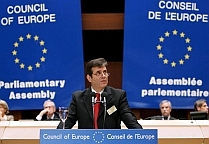
Author:
AP
I wish you also to know that Serbia in New York called the Albanian side as well as the international community to work together with us on determining the most-favoured national minority status and see together which particular rights are currently exercised by national minorities in the world and in what way, and then to use this as a reliable criterion for settling the dispute.
It is very important for me to inform you that today we are at a turning point where it is primarily the international community that must take a decision which of the two pathways to opt for in tackling the issue of the fortunes of the province of Kosovo-Metohija and, by the same token, the fortunes of Serbia. One of these pathways that I have already spoken about leads to a democratic solution based on the European values of respect for human rights, democracy and the rule of law. The second pathway leads to a highly risky zone of setting the most dangerous precedent since the end of World War Two and allowing a national minority, at the cost of grossly violating a valid Security Council resolution as well as the UN Charter and the Helsinki Final Act, to form its new state on the territory of a sovereign and internationally recognized state.
It is my duty to draw your attention here to the two arguments invoked in favour of this second extremely dangerous pathway, fully in the spirit of legal violence and the policy of pursuing a unilateral solution. Thus, one can hear from the top-ranking international officials that unless a solution is identified speedily, the peace in the Province may be put in jeopardy, which is immediately echoed by Albanian terrorists who send word that they will resort to massive violence unless Kosovo is granted independence. This type of arguments would not deserve any comment had we heard at least once a single clear message from the international community to the effect that such threats, rather than be rewarded by granting a state, must be most severely sanctioned.
The second reason for moving along the pathway of legal violence and dismembering Serbia should be looked for in the contents of Annex 11 of the rejected Ahtisaari plan. It was more than telling how all the Albanian representatives in New York repeated again and again that they would fully apply Ahtisaari’s plan although everybody was aware that that plan is not on the agenda at all. In other words, the Albanians are hoping that, for the sake of implementing Annex 11 and thus achieving their geo-strategic, military and security interests, certain big powers would agree to recognize unilaterally declared independence.
The Members of this august Assembly should know that Annex 11 of Ahtisaari’s plan envisages no clear civilian control over the international military presence in Kosovo in the form of NATO forces, which would constitute yet another unheard-of precedent since the democratic world was built. We are facing the risk that the application of Annex 11 would be more important than identifying a democratic solution, outweighing the destiny of Kosovo, the destiny of Serbia and even the destiny of the entire region.
The two pathways leading to a solution to the Kosovo problem outlined here deserve of us to stop and think them over. What I wish to tell you is that you can rest fully assured that, in keeping with the UN Charter and its own Constitution, Serbia will not abandon the quest for a democratic solution just as it is most resolutely rejecting even a mere thought that it could allow, for any reason and at any time, the making of a new Albanian state on its territory through legal violence, the pursuit of the policy of force and by unilateral steps. I assure you it is impossible to impose a solution on Serbia and that any possible unilaterally declared independence would prove to be unsustainable. Unilaterally declared independence would only aggravate the problem and then end up in failure, which would bring us back to the point where we would have to search together for a democratic and sustainable solution all over again.
It should, regrettably, also be borne in mind that there is a real threat that particular countries, and even European ones, would opt for blatant violation of the valid Security Council resolution 1244, which is binding on all the Governments and which explicitly guarantees Serbia’s sovereignty and territorial integrity, and would be prepared to recognize a unilateral act of Albanian separatists on the independence of the Province. Here, at the Council of Europe, we must pose the most natural possible question which is the following: if certain European states opt today to violate resolution 1244, what can prevent any European state tomorrow from violating yet another Security Council resolution if such a violation is mandated by its interests? The real question is whether all those taking decisions today have taken into account all the consequences that could arise in Europe and elsewhere in the world as a result of use of legal violence and blatant violation of international law and the universally binding UN resolutions?
At first sight it may appear that it is easier to cut things short even at the cost of blatantly violating the norms and values underpinning our present-day world. However, all the countries taking this shortsighted approach should bear in mind that as early as tomorrow they themselves could be faced with a similar threat. In this context, we all known full well, as we have learnt lessons based on European and global historic experience, that any violence and breaking of universal rules, and especially those that cause a sovereign country to be dismembered, will inevitably produce grave and tragic consequences.
Let us ask ourselves, honourable Members of Parliament, how many separatist-minded national minorities in today’s world are watching attentively how the issue of the Albanian national minority in Kosovo will be settled. How should one explain to them tomorrow that there are first-grade national minorities that are allowed to form states, and second-grade national minorities that are not permitted to do so? And, most importantly, would they be prepared reconcile themselves to such an unprincipled position or would numerous new problems arise through formation of new states riven by conflicts and presenting persistent threats to peace and stability.
I wish to voice my conviction that nobody should stay calm when faced with the fact that it is precisely in Europe - so very proud of its achievements in terms of respect for the rule of law, democracy and human rights - that certain countries are thinking of dismembering a sovereign and internationally recognized country by virtue of legal violence and by means of a unilateral solution. We have also seen a powerful non-European country assure us that we should regulate our affairs at the heart of Europe through the use of violence and through direct violation of the UN Charter and arguing that such an action would not constitute a precedent but rather a regular and normal state of affairs.
Common sense is warning us that we should stick to time-tested values and not abandon a democratic solution by any means. Europe’s experience is too vast and its commitment to persevere in the quest for a democratic solution too strong for us to dare give in to pressures and too readily engage in undermining the foundations on which the entire international order is based today.
If Serbia were to yield under such pressure and agree to take part in the making of another Albanian state on its own territory, it would thus take over gravest possible responsibility for all the far-reaching consequences of such an action. For, who is more called upon than Serbia itself to fight for adherence to universal rules when its territorial integrity and its province of Kosovo-Metohija are at stake? By consistently acting as we do, we have earned the right to call on you as well to stand in defense of the highest European values so that we do not allow legal violence to take precedence over a democratic solution at the heart of Europe, in Kosovo-Metohija.
Nobody has told us yet to this very date what might be wrong in our proposal and why Kosovo should be granted independence. What are the arguments that can challenge Belgrade’s offer on the status of the most-favoured national minority? Are there any arguments at all, and what are the legal grounds for taking away 15 percent of Serbia’s territory in order to create the second Albanian state in the Balkan region? How come the rejected Ahtisaari’s proposal does not contain even a single word in terms of a legal explanation for such a solution? Lastly, how come nobody has yet thought of at least a single argument in favour of Kosovo’s independence except unless we consider as such an explanation the often quoted expression ‘this is a reality’?
Honourable Members of the Parliamentary Assembly,
The only reality recognized by Serbia is the duty of all the countries of the world to respect the UN Charter and to act in line with the values underpinning post-war Europe. Respect for that reality has brought peace, stability and prosperity to Europe. Rest assured that Serbia will do everything in its power to have this reality applied throughout its territory by means of a democratic solution, and rest equally assured that Serbia will never accept the reality of the policy of force or recognize any unilaterally declared independence for the Province.
Serbia, honourable Members of Parliamentary Assembly, rightfully expects your support in achieving a democratic and negotiated settlement for the future status of Serbian Province of Kosovo-Metohija. We remain convinced that by defending law and justice, the UN Charter, the order of present-day world and European democratic values we are not thinking only of our own future, and that by doing so Serbia is not defending only its own sovereignty and dignity.
Thank you for your attention.
It is my duty to draw your attention here to the two arguments invoked in favour of this second extremely dangerous pathway, fully in the spirit of legal violence and the policy of pursuing a unilateral solution. Thus, one can hear from the top-ranking international officials that unless a solution is identified speedily, the peace in the Province may be put in jeopardy, which is immediately echoed by Albanian terrorists who send word that they will resort to massive violence unless Kosovo is granted independence. This type of arguments would not deserve any comment had we heard at least once a single clear message from the international community to the effect that such threats, rather than be rewarded by granting a state, must be most severely sanctioned.
The second reason for moving along the pathway of legal violence and dismembering Serbia should be looked for in the contents of Annex 11 of the rejected Ahtisaari plan. It was more than telling how all the Albanian representatives in New York repeated again and again that they would fully apply Ahtisaari’s plan although everybody was aware that that plan is not on the agenda at all. In other words, the Albanians are hoping that, for the sake of implementing Annex 11 and thus achieving their geo-strategic, military and security interests, certain big powers would agree to recognize unilaterally declared independence.
The Members of this august Assembly should know that Annex 11 of Ahtisaari’s plan envisages no clear civilian control over the international military presence in Kosovo in the form of NATO forces, which would constitute yet another unheard-of precedent since the democratic world was built. We are facing the risk that the application of Annex 11 would be more important than identifying a democratic solution, outweighing the destiny of Kosovo, the destiny of Serbia and even the destiny of the entire region.
The two pathways leading to a solution to the Kosovo problem outlined here deserve of us to stop and think them over. What I wish to tell you is that you can rest fully assured that, in keeping with the UN Charter and its own Constitution, Serbia will not abandon the quest for a democratic solution just as it is most resolutely rejecting even a mere thought that it could allow, for any reason and at any time, the making of a new Albanian state on its territory through legal violence, the pursuit of the policy of force and by unilateral steps. I assure you it is impossible to impose a solution on Serbia and that any possible unilaterally declared independence would prove to be unsustainable. Unilaterally declared independence would only aggravate the problem and then end up in failure, which would bring us back to the point where we would have to search together for a democratic and sustainable solution all over again.
It should, regrettably, also be borne in mind that there is a real threat that particular countries, and even European ones, would opt for blatant violation of the valid Security Council resolution 1244, which is binding on all the Governments and which explicitly guarantees Serbia’s sovereignty and territorial integrity, and would be prepared to recognize a unilateral act of Albanian separatists on the independence of the Province. Here, at the Council of Europe, we must pose the most natural possible question which is the following: if certain European states opt today to violate resolution 1244, what can prevent any European state tomorrow from violating yet another Security Council resolution if such a violation is mandated by its interests? The real question is whether all those taking decisions today have taken into account all the consequences that could arise in Europe and elsewhere in the world as a result of use of legal violence and blatant violation of international law and the universally binding UN resolutions?
At first sight it may appear that it is easier to cut things short even at the cost of blatantly violating the norms and values underpinning our present-day world. However, all the countries taking this shortsighted approach should bear in mind that as early as tomorrow they themselves could be faced with a similar threat. In this context, we all known full well, as we have learnt lessons based on European and global historic experience, that any violence and breaking of universal rules, and especially those that cause a sovereign country to be dismembered, will inevitably produce grave and tragic consequences.
Let us ask ourselves, honourable Members of Parliament, how many separatist-minded national minorities in today’s world are watching attentively how the issue of the Albanian national minority in Kosovo will be settled. How should one explain to them tomorrow that there are first-grade national minorities that are allowed to form states, and second-grade national minorities that are not permitted to do so? And, most importantly, would they be prepared reconcile themselves to such an unprincipled position or would numerous new problems arise through formation of new states riven by conflicts and presenting persistent threats to peace and stability.
I wish to voice my conviction that nobody should stay calm when faced with the fact that it is precisely in Europe - so very proud of its achievements in terms of respect for the rule of law, democracy and human rights - that certain countries are thinking of dismembering a sovereign and internationally recognized country by virtue of legal violence and by means of a unilateral solution. We have also seen a powerful non-European country assure us that we should regulate our affairs at the heart of Europe through the use of violence and through direct violation of the UN Charter and arguing that such an action would not constitute a precedent but rather a regular and normal state of affairs.
Common sense is warning us that we should stick to time-tested values and not abandon a democratic solution by any means. Europe’s experience is too vast and its commitment to persevere in the quest for a democratic solution too strong for us to dare give in to pressures and too readily engage in undermining the foundations on which the entire international order is based today.
If Serbia were to yield under such pressure and agree to take part in the making of another Albanian state on its own territory, it would thus take over gravest possible responsibility for all the far-reaching consequences of such an action. For, who is more called upon than Serbia itself to fight for adherence to universal rules when its territorial integrity and its province of Kosovo-Metohija are at stake? By consistently acting as we do, we have earned the right to call on you as well to stand in defense of the highest European values so that we do not allow legal violence to take precedence over a democratic solution at the heart of Europe, in Kosovo-Metohija.
Nobody has told us yet to this very date what might be wrong in our proposal and why Kosovo should be granted independence. What are the arguments that can challenge Belgrade’s offer on the status of the most-favoured national minority? Are there any arguments at all, and what are the legal grounds for taking away 15 percent of Serbia’s territory in order to create the second Albanian state in the Balkan region? How come the rejected Ahtisaari’s proposal does not contain even a single word in terms of a legal explanation for such a solution? Lastly, how come nobody has yet thought of at least a single argument in favour of Kosovo’s independence except unless we consider as such an explanation the often quoted expression ‘this is a reality’?
Honourable Members of the Parliamentary Assembly,
The only reality recognized by Serbia is the duty of all the countries of the world to respect the UN Charter and to act in line with the values underpinning post-war Europe. Respect for that reality has brought peace, stability and prosperity to Europe. Rest assured that Serbia will do everything in its power to have this reality applied throughout its territory by means of a democratic solution, and rest equally assured that Serbia will never accept the reality of the policy of force or recognize any unilaterally declared independence for the Province.
Serbia, honourable Members of Parliamentary Assembly, rightfully expects your support in achieving a democratic and negotiated settlement for the future status of Serbian Province of Kosovo-Metohija. We remain convinced that by defending law and justice, the UN Charter, the order of present-day world and European democratic values we are not thinking only of our own future, and that by doing so Serbia is not defending only its own sovereignty and dignity.
Thank you for your attention.
Multimedia
 VIDEO: Prime Minister Vojislav Kostunica holds speech at CoE Parliamentary Assembly (source: Council of Europe)
-
 Belgrade/Cairo, 16 June 2026
Considerable room for cooperation with Egypt in field of tourism, cultural heritage
-
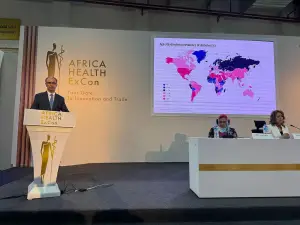 Belgrade/Cairo, 16 June 2026
Significance of international cooperation in improving human health worldwide
-
 Belgrade/Cairo, 16 June 2026
Promotion of Serbia’s potential at Expo stand in Cairo
-
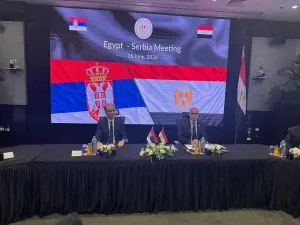 Belgrade/Cairo, 15 June 2026
Serbia committed to deepening cooperation with Egypt in numerous areas
-
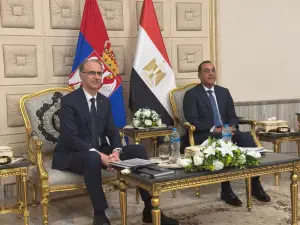 Belgrade/Cairo, 15 June 2026
Significant space for further advancing partnership with Egypt
-
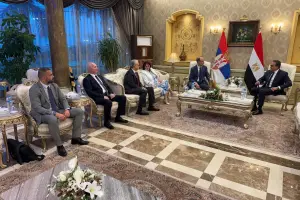 Belgrade/Cairo, 15 June 2026
Prime Minister begins multi-day working visit to Egypt
-
 Belgrade, 14 June 2026
Macut on working visit to Egypt
-
 Belgrade, 13 June 2026
Dialogue important for finding solutions to fertility challenges
-
 Belgrade, 12 June 2026
Intensifying cooperation with Greece in numerous areas
-
 Zrenjanin, 11 June 2026
Linglong plant symbol of strategic partnership between Serbia, China