Q:
A:
Serbia rejects Ahtisaari's proposal before UN Security Council and requests new international mediator
Belgrade/New York,
3 April 2007
Serbian Prime Minister Vojislav Kostunica informed the United Nations Security Council this evening that Serbia rejects the proposal of Martti Ahtisaari and requested this body to appoint a new mediator and launch new negotiations that will take the valid Resolution 1244 as a clear and firm framework for finding a solution based on agreement.
Address by Prime Minister of Serbia Vojislav Kostunica to the UN Security Council
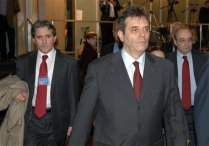
Serbian Prime Minister Vojislav Kostunica (center) and coordinators of the state negotiating team for the Kosovo status talks Slobodan Samardzic (left) and Leon Kojen arrive for a meeting of the Security Council at the United Nations
Author:
AP
New York, 3 April 2007
Mr. President, Distinguished representatives of the Security Council member-states, Your Excellencies, Ladies and gentlemen, At the outset I wish to present my compliments to this august body of the World Organization. I believe that the distinguished representatives of the Security Council member states who are present here are well aware that Serbia is an old European state. It was a member of the League of Nations and later one of the founding members of the United Nations. With its centuries-old tradition of state building, Serbia has taken part in shaping the history of Europe and thus in contributing to the definition of lasting and universal values essential to the world that we live in. When saying this, I refer first of all to fundamental values such as justice and the rule of law.
I am certain that we all fully share the belief that every state has the right, guaranteed by the UN Charter, to demand that it be protected by the general principles of international law and elementary justice. To this date nobody has ever attempted to challenge the validity of the fundamental principle of respect for the sovereignty and territorial integrity of internationally recognized states, or to question the principle of inviolability of their internationally recognized borders. I stress that this has never happened before, that is – not until the UN Secretary General’s Special Envoy Mr. Martti Ahtisaari presented his proposal on the Kosovo status settlement. In this respect, your Excellencies, we are indeed confronted with a potentially very dangerous precedent.
Serbia has already clearly stated that Special Envoy Ahtisaari in effect proposes to deprive Serbia of 15 percent of its territory. This is contrary to the principles of international law, contrary to the UN Charter, contrary to the UN SC Resolution 1244, contrary to the Helsinki Final Act, contrary to the Constitution of the Republic of Serbia and, last but not least, contrary to elementary justice. His proposal envisages that internationally recognized borders of Serbia should be redrawn against its will, by brutal imposition. The only justification offered is that thus Kosovo and Metohija Albanians, a national minority within our country, could form another Albanian state on Serbian territory, adjacent to the already existing state of Albania. When a nation is faced with such an attempt to trample upon law and justice, every citizen and the whole country know and are united in the feeling that the dignity of their state is profoundly undermined and its future called into question.
This, Mr. President, is the reason why Serbia has unambiguously rejected Ahtisaari’s proposal as an unlawful and illegitimate attempt to dismember our state. It was not within the mandate of the Special Envoy to violate the principle of sovereignty and territorial integrity and to propose redrawing Serbia’s internationally recognized borders. In fact, the UN Secretary General had given Mr. Ahtisaari the mandate to act as a mediator in the talks aimed at determining the future status of the Serbian province of Kosovo and Metohija. This is the way his role has to be understood within the UN framework: neither the Secretary General nor the Security Council could have given Mr. Ahtisaari the mandate to open the issue of the state status of Serbia, simply because this is not permitted under the UN Charter.
The Security Council is the right place to ask Mr. Ahtisaari – what is the legal basis of his proposal to violate the principle of sovereignty and territorial integrity of internationally recognized states, thus depriving Serbia, a UN member state, of a significant part of its territory? The Special Envoy has so far been silent on this issue, and it is high time that he should repair this omission. Of course, we all know that, as long as the UN Charter remains in force, there simply cannot be any legal basis for such a proposal. No explanation can turn a violation of law into law, nor can brute might become right in such a manner.
The real question is: why has Special Envoy Ahtisaari chosen to act outside the scope of his mandate and why he has failed to take up the role of the mediator in the talks that should have been pursued within the framework of SC Resolution 1244 and the UN Charter? Renouncing his role as mediator, the Special Envoy has decided to come forward with a one-sided proposal of his own which completely disregards the position of Belgrade and is in direct violation of valid norms of international law.
The moment the Special Envoy decided to act contrary to the UN Charter, it became clear that his aim was not to help the two sides to reach a political compromise through a negotiated settlement. In fact, Mr. Ahtisaari deliberately adopted the position of the Albanian side and thus produced a proposal that only meets the demands of the Kosovo and Metohija Albanians. The best proof of this is the outright rejection of this plan by Serbia and its ready acceptance by the Albanians in the province.
From the very start of the status process, Mr. President, and I wish to emphasize this very strongly, Serbia made every effort to convince the Special Envoy that the key to his success lay in carefully observing two fundamental conditions. First, that the status talks must be pursued within the scope of the UN Charter, and that this entails respect for the inviolability of internationally recognized borders and respect for the sovereignty and territorial integrity of existing states. Second, that he should be a mediator trying to find a political compromise and a mutually acceptable solution, and not an advocate of one side only, in this particular case the Kosovo and Metohija Albanians. In spite of our persistent reminders, Mr. Ahtisaari has clearly disregarded these two crucial conditions. In fact, his proposal directly contravenes the UN Charter, and this is why Serbia insists that the Security Council should reject it as unlawful and illegitimate.
The lack of any legal grounds for depriving Serbia of a part of its territory explains why Albanian separatists and terrorists have been increasingly resorting to threats of violence unless Kosovo is given independence. In the name of my country I ask you – can the Security Council afford to remain silent in the face of open threats of violence and, moreover, allow those threats to serve as an argument in favour of forming a new state on the territory of Serbia, an internationally recognized state and a member of the UN. Serbia is convinced that the Security Council will authoritatively reject all threats of violence and that this august body will clearly oppose the use of force as a way of settling the Kosovo issue, just as it would do in the case of any similar problem elsewhere.
I take this opportunity, Mr. President, to say once again clearly to all the Security Council member states that Serbia is fully committed to engage constructively and responsibly in further talks aimed at reaching a compromise solution for the southern Serbian province. It is of crucial importance to recognize all the shortcomings in the negotiation process so far and to ensure that a new international mediator concentrates on reaching a compromise solution that should respect the fundamental principle of preserving sovereignty and territorial integrity of the state of Serbia.
Serbia is fully convinced that it is possible to find such a negotiated and historically just solution. Serbs and Albanians have lived together for centuries, and for centuries Kosovo and Metohija has been a part of Serbia. Serbia is fully committed to enabling the Albanian national minority to achieve, in accordance with the SC Resolution 1244, substantial autonomy in the Province of Kosovo and Metohija. This means that the Albanians in the Province would be able to decide upon their future, manage their own affairs and protect their interests, while at the same time Serbia would, in accordance with the UN Charter, preserve its sovereignty and territorial integrity. It is entirely possible to reconcile these two demands. In such a case, it would be perfectly acceptable to Serbia to have the United Nations supervise the implementation of substantive autonomy of Kosovo and Metohija within Serbia.
The justice of Serbia’s proposal may best be seen by asking whether a single national minority in the world today would reject substantive autonomy defined in this way. I believe that we are all aware that if a negative precedent is once set, and if national minorities are given the right to violate the UN Charter by dismembering existing states, this would mean that the Rubicon has been crossed. In that case nobody can foresee what dangerous consequences for global peace such a precedent might trigger.
This is why Serbia is convinced that negotiations must continue, with a new international mediator, and with the focus on finding the best form of substantive autonomy for the Province. I repeat: Serbs and Albanians have lived together for centuries, and it is impermissible to conclude, as Albanian separatists are suggesting, that living together is not possible. Genuinely democratic principles, as well as the principle of multiethnicity, involve joint responsibilities for living together. In this distribution of responsibilities, the Albanian side would exercise all the competences entailed by the mutually agreed substantive autonomy. Countries all over the world have developed a variety of arrangements to ensure autonomy for their national minorities, and it is impermissible that, in only one case, a single minority should have the right to form an independent state and reject even the highest form of autonomy as insufficient.
It is time to address the matter properly and to open direct talks between Belgrade and Pristina. Regrettably, in spite of Belgrade’s insistence, such talks have not taken place so far. We have said several times that, before submitting his status proposal, Mr. Ahtisaari had organized only one meeting on the future status of Kosovo and Metohija. If we all agree on the complexity of the Kosovo problem, it surely follows that such an issue can hardly be settled at a single meeting. Strong commitment to continued dialogue as the only way of reaching a mutually acceptable solution and settling the future status of the province is necessary, and it is particularly important that all parties abide by this principle. If one side does not want to reach a solution through dialogue but resorts to threats of violence, clear mechanisms must be defined in order to prevent and punish such violence.
Mr. President, your Excellencies,
Today Serbia is proposing that further negotiations be based on a comprehensive discussion about the implementation of the SC Resolution 1244. This is the right moment to review objectively whether, and to what extent, the binding provisions of this Resolution have been implemented. More specifically, Belgrade welcomes the initiative of the Russian Federation that the Security Council appoint a fact-finding mission to visit Serbia and establish the extent to which the standards defined by the Resolution 1244 have been fulfilled to date. To start with, such a SC mission could see for itself how many Serbs expelled since 1999 have returned to the Province. It is common knowledge that since then more than 200 thousand Serbs have been forced to leave the Province. More than 40,000 Serbs have been expelled just from the capital city of the Province, Priština, so that at present there are only around 100 Serbs living there. Why cannot the expelled Serbs return to the capital city of the Province? Perhaps there could be a reason why return is not possible to some highly inaccessible areas. But the fact that expelled people cannot return to the capital of the Province due to security concerns, and that they do not feel safe in other big towns such as Peć, Prizren, Uroševac and Đakovica, is clear evidence of the extent to which standards set by the Resolution 1244 have remained unfulfilled.
Only days before this Security Council session, terrorists again shelled the mediaeval Serbian monastery of Visoki Dečani, dating to the mid 14th century, and ranked by UNESCO as part of the world cultural heritage. During the last eight years, the terrorists destroyed over 150 Serbian Orthodox churches and monasteries, many of which have been an irreplaceable part of both Serbian and European cultural heritage.
In view of all these facts, the next natural step is to take stock of the actual situation in terms of the implementation of the SC Resolution 1244. We are convinced that this is the best way to launch a new cycle of negotiations. I stress in particular that Resolution 1244 explicitly reaffirms the sovereignty and territorial integrity of Serbia with regard to Kosovo and Metohija and – I quote – ‘calls for substantive autonomy to be secured for the Province’. This explains why it is precisely this SC Resolution that should be central to further talks on the future status of the Province.
Serbia is taking this opportunity to point out once again that the SC Resolution 1244 is binding on the Governments of all UN member states. No state may violate this Resolution, or take a unilateral position on the future status of the Province. Any unilateral recognition of Kosovo’s independence would constitute flagrant and - I stress - double violation of UN norms. Both the UN Charter and Resolution 1244 would be violated, and any state that decides to act in such an unlawful manner would directly call into question the authority of the UN. Serbia would, of course, unequivocally reject any such recognition of Kosovo and Metohija’s independence as null and void, as it would constitute direct interference on the part of such states in the internal affairs of Serbia. In that case, Serbia would ask the Security Council to act in accordance with its own Resolution 1244, so as to protect and reaffirm the territorial integrity of Serbia, as well as the inviolability of its internationally recognized borders.
Let me remind you that Serbia has adopted a new Constitution in November of 2006. Everyone has to recognize the fact that, through a referendum, over half of the total number of the adult citizens of Serbia freely expressed their will, reasserting once again that the Province of Kosovo and Metohija is an integral part of Serbia’s territory as laid down by the Constitution. In addressing the issue of Serbia’s territorial integrity, this sovereign will of the people of Serbia must be fully taken into account. With the adoption of the new Constitution of Serbia, its international state borders have been unambiguously and explicitly confirmed.
Once again I want to emphasize that Serbia is an old European state, and that it cannot permit that law and justice be trampled upon by depriving it of a part of its territory. The dignity of our country and our people are inseparably bound with Kosovo and Metohija – the place of origin of our state, of our faith, of our culture, and of our national and state identity. For Serbia, this is a question of truth, a matter of law and of basic, elementary justice.
As any other sovereign state, Serbia can only see its future within its internationally recognized borders, and upon the entirety of its territory. You can rest assured that Serbian people will never permit its state to be dismembered, nor could it ever recognize the existence of another independent state on its sovereign territory.
Mr. President, I thank you for the opportunity to present the position of Serbia, to inform the Security Council that Serbia has rejected the Ahtisaari proposal, and to request that the Security Council support further negotiations, with a new international mediator, this time taking the UN SC Resolution 1244 as a clear and firm framework for reaching a negotiated settlement.
Thank you for the attention with which you heard me out.
Mr. President, Distinguished representatives of the Security Council member-states, Your Excellencies, Ladies and gentlemen, At the outset I wish to present my compliments to this august body of the World Organization. I believe that the distinguished representatives of the Security Council member states who are present here are well aware that Serbia is an old European state. It was a member of the League of Nations and later one of the founding members of the United Nations. With its centuries-old tradition of state building, Serbia has taken part in shaping the history of Europe and thus in contributing to the definition of lasting and universal values essential to the world that we live in. When saying this, I refer first of all to fundamental values such as justice and the rule of law.
I am certain that we all fully share the belief that every state has the right, guaranteed by the UN Charter, to demand that it be protected by the general principles of international law and elementary justice. To this date nobody has ever attempted to challenge the validity of the fundamental principle of respect for the sovereignty and territorial integrity of internationally recognized states, or to question the principle of inviolability of their internationally recognized borders. I stress that this has never happened before, that is – not until the UN Secretary General’s Special Envoy Mr. Martti Ahtisaari presented his proposal on the Kosovo status settlement. In this respect, your Excellencies, we are indeed confronted with a potentially very dangerous precedent.
Serbia has already clearly stated that Special Envoy Ahtisaari in effect proposes to deprive Serbia of 15 percent of its territory. This is contrary to the principles of international law, contrary to the UN Charter, contrary to the UN SC Resolution 1244, contrary to the Helsinki Final Act, contrary to the Constitution of the Republic of Serbia and, last but not least, contrary to elementary justice. His proposal envisages that internationally recognized borders of Serbia should be redrawn against its will, by brutal imposition. The only justification offered is that thus Kosovo and Metohija Albanians, a national minority within our country, could form another Albanian state on Serbian territory, adjacent to the already existing state of Albania. When a nation is faced with such an attempt to trample upon law and justice, every citizen and the whole country know and are united in the feeling that the dignity of their state is profoundly undermined and its future called into question.
This, Mr. President, is the reason why Serbia has unambiguously rejected Ahtisaari’s proposal as an unlawful and illegitimate attempt to dismember our state. It was not within the mandate of the Special Envoy to violate the principle of sovereignty and territorial integrity and to propose redrawing Serbia’s internationally recognized borders. In fact, the UN Secretary General had given Mr. Ahtisaari the mandate to act as a mediator in the talks aimed at determining the future status of the Serbian province of Kosovo and Metohija. This is the way his role has to be understood within the UN framework: neither the Secretary General nor the Security Council could have given Mr. Ahtisaari the mandate to open the issue of the state status of Serbia, simply because this is not permitted under the UN Charter.
The Security Council is the right place to ask Mr. Ahtisaari – what is the legal basis of his proposal to violate the principle of sovereignty and territorial integrity of internationally recognized states, thus depriving Serbia, a UN member state, of a significant part of its territory? The Special Envoy has so far been silent on this issue, and it is high time that he should repair this omission. Of course, we all know that, as long as the UN Charter remains in force, there simply cannot be any legal basis for such a proposal. No explanation can turn a violation of law into law, nor can brute might become right in such a manner.
The real question is: why has Special Envoy Ahtisaari chosen to act outside the scope of his mandate and why he has failed to take up the role of the mediator in the talks that should have been pursued within the framework of SC Resolution 1244 and the UN Charter? Renouncing his role as mediator, the Special Envoy has decided to come forward with a one-sided proposal of his own which completely disregards the position of Belgrade and is in direct violation of valid norms of international law.
The moment the Special Envoy decided to act contrary to the UN Charter, it became clear that his aim was not to help the two sides to reach a political compromise through a negotiated settlement. In fact, Mr. Ahtisaari deliberately adopted the position of the Albanian side and thus produced a proposal that only meets the demands of the Kosovo and Metohija Albanians. The best proof of this is the outright rejection of this plan by Serbia and its ready acceptance by the Albanians in the province.
From the very start of the status process, Mr. President, and I wish to emphasize this very strongly, Serbia made every effort to convince the Special Envoy that the key to his success lay in carefully observing two fundamental conditions. First, that the status talks must be pursued within the scope of the UN Charter, and that this entails respect for the inviolability of internationally recognized borders and respect for the sovereignty and territorial integrity of existing states. Second, that he should be a mediator trying to find a political compromise and a mutually acceptable solution, and not an advocate of one side only, in this particular case the Kosovo and Metohija Albanians. In spite of our persistent reminders, Mr. Ahtisaari has clearly disregarded these two crucial conditions. In fact, his proposal directly contravenes the UN Charter, and this is why Serbia insists that the Security Council should reject it as unlawful and illegitimate.
The lack of any legal grounds for depriving Serbia of a part of its territory explains why Albanian separatists and terrorists have been increasingly resorting to threats of violence unless Kosovo is given independence. In the name of my country I ask you – can the Security Council afford to remain silent in the face of open threats of violence and, moreover, allow those threats to serve as an argument in favour of forming a new state on the territory of Serbia, an internationally recognized state and a member of the UN. Serbia is convinced that the Security Council will authoritatively reject all threats of violence and that this august body will clearly oppose the use of force as a way of settling the Kosovo issue, just as it would do in the case of any similar problem elsewhere.
I take this opportunity, Mr. President, to say once again clearly to all the Security Council member states that Serbia is fully committed to engage constructively and responsibly in further talks aimed at reaching a compromise solution for the southern Serbian province. It is of crucial importance to recognize all the shortcomings in the negotiation process so far and to ensure that a new international mediator concentrates on reaching a compromise solution that should respect the fundamental principle of preserving sovereignty and territorial integrity of the state of Serbia.
Serbia is fully convinced that it is possible to find such a negotiated and historically just solution. Serbs and Albanians have lived together for centuries, and for centuries Kosovo and Metohija has been a part of Serbia. Serbia is fully committed to enabling the Albanian national minority to achieve, in accordance with the SC Resolution 1244, substantial autonomy in the Province of Kosovo and Metohija. This means that the Albanians in the Province would be able to decide upon their future, manage their own affairs and protect their interests, while at the same time Serbia would, in accordance with the UN Charter, preserve its sovereignty and territorial integrity. It is entirely possible to reconcile these two demands. In such a case, it would be perfectly acceptable to Serbia to have the United Nations supervise the implementation of substantive autonomy of Kosovo and Metohija within Serbia.
The justice of Serbia’s proposal may best be seen by asking whether a single national minority in the world today would reject substantive autonomy defined in this way. I believe that we are all aware that if a negative precedent is once set, and if national minorities are given the right to violate the UN Charter by dismembering existing states, this would mean that the Rubicon has been crossed. In that case nobody can foresee what dangerous consequences for global peace such a precedent might trigger.
This is why Serbia is convinced that negotiations must continue, with a new international mediator, and with the focus on finding the best form of substantive autonomy for the Province. I repeat: Serbs and Albanians have lived together for centuries, and it is impermissible to conclude, as Albanian separatists are suggesting, that living together is not possible. Genuinely democratic principles, as well as the principle of multiethnicity, involve joint responsibilities for living together. In this distribution of responsibilities, the Albanian side would exercise all the competences entailed by the mutually agreed substantive autonomy. Countries all over the world have developed a variety of arrangements to ensure autonomy for their national minorities, and it is impermissible that, in only one case, a single minority should have the right to form an independent state and reject even the highest form of autonomy as insufficient.
It is time to address the matter properly and to open direct talks between Belgrade and Pristina. Regrettably, in spite of Belgrade’s insistence, such talks have not taken place so far. We have said several times that, before submitting his status proposal, Mr. Ahtisaari had organized only one meeting on the future status of Kosovo and Metohija. If we all agree on the complexity of the Kosovo problem, it surely follows that such an issue can hardly be settled at a single meeting. Strong commitment to continued dialogue as the only way of reaching a mutually acceptable solution and settling the future status of the province is necessary, and it is particularly important that all parties abide by this principle. If one side does not want to reach a solution through dialogue but resorts to threats of violence, clear mechanisms must be defined in order to prevent and punish such violence.
Mr. President, your Excellencies,
Today Serbia is proposing that further negotiations be based on a comprehensive discussion about the implementation of the SC Resolution 1244. This is the right moment to review objectively whether, and to what extent, the binding provisions of this Resolution have been implemented. More specifically, Belgrade welcomes the initiative of the Russian Federation that the Security Council appoint a fact-finding mission to visit Serbia and establish the extent to which the standards defined by the Resolution 1244 have been fulfilled to date. To start with, such a SC mission could see for itself how many Serbs expelled since 1999 have returned to the Province. It is common knowledge that since then more than 200 thousand Serbs have been forced to leave the Province. More than 40,000 Serbs have been expelled just from the capital city of the Province, Priština, so that at present there are only around 100 Serbs living there. Why cannot the expelled Serbs return to the capital city of the Province? Perhaps there could be a reason why return is not possible to some highly inaccessible areas. But the fact that expelled people cannot return to the capital of the Province due to security concerns, and that they do not feel safe in other big towns such as Peć, Prizren, Uroševac and Đakovica, is clear evidence of the extent to which standards set by the Resolution 1244 have remained unfulfilled.
Only days before this Security Council session, terrorists again shelled the mediaeval Serbian monastery of Visoki Dečani, dating to the mid 14th century, and ranked by UNESCO as part of the world cultural heritage. During the last eight years, the terrorists destroyed over 150 Serbian Orthodox churches and monasteries, many of which have been an irreplaceable part of both Serbian and European cultural heritage.
In view of all these facts, the next natural step is to take stock of the actual situation in terms of the implementation of the SC Resolution 1244. We are convinced that this is the best way to launch a new cycle of negotiations. I stress in particular that Resolution 1244 explicitly reaffirms the sovereignty and territorial integrity of Serbia with regard to Kosovo and Metohija and – I quote – ‘calls for substantive autonomy to be secured for the Province’. This explains why it is precisely this SC Resolution that should be central to further talks on the future status of the Province.
Serbia is taking this opportunity to point out once again that the SC Resolution 1244 is binding on the Governments of all UN member states. No state may violate this Resolution, or take a unilateral position on the future status of the Province. Any unilateral recognition of Kosovo’s independence would constitute flagrant and - I stress - double violation of UN norms. Both the UN Charter and Resolution 1244 would be violated, and any state that decides to act in such an unlawful manner would directly call into question the authority of the UN. Serbia would, of course, unequivocally reject any such recognition of Kosovo and Metohija’s independence as null and void, as it would constitute direct interference on the part of such states in the internal affairs of Serbia. In that case, Serbia would ask the Security Council to act in accordance with its own Resolution 1244, so as to protect and reaffirm the territorial integrity of Serbia, as well as the inviolability of its internationally recognized borders.
Let me remind you that Serbia has adopted a new Constitution in November of 2006. Everyone has to recognize the fact that, through a referendum, over half of the total number of the adult citizens of Serbia freely expressed their will, reasserting once again that the Province of Kosovo and Metohija is an integral part of Serbia’s territory as laid down by the Constitution. In addressing the issue of Serbia’s territorial integrity, this sovereign will of the people of Serbia must be fully taken into account. With the adoption of the new Constitution of Serbia, its international state borders have been unambiguously and explicitly confirmed.
Once again I want to emphasize that Serbia is an old European state, and that it cannot permit that law and justice be trampled upon by depriving it of a part of its territory. The dignity of our country and our people are inseparably bound with Kosovo and Metohija – the place of origin of our state, of our faith, of our culture, and of our national and state identity. For Serbia, this is a question of truth, a matter of law and of basic, elementary justice.
As any other sovereign state, Serbia can only see its future within its internationally recognized borders, and upon the entirety of its territory. You can rest assured that Serbian people will never permit its state to be dismembered, nor could it ever recognize the existence of another independent state on its sovereign territory.
Mr. President, I thank you for the opportunity to present the position of Serbia, to inform the Security Council that Serbia has rejected the Ahtisaari proposal, and to request that the Security Council support further negotiations, with a new international mediator, this time taking the UN SC Resolution 1244 as a clear and firm framework for reaching a negotiated settlement.
Thank you for the attention with which you heard me out.
-
 Belgrade, 28 August 2026
Church broken into, ransacked in Bušince village in Kosovska Kamenica
-
 Belgrade, 27 August 2026
Remembrance of suffering of Serb civilians in village of Klečka
-
 Belgrade, 30 July 2026
Continued illegal demolition of Serb-owned buildings near Lake Gazivode
-
 Belgrade, 29 July 2026
Works in Special Protective Zone of Visoki Dečani Monastery must be halted
-
 Belgrade, 23 July 2026
Priština continues with unilateral, illegal moves
-
 Belgrade/Zurich, 4 June 2026
Exhibition in Zurich on position of Serbs in Kosovo and Metohija
-
 Belgrade/Brussels, 12 May 2026
Belgrade seeking concrete steps towards establishment of Community of Serb Municipalities
-
 Belgrade/Brussels, 11 May 2026
Belgrade-Priština dialogue not dialogue on mutual recognition
-
 Belgrade, 10 April 2026
Serbian health centres closed in villages of Suvo Grlo, Banje