Q:
A:
Serbian negotiating team presents several amendments aiming to reach a solution for Kosovo-Metohija
Vienna,
23 February 2007
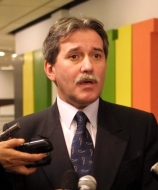
Coordinator in the Serbian team for negotiations on the future status of Kosovo-Metohija Slobodan Samardzic said this evening that the Serbian side was very active in the previous three days of talks on the proposal by UN Special Envoy Marti Ahtisaari, and has presented several amendments to improve the document with the aim of reaching a good solution.
Slobodan Samardzic
Author:
Fonet
Following three days of negotiations between Belgrade and Pristina in Vienna, Samardzic said to the press that the ethnic-Albanian side rejected that without much discussion, while the international mediators did not show major interest in examining larger parts of the recommendations made.
He said that some of the amendments were accepted for later discussion, but no agreement was reached regarding the amendments of essential importance, such as substantial autonomy for Kosovo-Metohija.
The Albanian side rejected everything and held firm to its demand for an independent Kosovo, said Samardzic, and added that in more than 95% of cases they accepted solutions presented by Ahtisaari, which were rejected by Belgrade, commenting that the way is being paved towards independence.
Member of the Serbian negotiating team Dejan Popovic said that the Belgrade delegation presented several amendments to Ahtisaari’s proposal today with the wish to protect the property interests of investors, citizens and legal persons, and to offer a viable solution, in accordance with global standards.
Popovic recalled that Ahtisaari’s proposal generally proclaims that public companies on the territory of Kosovo-Metohija will become the property of Kosovo, whatever its status might be.
We pointed to the fact that these are legal subjects with property ownership and the Electric Power Industry of Serbia (EPS) and all other companies had their property, and the UNMIK, through its measures simply separated property which was in Kosovo-Metohija and made other companies from it, such as the Kosovo Energy Cooperation (KEK), said Popovic.
Belgrade has asked that companies whose interests have been damaged should be given either compensation or their property be returned, such as Telekom Srbija, said Popovic, and added that property owned by central Serbia and Vojvodina based socially owned companies which were privatised cannot be appropriated.
According to Popovic, the Serbian team insisted in the negotiations that members of the Serbian community must be able to take part in the work of bodies which will carry out privatisation.
He said that Belgrade’s demand that deadlines for the process of settling disputes regarding property owned by members of the Serbian community in Kosovo-Metohija, who have not had a chance to start the procedure should be removed.
Coordinator in the Serbian negotiating team Leon Kojen said that the property of firms from central Serbia in Kosovo was considerable in some cases, and recalled that Telekom Srbija paid 120 million deutsch marks in 1997 for a telephony license, which are huge funds and were simply taken.
We did not dispute the fact that privatisation of socially owned companies should be implemented in full, we only opposed that investments of companies outside Kosovo-Metohija are invalidated, explained Kojen and stressed that the basis of the recommendation made by Belgrade was the demand that compensations should be made to former investors from investments in the privatisation process.
He said that some of the amendments were accepted for later discussion, but no agreement was reached regarding the amendments of essential importance, such as substantial autonomy for Kosovo-Metohija.
The Albanian side rejected everything and held firm to its demand for an independent Kosovo, said Samardzic, and added that in more than 95% of cases they accepted solutions presented by Ahtisaari, which were rejected by Belgrade, commenting that the way is being paved towards independence.
Member of the Serbian negotiating team Dejan Popovic said that the Belgrade delegation presented several amendments to Ahtisaari’s proposal today with the wish to protect the property interests of investors, citizens and legal persons, and to offer a viable solution, in accordance with global standards.
Popovic recalled that Ahtisaari’s proposal generally proclaims that public companies on the territory of Kosovo-Metohija will become the property of Kosovo, whatever its status might be.
We pointed to the fact that these are legal subjects with property ownership and the Electric Power Industry of Serbia (EPS) and all other companies had their property, and the UNMIK, through its measures simply separated property which was in Kosovo-Metohija and made other companies from it, such as the Kosovo Energy Cooperation (KEK), said Popovic.
Belgrade has asked that companies whose interests have been damaged should be given either compensation or their property be returned, such as Telekom Srbija, said Popovic, and added that property owned by central Serbia and Vojvodina based socially owned companies which were privatised cannot be appropriated.
According to Popovic, the Serbian team insisted in the negotiations that members of the Serbian community must be able to take part in the work of bodies which will carry out privatisation.
He said that Belgrade’s demand that deadlines for the process of settling disputes regarding property owned by members of the Serbian community in Kosovo-Metohija, who have not had a chance to start the procedure should be removed.
Coordinator in the Serbian negotiating team Leon Kojen said that the property of firms from central Serbia in Kosovo was considerable in some cases, and recalled that Telekom Srbija paid 120 million deutsch marks in 1997 for a telephony license, which are huge funds and were simply taken.
We did not dispute the fact that privatisation of socially owned companies should be implemented in full, we only opposed that investments of companies outside Kosovo-Metohija are invalidated, explained Kojen and stressed that the basis of the recommendation made by Belgrade was the demand that compensations should be made to former investors from investments in the privatisation process.
-
 Belgrade, 28 August 2026
Church broken into, ransacked in Bušince village in Kosovska Kamenica
-
 Belgrade, 27 August 2026
Remembrance of suffering of Serb civilians in village of Klečka
-
 Belgrade, 30 July 2026
Continued illegal demolition of Serb-owned buildings near Lake Gazivode
-
 Belgrade, 29 July 2026
Works in Special Protective Zone of Visoki Dečani Monastery must be halted
-
 Belgrade, 23 July 2026
Priština continues with unilateral, illegal moves
-
 Belgrade/Zurich, 4 June 2026
Exhibition in Zurich on position of Serbs in Kosovo and Metohija
-
 Belgrade/Brussels, 12 May 2026
Belgrade seeking concrete steps towards establishment of Community of Serb Municipalities
-
 Belgrade/Brussels, 11 May 2026
Belgrade-Priština dialogue not dialogue on mutual recognition
-
 Belgrade, 10 April 2026
Serbian health centres closed in villages of Suvo Grlo, Banje