Q:
A:
Serbia will not accept independence for Kosovo-Metohija
Belgrade,
15 February 2007
Advisor to the Serbian Prime Minister Vladeta Jankovic said today that Serbia cannot and will not accept any concessions or compensations in exchange for accepting an independent Kosovo-Metohija, and added that the battle for keeping the province within the borders of Serbia is not lost.
In a statement to the news agency Tanjug, Jankovic stressed that Serbia will not accept an independent Kosovo-Metohija, nor will give consent to the plan proposed by UN Special Envoy Marti Ahtisaari, particularly not in the form in which it was presented.
He said that the Resolution which Serbian parliament adopted last night with a huge majority will act as a convincing message to the international community that Ahtisaari’s plan for Kosovo is unacceptable.
According to Jankovic, this document also presents the grounds for negotiations in Vienna and determines a precise framework within which the state negotiating team will be authorised to conduct further negotiations.
Jankovic said that this is a suitable moment for Serbia to strengthen diplomatic activity and the battle for Kosovo-Metohija is far from being lost.
He explained that naturally now diplomatic activity should be directed, above all, towards the UN, where the draft proposal must be ultimately brought for consideration.
The Security Council, as well as the UN General Assembly, are obliged to protect foundations of international order, that is, the crucial principles of their Charter, including the principle on inviolability of sovereignty and territorial integrity of internationally recognised states, such as Serbia, Jankovic underlined.
That is pointed out in the Resolution adopted by parliament, in which Serbia urges all states, international organisations and other international factors to confront the violation of sovereignty and territorial integrity of the Republic of Serbia and refuse any imposed solution for the future status of Kosovo-Metohija.
Our arguments in favour of a compromising, just and sustainable solution, advocated by Serbia through its proposal on substantial autonomy for the province, should be presented over again, and perhaps with stronger emphasis, to the OSCE, Council of Europe, European parliament, party international organisations, such as the European People's Party, Socialist or Liberal International, and finally to the International Court of Justice in the Hague, Jankovic added.
He pointed out that Serbia's diplomatic, international-legal and political activity must be conducted not only through regular diplomatic ways, but through parallel, semi-official and unofficial channels, through which an influence is made on the political public in other countries.
That is a serious job for the next government, but until the future Foreign Ministry starts operating with full capacities, the present Ministry and advisory teams at the cabinets of the Prime Minister and the President of the Republic must work on it, Jankovic explained.
He said that the Resolution which Serbian parliament adopted last night with a huge majority will act as a convincing message to the international community that Ahtisaari’s plan for Kosovo is unacceptable.
According to Jankovic, this document also presents the grounds for negotiations in Vienna and determines a precise framework within which the state negotiating team will be authorised to conduct further negotiations.
Jankovic said that this is a suitable moment for Serbia to strengthen diplomatic activity and the battle for Kosovo-Metohija is far from being lost.
He explained that naturally now diplomatic activity should be directed, above all, towards the UN, where the draft proposal must be ultimately brought for consideration.
The Security Council, as well as the UN General Assembly, are obliged to protect foundations of international order, that is, the crucial principles of their Charter, including the principle on inviolability of sovereignty and territorial integrity of internationally recognised states, such as Serbia, Jankovic underlined.
That is pointed out in the Resolution adopted by parliament, in which Serbia urges all states, international organisations and other international factors to confront the violation of sovereignty and territorial integrity of the Republic of Serbia and refuse any imposed solution for the future status of Kosovo-Metohija.
Our arguments in favour of a compromising, just and sustainable solution, advocated by Serbia through its proposal on substantial autonomy for the province, should be presented over again, and perhaps with stronger emphasis, to the OSCE, Council of Europe, European parliament, party international organisations, such as the European People's Party, Socialist or Liberal International, and finally to the International Court of Justice in the Hague, Jankovic added.
He pointed out that Serbia's diplomatic, international-legal and political activity must be conducted not only through regular diplomatic ways, but through parallel, semi-official and unofficial channels, through which an influence is made on the political public in other countries.
That is a serious job for the next government, but until the future Foreign Ministry starts operating with full capacities, the present Ministry and advisory teams at the cabinets of the Prime Minister and the President of the Republic must work on it, Jankovic explained.
-
 Belgrade, 28 August 2026
Church broken into, ransacked in Bušince village in Kosovska Kamenica
-
 Belgrade, 27 August 2026
Remembrance of suffering of Serb civilians in village of Klečka
-
 Belgrade, 30 July 2026
Continued illegal demolition of Serb-owned buildings near Lake Gazivode
-
 Belgrade, 29 July 2026
Works in Special Protective Zone of Visoki Dečani Monastery must be halted
-
 Belgrade, 23 July 2026
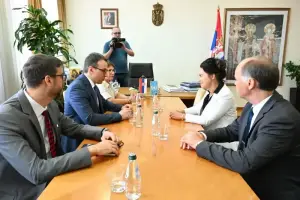
Priština continues with unilateral, illegal moves
-
 Belgrade/Zurich, 4 June 2026
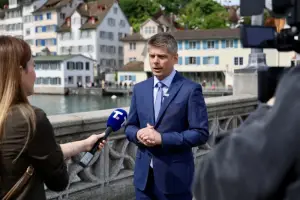
Exhibition in Zurich on position of Serbs in Kosovo and Metohija
-
 Belgrade/Brussels, 12 May 2026
Belgrade seeking concrete steps towards establishment of Community of Serb Municipalities
-
 Belgrade/Brussels, 11 May 2026
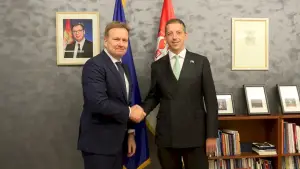
Belgrade-Priština dialogue not dialogue on mutual recognition
-
 Belgrade, 10 April 2026
Serbian health centres closed in villages of Suvo Grlo, Banje