
Q:
A:
World Health Day devoted to health employees
Belgrade,
7 April 2006
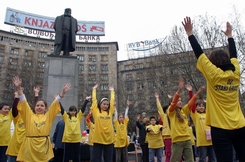
Serbian Minister of Health Tomica Milosavljevic said today that Serbia has surplus and unevenly distributed workers in the health sector, although over 10,000 employees took voluntary leave last October.
Author:
Fonet
At an expert conference held at the City Hall on the occasion of the World Health Day, Milosavljevic said that according to the Action Plan before 2010, the number of doctors should be reduced by 6%, dentists by 35%, administrative and technical staff by 18% and employees in public health centres by 11%.
According to Milosavljevic, more severance payments will be offered to non-medical staff by mid-year, as well as to dentists and dental technicians, because new laws envisage a lesser degree of health services funded from the obligatory health insurance fund.
Milosavljevic said that a job competition for 300 young doctors and 700 nurses will be announced in May and June. As for the distribution of staff, the Minister said it is most balanced in Belgrade and the Nis region, and least in the Srem region.
He stressed that there is no efficient health system without educated, motivated and satisfied health workers. He added that according to a survey, the majority of health employees feel only half-pleased with their work.
He said that the message on this year's World Health Day, which is being marked under the slogan "Together for Health", stresses the importance of workers who take care of the health of people worldwide.
He recalled that the situation in the health sector was unsatisfactory due to bad working conditions, low productivity and efficiency, unbalanced quality of services, low motivation for promoting health and disease prevention, as well as low professional satisfaction.
Unlike that, the year 2006 will be marked by new working standards, a new network of health centres and new organisation in them, he pointed out.
Head of the World Health Organisation (WHO) office in Belgrade Dorit Nitzan said that the emphasis of this year's World Health Day in Serbia is for the first time on health workers themselves, aiming to bring into focus the crisis in health systems worldwide.
Nitzan said that the situation is worrying in the eastern European part of WHO, more precisely in the Czech Republic, Hungary, Lithuania and Poland, where surveys conducted in 2002 showed that between 25% and 50% percent of doctors plans to move west in search of better salaries.
She said that although globalisation opened the door to the whole world, Southeast European countries should still make efforts to stop the brain drain. In the entire region, including Serbia, the most needed medical profiles are specialists for palliative care and health promotion, as well as nutritionists, she noted. It is therefore necessary to invest in their education and training, she concluded.
According to Milosavljevic, more severance payments will be offered to non-medical staff by mid-year, as well as to dentists and dental technicians, because new laws envisage a lesser degree of health services funded from the obligatory health insurance fund.
Milosavljevic said that a job competition for 300 young doctors and 700 nurses will be announced in May and June. As for the distribution of staff, the Minister said it is most balanced in Belgrade and the Nis region, and least in the Srem region.
He stressed that there is no efficient health system without educated, motivated and satisfied health workers. He added that according to a survey, the majority of health employees feel only half-pleased with their work.
He said that the message on this year's World Health Day, which is being marked under the slogan "Together for Health", stresses the importance of workers who take care of the health of people worldwide.
He recalled that the situation in the health sector was unsatisfactory due to bad working conditions, low productivity and efficiency, unbalanced quality of services, low motivation for promoting health and disease prevention, as well as low professional satisfaction.
Unlike that, the year 2006 will be marked by new working standards, a new network of health centres and new organisation in them, he pointed out.
Head of the World Health Organisation (WHO) office in Belgrade Dorit Nitzan said that the emphasis of this year's World Health Day in Serbia is for the first time on health workers themselves, aiming to bring into focus the crisis in health systems worldwide.
Nitzan said that the situation is worrying in the eastern European part of WHO, more precisely in the Czech Republic, Hungary, Lithuania and Poland, where surveys conducted in 2002 showed that between 25% and 50% percent of doctors plans to move west in search of better salaries.
She said that although globalisation opened the door to the whole world, Southeast European countries should still make efforts to stop the brain drain. In the entire region, including Serbia, the most needed medical profiles are specialists for palliative care and health promotion, as well as nutritionists, she noted. It is therefore necessary to invest in their education and training, she concluded.
-
 Belgrade, 10 July 2026
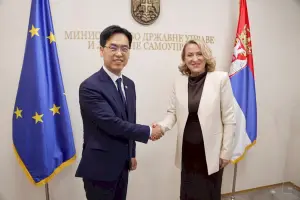
Advancing cooperation with Republic of Korea in digital governance
-
 Belgrade/Rome, 10 July 2026
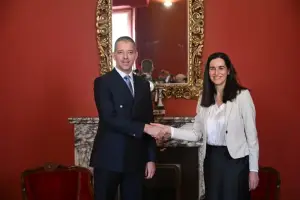
Continued strengthening of overall cooperation between Serbia, Hungary
-
 Belgrade/Brussels, 9 July 2026
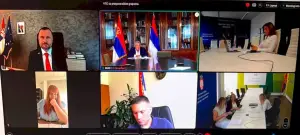
Continuing activities to meet European Commission’s recommendations
-
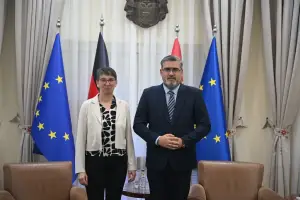 Belgrade, 9 July 2026
German development support important pillar for Serbia’s reforms, European path
-
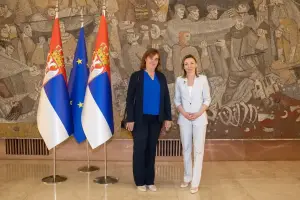 Belgrade, 8 July 2026
Continued cooperation with GIZ on improving position of women in Serbia
-
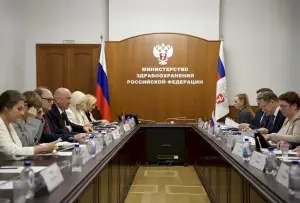 Belgrade/Moscow, 8 July 2026
Cooperation between Serbia, Russia in field of modern oncology therapies
-
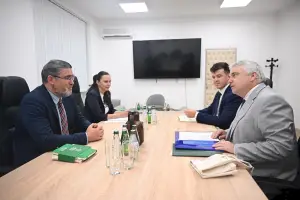 Belgrade, 8 July 2026
Ireland’s support for reform processes in Serbia on path to EU
-
 Belgrade, 8 July 2026
Continued strengthening of cooperation with Belgium in European integration process
-
 Belgrade, 7 July 2026
Possibilities for improving cooperation with Russia in several areas
-
 Belgrade, 7 July 2026
UN support for building equal opportunities society continues