
Q:
A:
Working group for financing gas infrastructure holds first meeting
Belgrade,
22 March 2006
Serbian Minister of Energy and Mining Radomir Naumov opened today in Belgrade the first joint meeting of the working group for financing gas infrastructure and regulatory bodies in southeast Europe. The meeting was held under the auspices of the European Commission's Energy Directorate.
In a statement to the Tanjug news agency, Naumov said that by participating in the work of the working group, representatives of national regulatory bodies gave a new dimension to its work. He added that the working group is becoming an institution in itself when it comes to the development of the gas economy in southeast Europe.
Naumov recalled that by signing the contract on forming the Energy Union late last year, not only Serbia but the entire region made a huge step forward regarding the EU integration process.
According to Naumov, formation of the market, development of distribution networks, linking together gas systems in the region and global safety are the areas that are offering possibilities for individual as well as regional economic development. They also encourage a better attitude towards the environment on a global level and promote social and political regional stability.
He stressed that a stable energy supply is an exceptionally important national and pan-European issue. According to analyses, in the period between 2010 and 2030, dependence on energy in EU countries will go from the current 50% up to 70%, he added.
Naumov explained that oil and gas, as energy sources, are a precondition for global energy stability of EU member countries and that all analyses show that the production of electricity will be directly dependent on available amounts of natural gas.
He said that one of the bases of stable supply of gas and oil to the EU is the construction of gas and oil pipelines that will enable safe transport of energy sources to the energy market.
Serbia has defined its priorities regarding gas infrastructure development, said the minister. He pointed out that in order to have a safe and stable supply, works on the Banatski Dvor underground gas storage facilities must be continued, and work must begin on the gas pipeline from Nis to the Bulgarian border.
Naumov recalled that by signing the contract on forming the Energy Union late last year, not only Serbia but the entire region made a huge step forward regarding the EU integration process.
According to Naumov, formation of the market, development of distribution networks, linking together gas systems in the region and global safety are the areas that are offering possibilities for individual as well as regional economic development. They also encourage a better attitude towards the environment on a global level and promote social and political regional stability.
He stressed that a stable energy supply is an exceptionally important national and pan-European issue. According to analyses, in the period between 2010 and 2030, dependence on energy in EU countries will go from the current 50% up to 70%, he added.
Naumov explained that oil and gas, as energy sources, are a precondition for global energy stability of EU member countries and that all analyses show that the production of electricity will be directly dependent on available amounts of natural gas.
He said that one of the bases of stable supply of gas and oil to the EU is the construction of gas and oil pipelines that will enable safe transport of energy sources to the energy market.
Serbia has defined its priorities regarding gas infrastructure development, said the minister. He pointed out that in order to have a safe and stable supply, works on the Banatski Dvor underground gas storage facilities must be continued, and work must begin on the gas pipeline from Nis to the Bulgarian border.
-
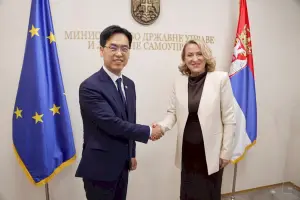 Belgrade, 10 July 2026
Advancing cooperation with Republic of Korea in digital governance
-
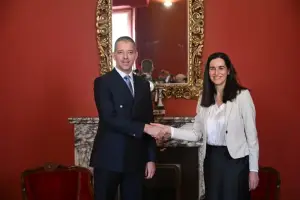 Belgrade/Rome, 10 July 2026
Continued strengthening of overall cooperation between Serbia, Hungary
-
 Belgrade/Brussels, 9 July 2026
Continuing activities to meet European Commission’s recommendations
-
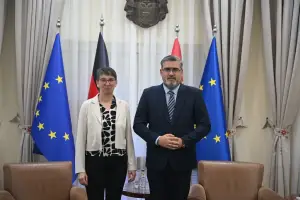 Belgrade, 9 July 2026
German development support important pillar for Serbia’s reforms, European path
-
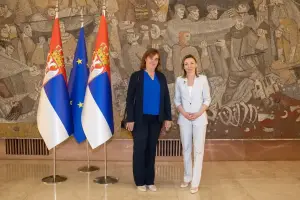 Belgrade, 8 July 2026
Continued cooperation with GIZ on improving position of women in Serbia
-
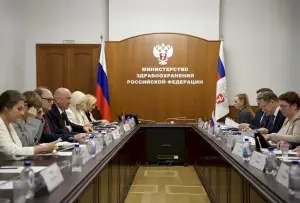 Belgrade/Moscow, 8 July 2026
Cooperation between Serbia, Russia in field of modern oncology therapies
-
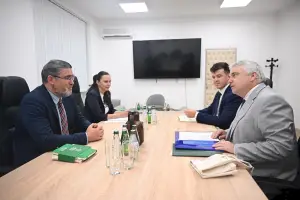 Belgrade, 8 July 2026
Ireland’s support for reform processes in Serbia on path to EU
-
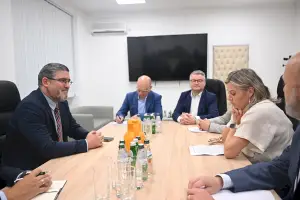 Belgrade, 8 July 2026
Continued strengthening of cooperation with Belgium in European integration process
-
 Belgrade, 7 July 2026
Possibilities for improving cooperation with Russia in several areas
-
 Belgrade, 7 July 2026
UN support for building equal opportunities society continues