
Q:
A:
National action plan for environmental protection and children’s health in preparation
Belgrade,
14 March 2006
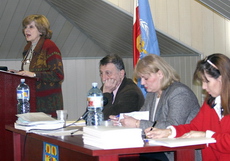
Serbian Assistant Minister of Health Snezana Simic said today that Serbia-Montenegro has begun preparations to adopt and implement a national action plan for environmental protection and children’s health next year.
Author:
Fonet
The workshop concerning the preparation for drafting and implementation of a national action plan for environmental protection and children’s health is being held under the auspices of the World Health Organisation (WHO). At the workshop Simic recalled that Serbia-Montenegro committed to adopting the national action plan by signing a declaration at the Ministerial Conference on environmental protection and children’s health in 2004 in Budapest.
Head of the Directorate for Environmental Protection at the Serbian Ministry of Science and Environmental Protection Miroslav Spasojevic said that throughout Europe, and not just in countries in transition, it has been observed that diseases among children are increasing, especially diseases of the respiratory organs, often a consequence of living in an environment which exposes them to risk.
He said that these diseases among children are caused mostly by polluted air in industrial centres and cities with heavy traffic, and an additional harmful factor in Serbia-Montenegro is the wide-spread use of leaded fuel.
WHO Regional Adviser for Environment and Health Coordination and Partnerships Lucianne Licari said that it is necessary to investigate in detail the effect of risk factors in the environment on health at a national and international level, and take measures to minimise them.
The project of drafting and implementation of a national action plan for environmental protection and children’s health is being organised by the WHO Regional Office for Europe and the WHO office to Serbia-Montenegro, in cooperation with the Serbian Ministry of Health and the Serbian Ministry of Science and Environmental Protection.
The Children’s Environment and Health Action Plan for Europe (CEHAPE) was adopted as a result of implementation of decisions taken at the Fourth Ministerial Conference on Environment and Health themed “The future for our children”, held in Budapest in 2004. Serbia-Montenegro is one of the signatory countries of this declaration.
Head of the Directorate for Environmental Protection at the Serbian Ministry of Science and Environmental Protection Miroslav Spasojevic said that throughout Europe, and not just in countries in transition, it has been observed that diseases among children are increasing, especially diseases of the respiratory organs, often a consequence of living in an environment which exposes them to risk.
He said that these diseases among children are caused mostly by polluted air in industrial centres and cities with heavy traffic, and an additional harmful factor in Serbia-Montenegro is the wide-spread use of leaded fuel.
WHO Regional Adviser for Environment and Health Coordination and Partnerships Lucianne Licari said that it is necessary to investigate in detail the effect of risk factors in the environment on health at a national and international level, and take measures to minimise them.
The project of drafting and implementation of a national action plan for environmental protection and children’s health is being organised by the WHO Regional Office for Europe and the WHO office to Serbia-Montenegro, in cooperation with the Serbian Ministry of Health and the Serbian Ministry of Science and Environmental Protection.
The Children’s Environment and Health Action Plan for Europe (CEHAPE) was adopted as a result of implementation of decisions taken at the Fourth Ministerial Conference on Environment and Health themed “The future for our children”, held in Budapest in 2004. Serbia-Montenegro is one of the signatory countries of this declaration.
-
 Belgrade, 10 July 2026
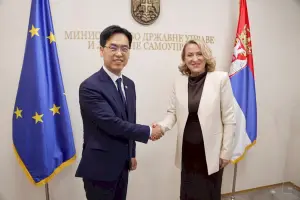
Advancing cooperation with Republic of Korea in digital governance
-
 Belgrade/Rome, 10 July 2026
Continued strengthening of overall cooperation between Serbia, Hungary
-
 Belgrade/Brussels, 9 July 2026
Continuing activities to meet European Commission’s recommendations
-
 Belgrade, 9 July 2026
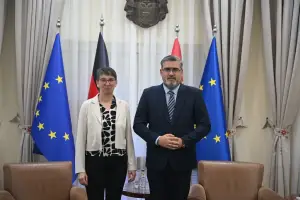
German development support important pillar for Serbia’s reforms, European path
-
 Belgrade, 8 July 2026
Continued cooperation with GIZ on improving position of women in Serbia
-
 Belgrade/Moscow, 8 July 2026
Cooperation between Serbia, Russia in field of modern oncology therapies
-
 Belgrade, 8 July 2026
Ireland’s support for reform processes in Serbia on path to EU
-
 Belgrade, 8 July 2026
Continued strengthening of cooperation with Belgium in European integration process
-
 Belgrade, 7 July 2026
Possibilities for improving cooperation with Russia in several areas
-
 Belgrade, 7 July 2026
UN support for building equal opportunities society continues