
Q:
A:
Towards courts' responsibility without violation of their independence
Belgrade,
14 February 2006
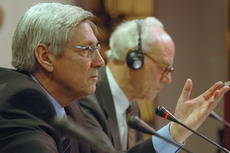
Serbian Minister of Justice Zoran Stojkovic said today at the round table discussion on the draft strategy and action plan for reforms in the judiciary in Serbia that without beneficial courts there is no well-ordered state. He added that within the scope of the strategy it is necessary to develop principles on courts' responsibilities in a way that does not violate their independence.
Author:
FoNet
Stojkovic said that if all branches of authority have clear responsibilities, then the judiciary, which assesses their work, must also have its responsibility, and reiterated that it is necessary to find a proper link which would guarantee responsibilities of courts without infringing on their independence.
He explained that the strategy envisages a five-year probationary period for all judges, after which expert bodies within courts will assess the judges' performance and offer them a permanent term in office or end it accordingly.
Commenting on a proposition that a new constitution should envisage reelection of judges, Stojkovic said that it is not a bad solution, but whether there will be a reelection depends solely on the constitution itself. If a constitutional law envisages it, judges will not be against it, provided that reelection is conducted according to the proper professional criteria, and not political, stressed Stojkovic.
He added that in the last two years both the Serbian parliament and the Serbian government have gained democratic legitimacy, while the situation in the judiciary remained static.
Speaking about the European Council's recommendation that judges be appointed by the High Judiciary Council rather than parliament, Stojkovic said that the strategy offers a similar solution.
Director of the Twinning Project and former State Secretary of Brandenburg Rainer Faupel pointed out that the draft strategy for reforms in the judiciary is a crucial step forward, adding that speedy reform of the Serbian judiciary is necessary.
Commenting on the draft strategy, Faupel said that the Serbian public is very keen to regain trust in the judiciary.
According to Faupel, the strategy envisages that the High Judiciary Council plays a major role in the judiciary, but added that it is also necessary that the Ministry of Justice has some influence in these matters.
He added that the Ministry should take part in the drafting of the budget for the judiciary and that parliamentary committees should have a more important role in appointing judges.
Serbian Supreme Court President Vida Petrovic-Skero welcomed the ongoing reforms and added that an efficient reform process is not possible without appropriate bodies.
She asked that the Ministry set aside funds for establishing a supervisory committee to monitor the implementation of the strategy, explaining that in some aspects of the judiciary, the implementation of the reform process is failing to meet the set deadlines.
She also proposed that they form a centre for informing citizens on the jurisdiction of the judiciary and other government bodies and state institutions.
He explained that the strategy envisages a five-year probationary period for all judges, after which expert bodies within courts will assess the judges' performance and offer them a permanent term in office or end it accordingly.
Commenting on a proposition that a new constitution should envisage reelection of judges, Stojkovic said that it is not a bad solution, but whether there will be a reelection depends solely on the constitution itself. If a constitutional law envisages it, judges will not be against it, provided that reelection is conducted according to the proper professional criteria, and not political, stressed Stojkovic.
He added that in the last two years both the Serbian parliament and the Serbian government have gained democratic legitimacy, while the situation in the judiciary remained static.
Speaking about the European Council's recommendation that judges be appointed by the High Judiciary Council rather than parliament, Stojkovic said that the strategy offers a similar solution.
Director of the Twinning Project and former State Secretary of Brandenburg Rainer Faupel pointed out that the draft strategy for reforms in the judiciary is a crucial step forward, adding that speedy reform of the Serbian judiciary is necessary.
Commenting on the draft strategy, Faupel said that the Serbian public is very keen to regain trust in the judiciary.
According to Faupel, the strategy envisages that the High Judiciary Council plays a major role in the judiciary, but added that it is also necessary that the Ministry of Justice has some influence in these matters.
He added that the Ministry should take part in the drafting of the budget for the judiciary and that parliamentary committees should have a more important role in appointing judges.
Serbian Supreme Court President Vida Petrovic-Skero welcomed the ongoing reforms and added that an efficient reform process is not possible without appropriate bodies.
She asked that the Ministry set aside funds for establishing a supervisory committee to monitor the implementation of the strategy, explaining that in some aspects of the judiciary, the implementation of the reform process is failing to meet the set deadlines.
She also proposed that they form a centre for informing citizens on the jurisdiction of the judiciary and other government bodies and state institutions.
-
 Belgrade, 10 July 2026
Advancing cooperation with Republic of Korea in digital governance
-
 Belgrade/Rome, 10 July 2026
Continued strengthening of overall cooperation between Serbia, Hungary
-
 Belgrade/Brussels, 9 July 2026
Continuing activities to meet European Commission’s recommendations
-
 Belgrade, 9 July 2026
German development support important pillar for Serbia’s reforms, European path
-
 Belgrade, 8 July 2026
Continued cooperation with GIZ on improving position of women in Serbia
-
 Belgrade/Moscow, 8 July 2026
Cooperation between Serbia, Russia in field of modern oncology therapies
-
 Belgrade, 8 July 2026
Ireland’s support for reform processes in Serbia on path to EU
-
 Belgrade, 8 July 2026
Continued strengthening of cooperation with Belgium in European integration process
-
 Belgrade, 7 July 2026
Possibilities for improving cooperation with Russia in several areas
-
 Belgrade, 7 July 2026
UN support for building equal opportunities society continues