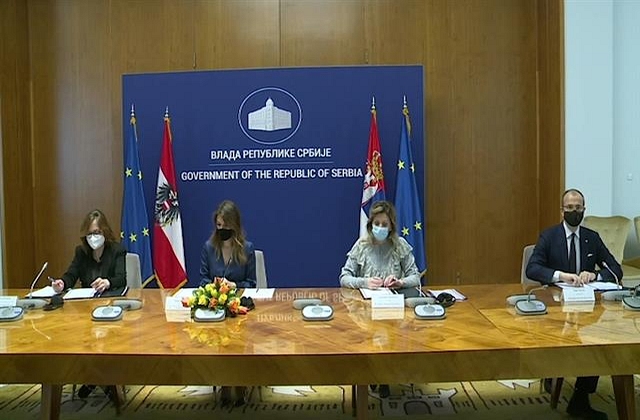
Minister of Trade, Telecommunications and Tourism Tatjana Matic, Minister of European Integration Jadranka Joksimovic and Director of the European Bank for Reconstruction and Development (EBRD) Zsuzsanna Hargitai signed today the Agreement on the donation of the European Bank for Reconstruction and Development for the project "Broadband Internet in Rural Areas in Serbia".

Q:
A:
EBRD supports introduction of broadband Internet in Serbian villages
Belgrade,
27 January 2021
The agreement on the realisation of the project which will introduce broadband internet in rural areas was signed in the Palace of Serbia in the presence of the Ambassador of Austria Nikolaus Lutterotti and Head of the EU Delegation to Serbia Sam Fabrizi.
The donation is intended for the preparation of project technical documentation, and will cover 90,000 households in 600 settlements throughout Serbia.
After the signing of the agreement, Matic said that this would ensure that two thirds of households, which now do not have broadband Internet, be covered by it.
She pointed out that this act confirms the determination of the Serbian government that all citizens who have been without the Internet so far and in some way excluded, will get access to the Internet, in accordance with the times in which we live.
According to her, this especially refers to school students and she noted that the signing of the agreement on the great holiday of Saint Sava has a kind of symbolism.
Matic wished students a happy Saint Sava's Day, which is a patron saint day of all schools in Serbia, and said that the introduction of broadband Internet would raise teaching in Serbia to a higher level.
Joksimovic said that she cannot think of a better way to celebrate Saint Sava's Day than by networking and connecting Serbia.
"Just as Sava did in his time, when he was educating and enlightening Serbia, today we connect and network Serbia in a different way," Joksimovic said.
She emphasised that this is a project that Serbia has nominated for the EU Economic and Social Plan this summer, and noted that the EU and the EBRD assist the project with €1.7 million for the preparation of project technical documentation, and that the entire project is worth €76 million. The project entails the introduction of broadband Internet for 90,000 inhabitants in 600 rural settlements, including 600 schools.
Hargitai said that this year Serbia celebrates 20th anniversary of membership in the EBRD, which invested €6.5 billion in Serbia, of which €1.7 billion over the past three years.
According to her, the countries bilateral donors for the Western Balkans will invest €1.8 billion for the preparation of the project technical documentation.
Fabrizi said that the coronavirus pandemic has shown the importance of the availability of the Internet for everyone, especially in the education sector, but at the same time security must be considered.
Over the past 15 years, the EU has invested €100 million in the education sector in Serbia, Fabrizi added.
Lutterotti said that Austria is chairing a group of bilateral donors for the Western Balkans, which have strong ties with the region, especially Serbia, and stressed that this is one more way to support Serbia's European integration.
-
 Author: Tanjug
-
 Belgrade, 5 June 2026
Cooperation with North Macedonia in field of innovation
-
 Belgrade/Baku, 5 June 2026
Serbia takes over hosting of World Environment Day 2027
-
 Belgrade/Saint Petersburg, 4 June 2026
Readiness to improve cooperation with Russia in areas of mutual interest
-
 Belgrade/Saint Petersburg, 4 June 2026
Strengthening Serbia’s position in contemporary digital environment
-
 Belgrade, 4 June 2026
Serbia, US building partnership aimed at future, shared prosperity
-
 Belgrade, 3 June 2026
Contract on Gabon’s participation in Expo 2027 signed
-
 Belgrade/Helsinki, 3 June 2026
Serbia stands for peace, cooperation, respect for international law
-
 Belgrade/Helsinki, 2 June 2026
Great potential for strengthening economic ties with Finland
-
 Belgrade/Helsinki, 2 June 2026
Finland confirms strong support for Serbia’s European future
-
 Belgrade, 1 June 2026
Coordination of services to reduce risks from extreme weather events