
Q:
A:
Creating conditions for lasting stability of banking sector in Serbia
Belgrade,
22 October 2012
In order to preserve the stability of the financial system, the Serbian government today adopted the Bill on the takeover of assets and liabilities of troubled banks and sent it to Serbian parliament for an immediate adoption.
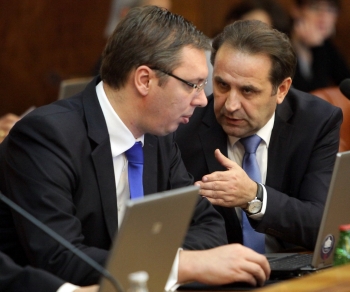
The act provides for the transfer of assets and liabilities of a troubled bank to another financially viable and stable bank, which is one of the most effective options to stabilise the banking sector and consolidate the domestic market.
This will provide a solution to the problem of Nova Agrobanka (which was inadequately formed for specific purposes in May of this year, on several grounds inconsistent with the Banking Law, where the state owns 100%), whose current business model is unsustainable on the long term.
This document allows the transmission of high-quality assets and liabilities of Nova Agrobanka the postal savings bank Postanska Stedionica without compromising its stability. Postanska Stedionica is the most stable bank in the market, with a wide business network and firm structure of deposits.
This law will enable the Serbian parliament to act quickly and efficiently in case of any risk to bank stability. With this proposed systemic solution to the most serious situation since the outbreak of the crisis in 2008 the government will create conditions for permanent stabilisation of the banking sector in Serbia.
With the support of the National Bank of Serbia (NBS), the government is determined to eliminate all elements of instability in the banking system and to resolve each individual case in line with the principles of total financial stability, with minimal costs to tax payers and by implementing lasting and sustainable solutions.
Expert teams of the Ministry of Finance and Economy, the NBS and the Deposit Insurance Agency are all engaged in the drafting of this document, and they are working closely with the IMF team.
At today’s session the government adopted a Conclusion recommending that the electricity distribution company compensates all citizens and businesses for the increased VAT they were charged for the September electricity bill by decreasing their October bill for the same amount.
This will provide a solution to the problem of Nova Agrobanka (which was inadequately formed for specific purposes in May of this year, on several grounds inconsistent with the Banking Law, where the state owns 100%), whose current business model is unsustainable on the long term.
This document allows the transmission of high-quality assets and liabilities of Nova Agrobanka the postal savings bank Postanska Stedionica without compromising its stability. Postanska Stedionica is the most stable bank in the market, with a wide business network and firm structure of deposits.
This law will enable the Serbian parliament to act quickly and efficiently in case of any risk to bank stability. With this proposed systemic solution to the most serious situation since the outbreak of the crisis in 2008 the government will create conditions for permanent stabilisation of the banking sector in Serbia.
With the support of the National Bank of Serbia (NBS), the government is determined to eliminate all elements of instability in the banking system and to resolve each individual case in line with the principles of total financial stability, with minimal costs to tax payers and by implementing lasting and sustainable solutions.
Expert teams of the Ministry of Finance and Economy, the NBS and the Deposit Insurance Agency are all engaged in the drafting of this document, and they are working closely with the IMF team.
At today’s session the government adopted a Conclusion recommending that the electricity distribution company compensates all citizens and businesses for the increased VAT they were charged for the September electricity bill by decreasing their October bill for the same amount.
-
 Belgrade, 15 October 2026
Next year declared Year of Saint Despot Stefan Lazarević
-
 Belgrade, 12 October 2026
5th “Wine Vision by Open Balkan” international fair ends
-
 Belgrade, 8 October 2026
Government adopts multiple documents across various sectors
-
 Belgrade, 5 October 2026
“Wine Vision by Open Balkan” to be held from 10 to 12 October
-
 Belgrade, 1 October 2026
Conclusion adopted on remediation plan for Deliblato Sands area
-
 Belgrade, 28 September 2026
Continuity of reforms in EU accession process
-
 Belgrade, 24 September 2026
Government adopts decrees, decisions of importance for migration, sport
-
 Belgrade, 17 September 2026
Linking state support measures for housing for families with children
-
 Belgrade, 14 September 2026
Official request for overflight clearance for Serbian government aircraft submitted on 11 September
-
 Belgrade, 11 September 2026
Eligibility expanded for rural house purchase grant scheme