Q:
A:
Introduction of information system in primary health care
Belgrade,
15 April 2011
The Ministry of Health stated that as part of the project "Delivery of Improved Local Services – DILS” a conference has been held today in Belgrade called “Introduction of information system in primary health care in the Republic of Serbia.".
The keynote address was held by Minister of Health Zoran Stankovic, specialist for health care sector of the World Bank Office in Belgrade Ana Holt and director of the Serbian Institute for Health Insurance Aleksandar Vuksanovic.
In accordance with the strategic objective of the Ministry of Health and the implementation of the document "E-Health2015" (Programme of work, development and organisation of the integrated information health system), it is actively being worked on further development of the information system for primary health care.
As part of DILS project, financed by a loan from the World Bank through realisation of the components for informatisation, €1.2 million has been set aside for the software and €5.1 million for the hardware for all 158 community health centres Serbia, institutes for student’s health care in Belgrade, Novi Sad and Nis and the Belgrade Institute for Gerontology.
All centres of primary health care will be equipped with 209 servers, 5,275 computers, 2,650 printers, 1,312 bar-code readers and 3,250 card readers, and the computer network installed will link 1800 remote health stations with their central buildings.
The process of procurement of software and hardware as part of the DILS project is being implemented through two separate procedures with the control mechanisms of the World Bank that are applied in the tender procurement procedures.
The procurement of hardware has been entrusted to INTEC Consortium, Orion Telecom, Logo, BSS & MMC Mikros and the delivery deadline is the end of this year.
The community health centres have been awarded funding worth €1.2 million for independent enforcement of acquisition of certified software, which is in progress.
For now, eight softwares were certified, and the certification of another 17 is underway of which several are used in primary care institutions.
Most of the certified softwares are on the way to get "EUROREC SEAL", a European certificate for health information systems. The certified software will enable the implementation of electronic medical records in all community health centres.
Staff training and introduction of software to health centres and institutions of primary care of students and the elderly will have been completed by April 2012.
In accordance with the strategic objective of the Ministry of Health and the implementation of the document "E-Health2015" (Programme of work, development and organisation of the integrated information health system), it is actively being worked on further development of the information system for primary health care.
As part of DILS project, financed by a loan from the World Bank through realisation of the components for informatisation, €1.2 million has been set aside for the software and €5.1 million for the hardware for all 158 community health centres Serbia, institutes for student’s health care in Belgrade, Novi Sad and Nis and the Belgrade Institute for Gerontology.
All centres of primary health care will be equipped with 209 servers, 5,275 computers, 2,650 printers, 1,312 bar-code readers and 3,250 card readers, and the computer network installed will link 1800 remote health stations with their central buildings.
The process of procurement of software and hardware as part of the DILS project is being implemented through two separate procedures with the control mechanisms of the World Bank that are applied in the tender procurement procedures.
The procurement of hardware has been entrusted to INTEC Consortium, Orion Telecom, Logo, BSS & MMC Mikros and the delivery deadline is the end of this year.
The community health centres have been awarded funding worth €1.2 million for independent enforcement of acquisition of certified software, which is in progress.
For now, eight softwares were certified, and the certification of another 17 is underway of which several are used in primary care institutions.
Most of the certified softwares are on the way to get "EUROREC SEAL", a European certificate for health information systems. The certified software will enable the implementation of electronic medical records in all community health centres.
Staff training and introduction of software to health centres and institutions of primary care of students and the elderly will have been completed by April 2012.
-
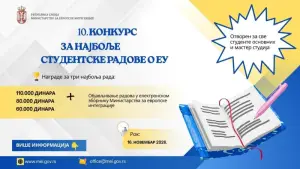 Belgrade, 15 October 2026
10th competition for best student papers on EU announced
-
 Belgrade/Moscow, 13 October 2026
Enhancing cooperation with Russia in areas of strategic importance
-
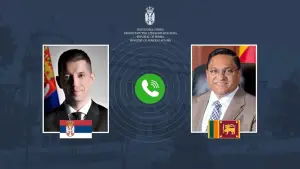 Belgrade, 12 October 2026
Significant potential for further deepening bilateral relations with Sri Lanka
-
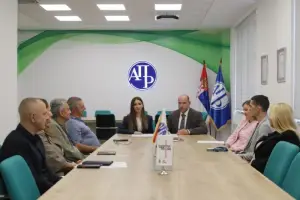 Belgrade, 9 October 2026
SBRA enables electronic submission of applications to Media Register
-
 Belgrade, 3 October 2026
Children’s Week to focus on combating violence against children
-
 Belgrade, 1 October 2026
Serbia joins partnership for development, application of artificial intelligence
-
 Kruševac, 28 September 2026
Training for foreign armed forces personnel at Nuclear, Biological and Chemical Defence Centre in Kruševac
-
 Belgrade, 22 September 2026
Cooperation with Justice Ministry of key importance for UNODC ROSEE
-
 Belgrade, 21 September 2026
Stronger cooperation with UNICEF on improving care for children
-
 Belgrade, 16 September 2026
Serbia committed to further strengthening relations with Republic of Korea