
Q:
A:
The national European integration programme progresses further
Belgrade,
22 January 2010
The Serbian government’s EU Integration Office stated today that the Serbian government adopted the report on the implementation of the national European integration programme for the October – December 2009 period.
According to the report, which was prepared by the EU Integration Office, 77% of the requirements of the national programme were fulfilled in the third quarter of 2009.
From 115 regulations that were expected to be passed according to the programme, 88 were passed. The government adopted 13 of 25 planned bills, thus completing 52% of its plan. Parliament passed 22 laws thereby meeting 170% of its obligations (22/13), which was the result of adopting bills that were supposed to be adopted earlier according to plans.
Regarding sub-laws, the government adopted 17 of the planned 26 or 65%, while the ministries adopted 32 or 56% codes of procedure out of the planned 57.
Concerning the government’s obligations to adopt bills and sub-laws, statistics show a success of 57%, as 62 of the planned 108 regulations were passed.
The most successful institution, according to the European Commission standards for adopting laws and implementing measures, are the ministries of interior, finance, economy, environment and science, which fulfilled more than 80% of their obligations.
The Ministry of Labour and Social Policy, the Republic Telecommunications Agency and the Serbian Statistical Office also met more than 50% of their integration obligations.
In its entirety, 79% of the national programme was completed from July 2008 to December 2009, with 273 out of planned 344 regulations passed. According to plans 145 laws were to be adopted and 109 or 75% were passed. From the planned 199 sub-laws, 164 or 82% were adopted.
A large percentage of the obligations from the national programme were met in the third and fourth quarters and the annual success rate increased as well.
This effective work by the ministries was also helped by the work done by parliament. Parliament adopted 109 of 113 or 96% of the bills presented before it.
Bearing in mind the changes to European legislation during 2009, the government adopted an annual revision of the national European integration programme on December 24, 2009, which will present guidelines for the further harmonisation of domestic legislation with EU law.
From 115 regulations that were expected to be passed according to the programme, 88 were passed. The government adopted 13 of 25 planned bills, thus completing 52% of its plan. Parliament passed 22 laws thereby meeting 170% of its obligations (22/13), which was the result of adopting bills that were supposed to be adopted earlier according to plans.
Regarding sub-laws, the government adopted 17 of the planned 26 or 65%, while the ministries adopted 32 or 56% codes of procedure out of the planned 57.
Concerning the government’s obligations to adopt bills and sub-laws, statistics show a success of 57%, as 62 of the planned 108 regulations were passed.
The most successful institution, according to the European Commission standards for adopting laws and implementing measures, are the ministries of interior, finance, economy, environment and science, which fulfilled more than 80% of their obligations.
The Ministry of Labour and Social Policy, the Republic Telecommunications Agency and the Serbian Statistical Office also met more than 50% of their integration obligations.
In its entirety, 79% of the national programme was completed from July 2008 to December 2009, with 273 out of planned 344 regulations passed. According to plans 145 laws were to be adopted and 109 or 75% were passed. From the planned 199 sub-laws, 164 or 82% were adopted.
A large percentage of the obligations from the national programme were met in the third and fourth quarters and the annual success rate increased as well.
This effective work by the ministries was also helped by the work done by parliament. Parliament adopted 109 of 113 or 96% of the bills presented before it.
Bearing in mind the changes to European legislation during 2009, the government adopted an annual revision of the national European integration programme on December 24, 2009, which will present guidelines for the further harmonisation of domestic legislation with EU law.
-
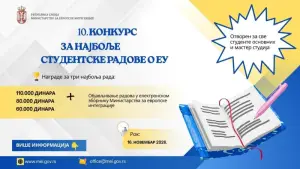 Belgrade, 15 October 2026
10th competition for best student papers on EU announced
-
 Belgrade/Moscow, 13 October 2026
Enhancing cooperation with Russia in areas of strategic importance
-
 Belgrade, 12 October 2026
Significant potential for further deepening bilateral relations with Sri Lanka
-
 Belgrade, 9 October 2026
SBRA enables electronic submission of applications to Media Register
-
 Belgrade, 3 October 2026
Children’s Week to focus on combating violence against children
-
 Belgrade, 1 October 2026
Serbia joins partnership for development, application of artificial intelligence
-
 Kruševac, 28 September 2026
Training for foreign armed forces personnel at Nuclear, Biological and Chemical Defence Centre in Kruševac
-
 Belgrade, 22 September 2026
Cooperation with Justice Ministry of key importance for UNODC ROSEE
-
 Belgrade, 21 September 2026
Stronger cooperation with UNICEF on improving care for children
-
 Belgrade, 16 September 2026
Serbia committed to further strengthening relations with Republic of Korea