
Q:
A:
Ljajic hands over ratification instruments of European Social Charter
Belgrade,
14 September 2009
On behalf of the Serbian government Minister of Labour and Social Policy Rasim Ljajic today in Strasbourg handed over the ratification instruments of the Revised European Social Charter, by which act Serbia fulfilled almost all their formal and legal obligations from the monitoring report of the Ministerial Committee and the Council of Europe Parliamentary Assembly (PACE).
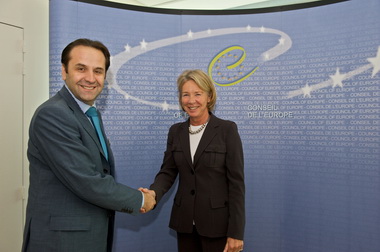
Rasim Ljajic, left, and Maud de Boer-Buquicchio
The Ministry says in a statement that the only remaining obligation is to ratify the European Charter for Cross-Border Cooperation, adding that on behalf of the Council of Europe the ratification instruments were received by the Council of Europe acting Secretary General Maud de Boer-Buquicchio.
The Revised Social Charter is the basic Council of Europe document on workers’ and social rights and as such it is also the most important document after the European Convention for the Protection of Human Rights and Fundamental Freedoms.
When this document is enforced, a month after the ratification instruments are handed over, Serbia will show its readiness to fully implement all standards in economic, social and working rights, which is of crucial importance during the global crisis.
At the meeting with Ljajic, Boer-Buquicchio voiced her interest in Serbia’s cooperation with the Hague tribunal.
Ljajic informed her that Serbia has fully cooperated over all aspects, including the delivery of required documents and making available its archives and witnesses, adding that the only open issue is the extradition of the two remaining indictees.
He told Boer-Buquicchio about the activities currently underway to locate and apprehend Ratko Mladic and Goran Hadzic.
The Minister also talked with Council of Europe Director General for Democracy and Political Affairs Jean-Louis Laurens and Jane Dinsdale, Director of Political and Legal Affairs of the PACE Secretariat and expressed his concern over the fact that the Albanian authorities have not allowed PACE Rapporteur Dick Marty to carry out a field investigation into allegations of human organ trafficking in Kosovo and Albania.
PACE representatives stressed that Marty will probably repeat his demand to visit the locations in question and carry out his investigation. Minister Ljajic said that Serbia will continue to insist at all international forums that this matter be thoroughly investigated so that the truth is established and the demands of justice are met, these being basic requirements for the regional process of reconciliation through confronting the past.
The Revised Social Charter is the basic Council of Europe document on workers’ and social rights and as such it is also the most important document after the European Convention for the Protection of Human Rights and Fundamental Freedoms.
When this document is enforced, a month after the ratification instruments are handed over, Serbia will show its readiness to fully implement all standards in economic, social and working rights, which is of crucial importance during the global crisis.
At the meeting with Ljajic, Boer-Buquicchio voiced her interest in Serbia’s cooperation with the Hague tribunal.
Ljajic informed her that Serbia has fully cooperated over all aspects, including the delivery of required documents and making available its archives and witnesses, adding that the only open issue is the extradition of the two remaining indictees.
He told Boer-Buquicchio about the activities currently underway to locate and apprehend Ratko Mladic and Goran Hadzic.
The Minister also talked with Council of Europe Director General for Democracy and Political Affairs Jean-Louis Laurens and Jane Dinsdale, Director of Political and Legal Affairs of the PACE Secretariat and expressed his concern over the fact that the Albanian authorities have not allowed PACE Rapporteur Dick Marty to carry out a field investigation into allegations of human organ trafficking in Kosovo and Albania.
PACE representatives stressed that Marty will probably repeat his demand to visit the locations in question and carry out his investigation. Minister Ljajic said that Serbia will continue to insist at all international forums that this matter be thoroughly investigated so that the truth is established and the demands of justice are met, these being basic requirements for the regional process of reconciliation through confronting the past.
-
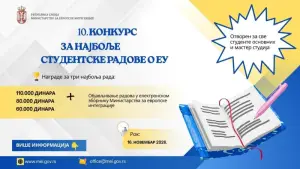 Belgrade, 15 October 2026
10th competition for best student papers on EU announced
-
 Belgrade/Moscow, 13 October 2026
Enhancing cooperation with Russia in areas of strategic importance
-
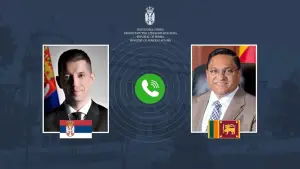 Belgrade, 12 October 2026
Significant potential for further deepening bilateral relations with Sri Lanka
-
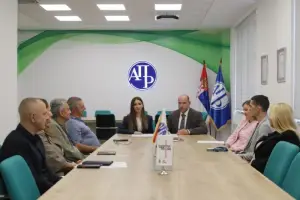 Belgrade, 9 October 2026
SBRA enables electronic submission of applications to Media Register
-
 Belgrade, 3 October 2026
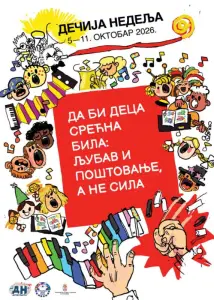
Children’s Week to focus on combating violence against children
-
 Belgrade, 1 October 2026
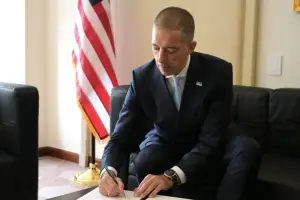
Serbia joins partnership for development, application of artificial intelligence
-
 Kruševac, 28 September 2026
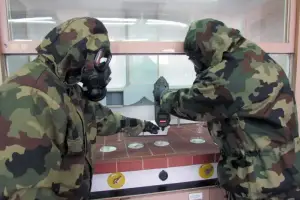
Training for foreign armed forces personnel at Nuclear, Biological and Chemical Defence Centre in Kruševac
-
 Belgrade, 22 September 2026
Cooperation with Justice Ministry of key importance for UNODC ROSEE
-
 Belgrade, 21 September 2026
Stronger cooperation with UNICEF on improving care for children
-
 Belgrade, 16 September 2026
Serbia committed to further strengthening relations with Republic of Korea