
Q:
A:
Report on national EU integration programme adopted
Belgrade,
24 April 2009
The Serbian government’s EU Integration Office stated today that the government has adopted the Report on the implementation of Serbia’s National European Integration Programme for the January – March 2009 period.
According to the statement the Report was drafted by the EU Integration Office and results show that 53% of the National Programme has been implemented so far, 36 of the legal regulations from the planned 68 having been adopted.
The Serbian Parliament has passed 8 (22%) of the 36 laws envisaged by the National Programme, the government has adopted 24 (86%) of the envisaged 28 sub-laws and ministries have adopted all (100%) planned sub-laws.
The government has adopted 23 of the planned 36 bills and parliament has passed eight (35%) of the bills put before it. The ratio of planned and adopted laws related to the jurisdiction of the government shows that 64% of the legislative work has been finished, including some activities planned for a later period. The ministries of the interior, agriculture and environment have fulfilled their obligations.
Ministries which were particularly urgently required to adopt certain regulations have fulfilled obligations from the earlier period. The Justice Ministry proposed eight laws which were passed by parliament. Serbia was required to pass these laws in order to fulfill legal conditions put forth in the road map for EU visa liberalisation.
The government has passed 10 decrees and strategies concerning the jurisdiction of the Ministry of Health and regulations pertaining to the Ministry of Labour and Social Policy.
An analysis of the efficiency of the government and parliament based on the two reports presented up until now shows that overall major progress has been made in the implementation of the National Programme for EU integration. In the first third of this year 53% of the National Programme was implemented, whilst in July – December 2008 this figure stood at 29%.
The Serbian Parliament has the same level of efficiency as before, with 35% of European integration related bill having been passed, while the government’s level of efficiency dropped. The government adopted two thirds of the envisaged laws, earlier its rate was 77%.
During the period from July, 2008 to March, 2009, 47% of the National Programme was implemented. Parliament passed 28% of the bills that were submitted to it, the government adopted 84% of the sub-laws and ministries 68% of the ministerial level regulations.
It can be expected that the economic crisis will affect the planned legislative activities considering the fact that budget revision implies that ministries and the government will have to make functional adjustments to the new conditions in which lower funds will be available.
The National European Integration Programme is a precise plan to meet criteria for EU membership, ranging from the political to the economic to the most detailed EU standards in trade, agriculture, environmental protection and infrastructure.
According to the National Programme all state institutions are to make progress in a clear and measurable manner. The Report on the implementation of the National Programme which presents the legislative activities of the government and parliament for the January – March 2009 period can be viewed at the website of the EU Integration Office.
The Serbian Parliament has passed 8 (22%) of the 36 laws envisaged by the National Programme, the government has adopted 24 (86%) of the envisaged 28 sub-laws and ministries have adopted all (100%) planned sub-laws.
The government has adopted 23 of the planned 36 bills and parliament has passed eight (35%) of the bills put before it. The ratio of planned and adopted laws related to the jurisdiction of the government shows that 64% of the legislative work has been finished, including some activities planned for a later period. The ministries of the interior, agriculture and environment have fulfilled their obligations.
Ministries which were particularly urgently required to adopt certain regulations have fulfilled obligations from the earlier period. The Justice Ministry proposed eight laws which were passed by parliament. Serbia was required to pass these laws in order to fulfill legal conditions put forth in the road map for EU visa liberalisation.
The government has passed 10 decrees and strategies concerning the jurisdiction of the Ministry of Health and regulations pertaining to the Ministry of Labour and Social Policy.
An analysis of the efficiency of the government and parliament based on the two reports presented up until now shows that overall major progress has been made in the implementation of the National Programme for EU integration. In the first third of this year 53% of the National Programme was implemented, whilst in July – December 2008 this figure stood at 29%.
The Serbian Parliament has the same level of efficiency as before, with 35% of European integration related bill having been passed, while the government’s level of efficiency dropped. The government adopted two thirds of the envisaged laws, earlier its rate was 77%.
During the period from July, 2008 to March, 2009, 47% of the National Programme was implemented. Parliament passed 28% of the bills that were submitted to it, the government adopted 84% of the sub-laws and ministries 68% of the ministerial level regulations.
It can be expected that the economic crisis will affect the planned legislative activities considering the fact that budget revision implies that ministries and the government will have to make functional adjustments to the new conditions in which lower funds will be available.
The National European Integration Programme is a precise plan to meet criteria for EU membership, ranging from the political to the economic to the most detailed EU standards in trade, agriculture, environmental protection and infrastructure.
According to the National Programme all state institutions are to make progress in a clear and measurable manner. The Report on the implementation of the National Programme which presents the legislative activities of the government and parliament for the January – March 2009 period can be viewed at the website of the EU Integration Office.
-
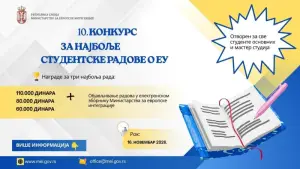 Belgrade, 15 October 2026
10th competition for best student papers on EU announced
-
 Belgrade/Moscow, 13 October 2026
Enhancing cooperation with Russia in areas of strategic importance
-
 Belgrade, 12 October 2026
Significant potential for further deepening bilateral relations with Sri Lanka
-
 Belgrade, 9 October 2026
SBRA enables electronic submission of applications to Media Register
-
 Belgrade, 3 October 2026
Children’s Week to focus on combating violence against children
-
 Belgrade, 1 October 2026
Serbia joins partnership for development, application of artificial intelligence
-
 Kruševac, 28 September 2026
Training for foreign armed forces personnel at Nuclear, Biological and Chemical Defence Centre in Kruševac
-
 Belgrade, 22 September 2026
Cooperation with Justice Ministry of key importance for UNODC ROSEE
-
 Belgrade, 21 September 2026
Stronger cooperation with UNICEF on improving care for children
-
 Belgrade, 16 September 2026
Serbia committed to further strengthening relations with Republic of Korea