Q:
A:
Communiqué on preparing EU law in Serbian
Belgrade,
21 April 2009
The Serbian government adopted the communiqué on preparing EU law in Serbian which sets up the translation of legal documents as a coordinated process.
The EU Integration Office states that EU legal achievements include the body of joint rights and obligations for all EU members, which can be divided into three categories.
The first category is primary legislation, comprising founding treaties signed by member states and treaties with third states.
The second category is secondary legislation, comprising decisions, directives, regulations etc by organs of European communities, while the third represents court practice of the European Court of Justice, the translation of which is not a formal precondition for accession.
Due to the volume of regulations published in the EU Official Gazette, the translation of legal achievements is the greatest translation enterprise for the majority of new members, says the statement.
By adopting this communiqué, the government appointed the EU Integration Office as the main coordinating body, while the Secretariat for Legislation, relevant ministries and other public administration organs will perform legal and technical part of the work.
A special working group will be tasked with verification of the translated texts, which will comprise representatives from all institutions taking part in the process.
The EU law in Serbian will be translated in line with the priorities from the National EU Integration Plan, based on priorities from the Stabilisation and Association Agreement (SAA) and recommendations of European partnership.
Harmonisation with EU law, for which the translation of legal documents is an indispensable precondition, is an obligation stemming from the SAA, as well as a precondition for further EU accession.
Legal harmonisation is carried out by non-EU members as well. Norway, for instance, is way ahead a number of EU members in this respect because the implementation of EU law enables the free movement of goods, people, services and capital within the European economic space.
The communiqué on the preparation of EU law in Serbia is available on the EU Integration Office web site www.seio.gov.rs, adds the statement.
The first category is primary legislation, comprising founding treaties signed by member states and treaties with third states.
The second category is secondary legislation, comprising decisions, directives, regulations etc by organs of European communities, while the third represents court practice of the European Court of Justice, the translation of which is not a formal precondition for accession.
Due to the volume of regulations published in the EU Official Gazette, the translation of legal achievements is the greatest translation enterprise for the majority of new members, says the statement.
By adopting this communiqué, the government appointed the EU Integration Office as the main coordinating body, while the Secretariat for Legislation, relevant ministries and other public administration organs will perform legal and technical part of the work.
A special working group will be tasked with verification of the translated texts, which will comprise representatives from all institutions taking part in the process.
The EU law in Serbian will be translated in line with the priorities from the National EU Integration Plan, based on priorities from the Stabilisation and Association Agreement (SAA) and recommendations of European partnership.
Harmonisation with EU law, for which the translation of legal documents is an indispensable precondition, is an obligation stemming from the SAA, as well as a precondition for further EU accession.
Legal harmonisation is carried out by non-EU members as well. Norway, for instance, is way ahead a number of EU members in this respect because the implementation of EU law enables the free movement of goods, people, services and capital within the European economic space.
The communiqué on the preparation of EU law in Serbia is available on the EU Integration Office web site www.seio.gov.rs, adds the statement.
-
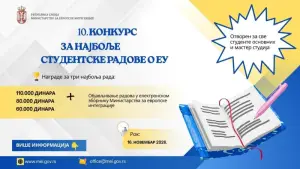 Belgrade, 15 October 2026
10th competition for best student papers on EU announced
-
 Belgrade/Moscow, 13 October 2026
Enhancing cooperation with Russia in areas of strategic importance
-
 Belgrade, 12 October 2026
Significant potential for further deepening bilateral relations with Sri Lanka
-
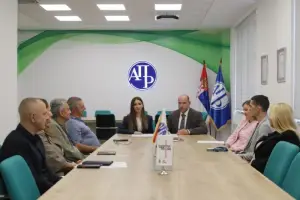 Belgrade, 9 October 2026
SBRA enables electronic submission of applications to Media Register
-
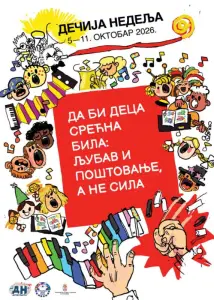 Belgrade, 3 October 2026
Children’s Week to focus on combating violence against children
-
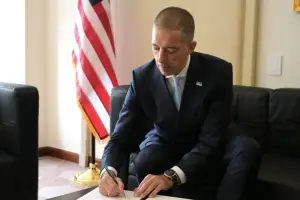 Belgrade, 1 October 2026
Serbia joins partnership for development, application of artificial intelligence
-
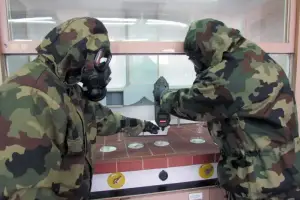 Kruševac, 28 September 2026
Training for foreign armed forces personnel at Nuclear, Biological and Chemical Defence Centre in Kruševac
-
 Belgrade, 22 September 2026
Cooperation with Justice Ministry of key importance for UNODC ROSEE
-
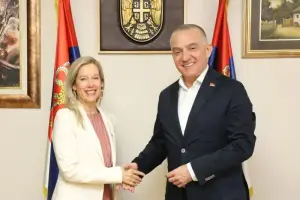 Belgrade, 21 September 2026
Stronger cooperation with UNICEF on improving care for children
-
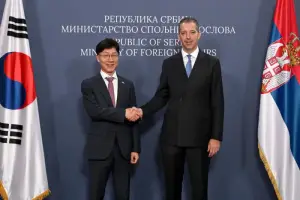 Belgrade, 16 September 2026
Serbia committed to further strengthening relations with Republic of Korea