
Q:
A:
European Commission Delegation opens new office in Belgrade
Belgrade,
12 February 2009
Serbian Prime Minister Mirko Cvetkovic, Deputy Prime Minister for EU integration Bozidar Djelic and Serbian President Boris Tadic attended today the opening ceremony of the new office of the European Commission Delegation to Serbia.
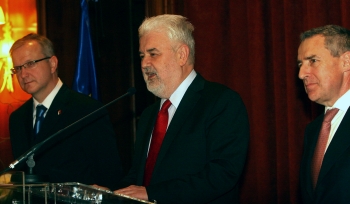
From left: Olli Rehn, Mirko Cvetkovic and Josep Lloveras
EU Enlargement Commissioner Olli Rehn, who inaugurated the new office, said that the opening of a new office is one more confirmation of the EU’s support for Serbia’s EU integration.
He said that the European Commission and Serbia have been partners for a long time and are jointly working for Serbia’s better future, praising President Tadic’s contribution to this process.
Rehn said that the number of employees in the European Commission Delegation to Serbia will be increased from 20 to 100, making it the third largest in the world, which also shows that Brussels is committed to a European future for Serbia.
Tadic said that it gives him great pleasure to attend the ceremony, adding that Serbia’s European future is also a strategic goal for the EU, not just for Belgrade. He also said that the high number of European Commission Delegation employees in Serbia shows that Europe is making efforts to facilitate Serbia’s European future.
He said that a few months ago Belgrade started its mission in Brussels, which will soon comprise more than 100 people, adding that it is further proof of Serbia’s EU aspirations.
Serbia is ready to implement reforms and adopt new laws, in accordance with the EU. Serbia, as a democratic and free country, aims to acquire EU candidate status, said Tadic.
The ceremony was attended by Head of the European Commission Delegation to Serbia Josep Lloveras, Director of the EU Integration Office Milica Delevic and the French and British Ambassadors.
At the end of the ceremony, the European Commissioner presented a memorial plaque, with an inscription “The Delegation of the European Commission to Serbia”, whose headquarters will be in Vladimira Popovica 40, New Belgrade.
Speaking at a reception held for the occasion, Rehn said that Serbia’s European future depends on its readiness to fulfil the conditions that all countries of the region are expected to meet in order to become EU members.
These conditions are well known; full cooperation between Belgrade and the Hague tribunal, fight against corruption and crime and the implementation of judicial reforms in the country, said Rehn.
He stressed that enormous efforts are being made to remove visa restrictions for Serbian citizens, adding that he is convinced that this will happen by the end of the year.
He recalled that an expert commission visited Belgrade recently to assess the progress made in this respect, adding that several new expert delegations will visit Serbia in the coming period to assess the progress made regarding the fulfilment of EU standards.
Cvetkovic expressed gratitude to the European Commission for its support, reiterating that the continuation of EU integration is one of the Serbian government’s main priorities.
We are firmly convinced that full EU membership is in the best interest of Serbia and the Serbian people. It is for this reason that the Serbian government is committed to certain priorities, said the Prime Minister.
He said that these priorities include unblocking the transitional trade agreement as soon as possible, bringing into force the Stabilisation and Association Agreement and the acquisition of candidate status.
We expect that Serbia will be included on to the Schengen “white list” and visa restrictions will be removed as soon as possible. The Serbian government is working hard to meet the legislative and other conditions, which is confirmed by the fact that the government decided to unilaterally implement the transitional trade agreement beginning from January 31, said the Prime Minister.
He said that the decision proves Serbia’s firm commitment to a European future, adding that Serbian authorities will continue to implement reforms in order to harmonize Serbia’s legal order and economic system with EU standards.
Serbian Deputy Prime Minister Bozidar Djelic said at the reception that along with regular macroeconomic assistance Serbia will also get significant additional help from the EU’s IPA funds as support to the budget.
Djelic said that he will soon visit Brussels in order to determine the exact amount of these funds, adding that the assistance will not affect projects which are currently being planned within the IPA framework.
We will consider both 2009 and 2010 so that on one hand we will have direct support for the budget beginning this year and on the other hand we will implement projects in accordance with IPA funds in the years ahead, said Djelic.
Djelic, who talked with Rehn earlier today, specified that the additional funds fit into the macroeconomic assistance from the EU, to the amount of €1 billion, for the Serbian budget from 2009 to 2012.
He said that the European Commission and Serbia have been partners for a long time and are jointly working for Serbia’s better future, praising President Tadic’s contribution to this process.
Rehn said that the number of employees in the European Commission Delegation to Serbia will be increased from 20 to 100, making it the third largest in the world, which also shows that Brussels is committed to a European future for Serbia.
Tadic said that it gives him great pleasure to attend the ceremony, adding that Serbia’s European future is also a strategic goal for the EU, not just for Belgrade. He also said that the high number of European Commission Delegation employees in Serbia shows that Europe is making efforts to facilitate Serbia’s European future.
He said that a few months ago Belgrade started its mission in Brussels, which will soon comprise more than 100 people, adding that it is further proof of Serbia’s EU aspirations.
Serbia is ready to implement reforms and adopt new laws, in accordance with the EU. Serbia, as a democratic and free country, aims to acquire EU candidate status, said Tadic.
The ceremony was attended by Head of the European Commission Delegation to Serbia Josep Lloveras, Director of the EU Integration Office Milica Delevic and the French and British Ambassadors.
At the end of the ceremony, the European Commissioner presented a memorial plaque, with an inscription “The Delegation of the European Commission to Serbia”, whose headquarters will be in Vladimira Popovica 40, New Belgrade.
Speaking at a reception held for the occasion, Rehn said that Serbia’s European future depends on its readiness to fulfil the conditions that all countries of the region are expected to meet in order to become EU members.
These conditions are well known; full cooperation between Belgrade and the Hague tribunal, fight against corruption and crime and the implementation of judicial reforms in the country, said Rehn.
He stressed that enormous efforts are being made to remove visa restrictions for Serbian citizens, adding that he is convinced that this will happen by the end of the year.
He recalled that an expert commission visited Belgrade recently to assess the progress made in this respect, adding that several new expert delegations will visit Serbia in the coming period to assess the progress made regarding the fulfilment of EU standards.
Cvetkovic expressed gratitude to the European Commission for its support, reiterating that the continuation of EU integration is one of the Serbian government’s main priorities.
We are firmly convinced that full EU membership is in the best interest of Serbia and the Serbian people. It is for this reason that the Serbian government is committed to certain priorities, said the Prime Minister.
He said that these priorities include unblocking the transitional trade agreement as soon as possible, bringing into force the Stabilisation and Association Agreement and the acquisition of candidate status.
We expect that Serbia will be included on to the Schengen “white list” and visa restrictions will be removed as soon as possible. The Serbian government is working hard to meet the legislative and other conditions, which is confirmed by the fact that the government decided to unilaterally implement the transitional trade agreement beginning from January 31, said the Prime Minister.
He said that the decision proves Serbia’s firm commitment to a European future, adding that Serbian authorities will continue to implement reforms in order to harmonize Serbia’s legal order and economic system with EU standards.
Serbian Deputy Prime Minister Bozidar Djelic said at the reception that along with regular macroeconomic assistance Serbia will also get significant additional help from the EU’s IPA funds as support to the budget.
Djelic said that he will soon visit Brussels in order to determine the exact amount of these funds, adding that the assistance will not affect projects which are currently being planned within the IPA framework.
We will consider both 2009 and 2010 so that on one hand we will have direct support for the budget beginning this year and on the other hand we will implement projects in accordance with IPA funds in the years ahead, said Djelic.
Djelic, who talked with Rehn earlier today, specified that the additional funds fit into the macroeconomic assistance from the EU, to the amount of €1 billion, for the Serbian budget from 2009 to 2012.
-
 Belgrade, 8 April 2026
Serbia remains firmly committed to strengthening cooperation in region
-
 Belgrade, 7 April 2026
Serbia’s infrastructure, economic development through partnership with China
-
 Belgrade, 6 April 2026
Anniversary of 1941 bombing of Belgrade marked
-
 Belgrade, 2 April 2026
Serbian Army remains committed to UNIFIL tasks
-
 Belgrade, 2 April 2026
Switzerland’s financial support for reform processes in Serbia
-
 Belgrade, 30 March 2026
Cooperation with Russia, Belarus in areas of mutual interest
-
 Belgrade, 27 March 2026
World Bank support for implementation of priority energy projects
-
 Belgrade, 27 March 2026
Continued cooperation with Germany on utility infrastructure projects
-
 Belgrade, 26 March 2026
Activities of state institutions for opening clusters 2 and 5 examined
-
 Belgrade, 26 March 2026
Exchange of experiences with Slovakia in field of ICT