
Q:
A:
Memorandum on promoting rail traffic in Serbia signed
Belgrade/Berlin,
16 December 2008
Deputy Prime Minister and Minister of Economy and Regional Development Mladjan Dinkic signed a memorandum on promoting rail traffic in Serbia in Berlin today, with representatives of German railways Deutsche Bahn AG.
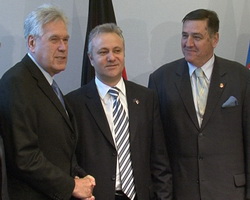
Michael Glos, Mladjan Dinkic and Milutin Mrkonjic
The document was signed by Dinkic, Minister of Infrastructure Milutin Mrkonjic and Otto Wiesheu, member of the Deutsche Bahn AG Board of Management for Economic and Political Affairs.
The document paves the way for necessary reform of the Serbian railways and modernisation of rail Corridor 10.
Dinkic explained that Deutsche Bahn AG was chosen as a partner because it is profitable and their experience can be useful in modernising Serbian railways.
He recalled that the German railway made a €2 billion profit and the Serbian railway is at a loss and therefore should follow the German example.
According to him the drafting of a master plan for logistics modernisation and Corridor 10 is of top importance, as it will be the basis of EU financial support for Serbia.
The Minister recalled that the Serbian and German railways have cooperated before, adding that 90% of the Serbian railway equipment has come from Germany.
The average speed of Serbian trains is 40 km per hour and should be at least 120 km per hour in order to attract people, explained Dinkic.
He said that Serbia will also be able to use EU pre-accession funds in this respect, adding that the process of railway modernisation will last from five to seven years.
Dinkic stressed that in times of the global financial crisis it is important that Serbia invests in infrastructure, particularly in the modernisation of both motorways and railways.
As for cooperation with Germany, he stressed that German companies are interested in building and modernising car-part factories in Serbia.
Mrkonjic said that this memorandum is a continuation of the traditional cooperation between Serbia and Germany and voiced hope that German and Serbian experts will work together on the new central station for Belgrade, to be modelled on that of Berlin.
German Minister of Economics and Technology Michael Glos commended the memorandum, saying that this document is of major importance in these hard economic times.
Glos stressed that the state must have an important role in infrastructure projects.
Having signed the memorandum, the Serbian and German delegations visited the central railway station in Berlin, which is one of the most modern in Europe.
The document paves the way for necessary reform of the Serbian railways and modernisation of rail Corridor 10.
Dinkic explained that Deutsche Bahn AG was chosen as a partner because it is profitable and their experience can be useful in modernising Serbian railways.
He recalled that the German railway made a €2 billion profit and the Serbian railway is at a loss and therefore should follow the German example.
According to him the drafting of a master plan for logistics modernisation and Corridor 10 is of top importance, as it will be the basis of EU financial support for Serbia.
The Minister recalled that the Serbian and German railways have cooperated before, adding that 90% of the Serbian railway equipment has come from Germany.
The average speed of Serbian trains is 40 km per hour and should be at least 120 km per hour in order to attract people, explained Dinkic.
He said that Serbia will also be able to use EU pre-accession funds in this respect, adding that the process of railway modernisation will last from five to seven years.
Dinkic stressed that in times of the global financial crisis it is important that Serbia invests in infrastructure, particularly in the modernisation of both motorways and railways.
As for cooperation with Germany, he stressed that German companies are interested in building and modernising car-part factories in Serbia.
Mrkonjic said that this memorandum is a continuation of the traditional cooperation between Serbia and Germany and voiced hope that German and Serbian experts will work together on the new central station for Belgrade, to be modelled on that of Berlin.
German Minister of Economics and Technology Michael Glos commended the memorandum, saying that this document is of major importance in these hard economic times.
Glos stressed that the state must have an important role in infrastructure projects.
Having signed the memorandum, the Serbian and German delegations visited the central railway station in Berlin, which is one of the most modern in Europe.
-
 Belgrade, 8 April 2026
Serbia remains firmly committed to strengthening cooperation in region
-
 Belgrade, 7 April 2026
Serbia’s infrastructure, economic development through partnership with China
-
 Belgrade, 6 April 2026
Anniversary of 1941 bombing of Belgrade marked
-
 Belgrade, 2 April 2026
Serbian Army remains committed to UNIFIL tasks
-
 Belgrade, 2 April 2026
Switzerland’s financial support for reform processes in Serbia
-
 Belgrade, 30 March 2026
Cooperation with Russia, Belarus in areas of mutual interest
-
 Belgrade, 27 March 2026
World Bank support for implementation of priority energy projects
-
 Belgrade, 27 March 2026
Continued cooperation with Germany on utility infrastructure projects
-
 Belgrade, 26 March 2026
Activities of state institutions for opening clusters 2 and 5 examined
-
 Belgrade, 26 March 2026
Exchange of experiences with Slovakia in field of ICT