
Q:
A:
Zastava to start paying off debts to employees
Kragujevac,
15 December 2008
Deputy Prime Minister and Minister of Economy and Regional Development Mladjan Dinkic announced today in Kragujevac that Zastava will start paying off its debts to former and current employees from tomorrow.
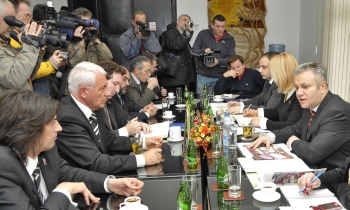
At a press conference following a meeting with Kragujevac authorities, Dinkic said that the payout, in line with a social programme for employees who voluntarily left the factory, will also start this week.
The Minister specified that the first RSD 200 million will be paid out to 15,000 employees, for the period 1997–2001.
According to Dinkic, funds will be paid out by the National Employment Service to employees’ current accounts and the remaining portion will be paid once a year, over the next three years.
The Minister said that RSD 450 million from the budget will be paid out to 1,269 Zastava Automobili workers who voluntarily agreed to leave the company.
He also said he talked with Fiat Vice President Alfredo Altavilla, who assured him that Fiat is fully committed to cooperate with Zastava.
According to Dinkic, Altavilla announced that this will be affirmed in a letter, in which, apart from guarantees for the realisation of the project, Fiat will also define the product range and output volume in Fiat plants throughout the world, including Kragujevac.
He noted that the factory will gradually be modernised until the production of a completely new car model begins. In the meantime the Fiat Punto will still be produced, he added.
Dinkic also said that the contract between truck companies Fiat Iveco and Zastava Kamioni will not be signed yet, because the Italian manufacturer has not made a definitive decision about cooperation, although the memorandum has already been signed.
Today in Kragujevac the Minister presented the draft law on regional development, which the Serbian parliament is to adopt next year.
Dinkic stressed that this is an extremely important law, which envisages that Serbia should be re-organised into seven Euroregions, modelled according to EU countries.
He said that the basic aim is to ensure sustainable growth by encouraging economic development, reducing regional disparities, developing competition and establishing knowledge based economy.
According to the draft law, a national agency for regional development with seven regional agencies will be formed. A national council for regional development will also be established. The public debate on the draft law will last until March 5, 2009.
Dinkic said that the draft law has been composed in accordance with European standards for regional policy, adding that practice has shown that the best results are achieved when the decision making process on development priorities is transferred from the regional to the local levels.
Apart from Minister Dinkic, the delegation visiting Kragujevac today included Minister for the National Development Plan Verica Kalanovic, State Secretary for Regional Development Dejan Jovanovic, Assistant Minister Misela Nikolic and director of the Agency for the Development of SMEs and Entrepreneurship Goran Dzafic.
After a meeting with the city management at which they discussed priority investments in the city in 2009 and the realisation of projects related with Fiat, the delegation visited the works on the motorway through Kragujevac, the industrial zone, the southern ring road and the Petrovac main road.
The Minister specified that the first RSD 200 million will be paid out to 15,000 employees, for the period 1997–2001.
According to Dinkic, funds will be paid out by the National Employment Service to employees’ current accounts and the remaining portion will be paid once a year, over the next three years.
The Minister said that RSD 450 million from the budget will be paid out to 1,269 Zastava Automobili workers who voluntarily agreed to leave the company.
He also said he talked with Fiat Vice President Alfredo Altavilla, who assured him that Fiat is fully committed to cooperate with Zastava.
According to Dinkic, Altavilla announced that this will be affirmed in a letter, in which, apart from guarantees for the realisation of the project, Fiat will also define the product range and output volume in Fiat plants throughout the world, including Kragujevac.
He noted that the factory will gradually be modernised until the production of a completely new car model begins. In the meantime the Fiat Punto will still be produced, he added.
Dinkic also said that the contract between truck companies Fiat Iveco and Zastava Kamioni will not be signed yet, because the Italian manufacturer has not made a definitive decision about cooperation, although the memorandum has already been signed.
Today in Kragujevac the Minister presented the draft law on regional development, which the Serbian parliament is to adopt next year.
Dinkic stressed that this is an extremely important law, which envisages that Serbia should be re-organised into seven Euroregions, modelled according to EU countries.
He said that the basic aim is to ensure sustainable growth by encouraging economic development, reducing regional disparities, developing competition and establishing knowledge based economy.
According to the draft law, a national agency for regional development with seven regional agencies will be formed. A national council for regional development will also be established. The public debate on the draft law will last until March 5, 2009.
Dinkic said that the draft law has been composed in accordance with European standards for regional policy, adding that practice has shown that the best results are achieved when the decision making process on development priorities is transferred from the regional to the local levels.
Apart from Minister Dinkic, the delegation visiting Kragujevac today included Minister for the National Development Plan Verica Kalanovic, State Secretary for Regional Development Dejan Jovanovic, Assistant Minister Misela Nikolic and director of the Agency for the Development of SMEs and Entrepreneurship Goran Dzafic.
After a meeting with the city management at which they discussed priority investments in the city in 2009 and the realisation of projects related with Fiat, the delegation visited the works on the motorway through Kragujevac, the industrial zone, the southern ring road and the Petrovac main road.
-
 Belgrade, 8 April 2026
Serbia remains firmly committed to strengthening cooperation in region
-
 Belgrade, 7 April 2026
Serbia’s infrastructure, economic development through partnership with China
-
 Belgrade, 6 April 2026
Anniversary of 1941 bombing of Belgrade marked
-
 Belgrade, 2 April 2026
Serbian Army remains committed to UNIFIL tasks
-
 Belgrade, 2 April 2026
Switzerland’s financial support for reform processes in Serbia
-
 Belgrade, 30 March 2026
Cooperation with Russia, Belarus in areas of mutual interest
-
 Belgrade, 27 March 2026
World Bank support for implementation of priority energy projects
-
 Belgrade, 27 March 2026
Continued cooperation with Germany on utility infrastructure projects
-
 Belgrade, 26 March 2026
Activities of state institutions for opening clusters 2 and 5 examined
-
 Belgrade, 26 March 2026
Exchange of experiences with Slovakia in field of ICT