
Q:
A:
Public debate on draft strategy for improving Roma position ends
Belgrade,
28 November 2008
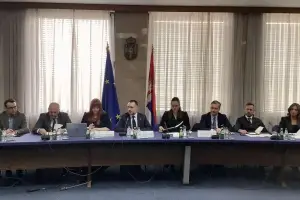
Serbian Deputy Prime Minister for EU integration and head of the council for improving the position of the Roma and the implementation of the recommendations of the Decade of Roma Inclusion Bozidar Djelic attended this evening the last in a series of public discussions on the draft strategy for improving the position of the Roma.
Speaking at the occasion Djelic said that Serbia’s proper EU integration requires a Serbian society with a well integrated Roma population adding that this is not only in the interest of the Roma but the entire nation.
He said that Serbia is presiding over the Decade of the Roma Inclusion this year and nearly RSD 1.1 billion has been set aside from the budget for education, health services and housing for the Roma, a far bigger sum than funds allocated earlier.
We have drafted not only a strategy but an action plan as well which will be implemented with funds from the 2009 budget with projections for 2010, 2011 and 2012, said Djelic.
He explained that RSD 340 million has been set aside for education projects, RSD 220 million for employment, RSD 180 million for internally displaced persons of Roma origin and RSD 50 million for housing.
He said that one of the important issues related to Serbia’s inclusion in the Schengen “white list” is the assessment of efforts being made to improve the position of the Roma because poverty leads to the risk of illegal immigration.
Helping disadvantaged groups such as the Roma is certainly our human and ethical responsibility but one aspect of these efforts is also a proper understanding of our joint interest, said Djelic.
Minister for Human and Minority Rights Svetozar Ciplic said at the occasion that the preparation of the draft law on national minority councils is in the last phase, and this evening and during the weekend expert ministerial teams will work with presidents of the councils to harmonise the text of the law by consensus.
It is only in this way that we can be certain that the draft law will be approved by all those it concerns and who have been waiting for this law since 2002, said Ciplic.
According to the new law the national councils will take over jurisdictions of minority self-government defined by the Serbian Constitution, said the Minister.
He said that the new law will make it possible for national minorities to secure their constitutionally guaranteed rights by working through national councils without waiting for help from the state and the administration.
Some national minorities, because of their population size and specific needs, have expressed the wish to have indirect elections for councils, while others have shown an interest in the electoral system, therefore the law is flexible and offers both options, he said.
He said that Serbia is presiding over the Decade of the Roma Inclusion this year and nearly RSD 1.1 billion has been set aside from the budget for education, health services and housing for the Roma, a far bigger sum than funds allocated earlier.
We have drafted not only a strategy but an action plan as well which will be implemented with funds from the 2009 budget with projections for 2010, 2011 and 2012, said Djelic.
He explained that RSD 340 million has been set aside for education projects, RSD 220 million for employment, RSD 180 million for internally displaced persons of Roma origin and RSD 50 million for housing.
He said that one of the important issues related to Serbia’s inclusion in the Schengen “white list” is the assessment of efforts being made to improve the position of the Roma because poverty leads to the risk of illegal immigration.
Helping disadvantaged groups such as the Roma is certainly our human and ethical responsibility but one aspect of these efforts is also a proper understanding of our joint interest, said Djelic.
Minister for Human and Minority Rights Svetozar Ciplic said at the occasion that the preparation of the draft law on national minority councils is in the last phase, and this evening and during the weekend expert ministerial teams will work with presidents of the councils to harmonise the text of the law by consensus.
It is only in this way that we can be certain that the draft law will be approved by all those it concerns and who have been waiting for this law since 2002, said Ciplic.
According to the new law the national councils will take over jurisdictions of minority self-government defined by the Serbian Constitution, said the Minister.
He said that the new law will make it possible for national minorities to secure their constitutionally guaranteed rights by working through national councils without waiting for help from the state and the administration.
Some national minorities, because of their population size and specific needs, have expressed the wish to have indirect elections for councils, while others have shown an interest in the electoral system, therefore the law is flexible and offers both options, he said.
-
 Belgrade, 8 April 2026
Serbia remains firmly committed to strengthening cooperation in region
-
 Belgrade, 7 April 2026
Serbia’s infrastructure, economic development through partnership with China
-
 Belgrade, 6 April 2026
Anniversary of 1941 bombing of Belgrade marked
-
 Belgrade, 2 April 2026
Serbian Army remains committed to UNIFIL tasks
-
 Belgrade, 2 April 2026
Switzerland’s financial support for reform processes in Serbia
-
 Belgrade, 30 March 2026
Cooperation with Russia, Belarus in areas of mutual interest
-
 Belgrade, 27 March 2026
World Bank support for implementation of priority energy projects
-
 Belgrade, 27 March 2026
Continued cooperation with Germany on utility infrastructure projects
-
 Belgrade, 26 March 2026
Activities of state institutions for opening clusters 2 and 5 examined
-
 Belgrade, 26 March 2026
Exchange of experiences with Slovakia in field of ICT