
Q:
A:
Greenfield FDI important for Serbian economy
Belgrade,
17 November 2008
Serbian Deputy Prime Minister and Minister of Economy and Regional Development Mladjan Dinkic said today that the introduction of an incentives programme for the period from 2006 to 2010 was the most positive measure taken by the Serbian government so far.
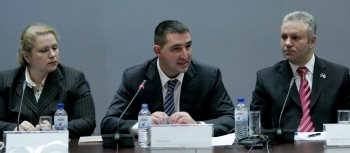
From left: Jasna Matic, Oliver Dulic and Mladjan Dinkic
Author:
Fonet
Speaking at the presentation of a study on greenfield foreign direct investments in Serbia organized by the Centre for Liberal Democratic Studies, Dinkic said that foreign investments must be attracted by offering stimulants even though the science of economics instructs against subsidising investors.
He said that the number of greenfield foreign direct investments in Serbia, crucial to the development of the economy, is still far less than in Romania, Bulgaria, the Czech Republic and Hungary, while bigger than in Bosnia-Herzegovina, Montenegro and Albania.
Dinkic said that from 2000 onwards $17 billion was invested, $5 billion in the banking sector, $2.6 billion in production, $2.4 billion in telecommunications, $1.7 billion in trade and $1.6 billion in real estate.
Austria was the top investor with $2.5 billion, Greece invested $2 billion, Norway $1.5 billion and Germany $1.6 billion, said Dinkic.
He said that it is a particularly significant fact that during the past couple of years 60% of the investment projects were for the production sector, primarily the car parts industry and the electronics and food industries.
Greenfield investments will be of key importance in the future because they have a positive influence on growth in production, exports and employment as well as on technological development.
He said that a tender will be called for leasing abandoned factories, adding that Brownfield investments are also extremely important for Serbia.
Minister of Environment and Spatial Planning Oliver Dulic said that brownfield investments are indeed very important because leasing existing facilities helps conserve agricultural land.
He said that the government will pass a decree this week according to which local self-governments will have the right to demand a report on the environmental effects of building any facility.
According to the amendments to the law on assessment of environmental effects the procedure for issuing assessment reports will be shortened from 265 days to 108, he explained adding that this law and the laws on planning and building, public property, land registry and the law on real estate trading will provide lasting solutions to most of the problems in the building sector.
He said that currently the biggest problems in the building sector are a shortage of locations that are not subject to dispute and have the required infrastructure and the time consuming procedure for obtaining building permits.
New laws will make it possible to privatise city building land and simplify the procedure for issuing and transferring building permits.
Dulic said that a few categories of buildings will be introduced and it will be possible to obtain permits for certain kinds of building much more quickly and simply.
He said that the question of the property of local self-governments will also be resolved, the number of planning documents will be reduced and the state will insist that every municipality prepares its own planning.
The state plans to introduce checks to assess the solvency status of companies interested in building in Serbia to ensure that buyers are on safe legal ground, said the Minister, adding that there are many locations and facilities in Serbia that are not in use and that could be used in brownfield investments.
Dulic said that privatisation of military property is a so far unexplored potential for foreign investors.
Minister of Telecommunications and Information Society Jasna Matic said that Serbia’s IT sector is the fastest growing in the economy, adding that the first authority for issuing digital signatures will be certified at the end of November.
A public debate on the action plan for the development of IT will start within 10 days, and the law on electronic communications is being drafted, said Matic, adding that work has begun on drafting a strategy for converting analogue TV transmission to digital.
She said that investors are very interested in the IT sector and the largest Indian real estate investment company has decided to invest in the Indjija IT Park, where production will supplement production in India.
Director of the Serbian Investment and Export Promotion Agency Vesna Peric said that 66 investment projects were approved this year, with investments of €430 million, which will create 13,500 new jobs and the state will provide financial support of €2,159 per job.
He said that the number of greenfield foreign direct investments in Serbia, crucial to the development of the economy, is still far less than in Romania, Bulgaria, the Czech Republic and Hungary, while bigger than in Bosnia-Herzegovina, Montenegro and Albania.
Dinkic said that from 2000 onwards $17 billion was invested, $5 billion in the banking sector, $2.6 billion in production, $2.4 billion in telecommunications, $1.7 billion in trade and $1.6 billion in real estate.
Austria was the top investor with $2.5 billion, Greece invested $2 billion, Norway $1.5 billion and Germany $1.6 billion, said Dinkic.
He said that it is a particularly significant fact that during the past couple of years 60% of the investment projects were for the production sector, primarily the car parts industry and the electronics and food industries.
Greenfield investments will be of key importance in the future because they have a positive influence on growth in production, exports and employment as well as on technological development.
He said that a tender will be called for leasing abandoned factories, adding that Brownfield investments are also extremely important for Serbia.
Minister of Environment and Spatial Planning Oliver Dulic said that brownfield investments are indeed very important because leasing existing facilities helps conserve agricultural land.
He said that the government will pass a decree this week according to which local self-governments will have the right to demand a report on the environmental effects of building any facility.
According to the amendments to the law on assessment of environmental effects the procedure for issuing assessment reports will be shortened from 265 days to 108, he explained adding that this law and the laws on planning and building, public property, land registry and the law on real estate trading will provide lasting solutions to most of the problems in the building sector.
He said that currently the biggest problems in the building sector are a shortage of locations that are not subject to dispute and have the required infrastructure and the time consuming procedure for obtaining building permits.
New laws will make it possible to privatise city building land and simplify the procedure for issuing and transferring building permits.
Dulic said that a few categories of buildings will be introduced and it will be possible to obtain permits for certain kinds of building much more quickly and simply.
He said that the question of the property of local self-governments will also be resolved, the number of planning documents will be reduced and the state will insist that every municipality prepares its own planning.
The state plans to introduce checks to assess the solvency status of companies interested in building in Serbia to ensure that buyers are on safe legal ground, said the Minister, adding that there are many locations and facilities in Serbia that are not in use and that could be used in brownfield investments.
Dulic said that privatisation of military property is a so far unexplored potential for foreign investors.
Minister of Telecommunications and Information Society Jasna Matic said that Serbia’s IT sector is the fastest growing in the economy, adding that the first authority for issuing digital signatures will be certified at the end of November.
A public debate on the action plan for the development of IT will start within 10 days, and the law on electronic communications is being drafted, said Matic, adding that work has begun on drafting a strategy for converting analogue TV transmission to digital.
She said that investors are very interested in the IT sector and the largest Indian real estate investment company has decided to invest in the Indjija IT Park, where production will supplement production in India.
Director of the Serbian Investment and Export Promotion Agency Vesna Peric said that 66 investment projects were approved this year, with investments of €430 million, which will create 13,500 new jobs and the state will provide financial support of €2,159 per job.
-
 Belgrade, 8 April 2026
Serbia remains firmly committed to strengthening cooperation in region
-
 Belgrade, 7 April 2026
Serbia’s infrastructure, economic development through partnership with China
-
 Belgrade, 6 April 2026
Anniversary of 1941 bombing of Belgrade marked
-
 Belgrade, 2 April 2026
Serbian Army remains committed to UNIFIL tasks
-
 Belgrade, 2 April 2026
Switzerland’s financial support for reform processes in Serbia
-
 Belgrade, 30 March 2026
Cooperation with Russia, Belarus in areas of mutual interest
-
 Belgrade, 27 March 2026
World Bank support for implementation of priority energy projects
-
 Belgrade, 27 March 2026
Continued cooperation with Germany on utility infrastructure projects
-
 Belgrade, 26 March 2026
Activities of state institutions for opening clusters 2 and 5 examined
-
 Belgrade, 26 March 2026
Exchange of experiences with Slovakia in field of ICT