
Q:
A:
Montenegro’s Kosovo recognition to affect regional cooperation
Belgrade,
10 October 2008
Director of the government’s EU Integration Office Tanja Miscevic stated today that Montenegro’s decision to recognise Kosovo’s independence will mostly affect regional cooperation which presupposes good relations and bilateral projects with regional countries.
Addressing the press at the Official Gazette’s gallery, where presentation of the magazine titled Challenges of EU Integration was held, Miscevic noted that following Montenegro’s recognition of the province’s independence, Serbia resorted to diplomatic means envisaged by the government’s action plan.
She explained that while determining the course of action, Serbia took into consideration the fact that the recognition was announced after the adoption of Serbia’s initiative at the UN General Assembly, as well as Serbia’s commitment to good neighbourly and brotherly relations with Montenegro.
The diplomatic retorsion is not directed at Montenegrin citizens and cannot be viewed that way. On the other hand, we are trying to maintain Serbia’s EU integration and Kosovo status issue as separate and parallel processes with EU’s approval, stressed Miscevic.
She highlighted that in that sense, imposing further conditions is impossible and added that this has never been mentioned at all.
German Ambassador to Serbia Wolfram Maas also spoke at the presentation of the first issue of the magazine Challenges of EU Integration. He welcomed the Serbian government’s decision to return ambassadors to countries from which they were revoked after their recognition of Kosovo’s independence, because he thinks that such a decision enables the exchange of information between those countries and Serbia.
Maas said that the speed with which Serbia will get closer to the EU depends solely on itself, and added that while on that path, Serbia will continue to enjoy the assistance of Germany, one of the countries offering the largest financial, personal and development aid.
The first issue of the magazine deals with the implementation of the Stabilisation and Association Agreement and clarifies all segments of Serbia’s EU integration process. The magazine was presented by editor Nikola Jovanovic and the Serbian President’s advisor Jurij Bajec.
She explained that while determining the course of action, Serbia took into consideration the fact that the recognition was announced after the adoption of Serbia’s initiative at the UN General Assembly, as well as Serbia’s commitment to good neighbourly and brotherly relations with Montenegro.
The diplomatic retorsion is not directed at Montenegrin citizens and cannot be viewed that way. On the other hand, we are trying to maintain Serbia’s EU integration and Kosovo status issue as separate and parallel processes with EU’s approval, stressed Miscevic.
She highlighted that in that sense, imposing further conditions is impossible and added that this has never been mentioned at all.
German Ambassador to Serbia Wolfram Maas also spoke at the presentation of the first issue of the magazine Challenges of EU Integration. He welcomed the Serbian government’s decision to return ambassadors to countries from which they were revoked after their recognition of Kosovo’s independence, because he thinks that such a decision enables the exchange of information between those countries and Serbia.
Maas said that the speed with which Serbia will get closer to the EU depends solely on itself, and added that while on that path, Serbia will continue to enjoy the assistance of Germany, one of the countries offering the largest financial, personal and development aid.
The first issue of the magazine deals with the implementation of the Stabilisation and Association Agreement and clarifies all segments of Serbia’s EU integration process. The magazine was presented by editor Nikola Jovanovic and the Serbian President’s advisor Jurij Bajec.
-
 Belgrade, 8 April 2026
Serbia remains firmly committed to strengthening cooperation in region
-
 Belgrade, 7 April 2026
Serbia’s infrastructure, economic development through partnership with China
-
 Belgrade, 6 April 2026
Anniversary of 1941 bombing of Belgrade marked
-
 Belgrade, 2 April 2026
Serbian Army remains committed to UNIFIL tasks
-
 Belgrade, 2 April 2026
Switzerland’s financial support for reform processes in Serbia
-
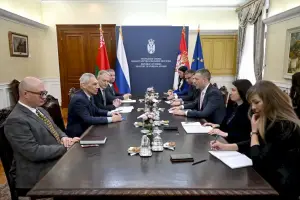 Belgrade, 30 March 2026
Cooperation with Russia, Belarus in areas of mutual interest
-
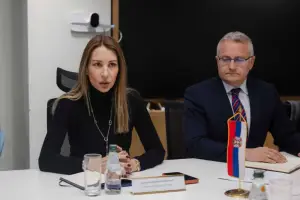 Belgrade, 27 March 2026
World Bank support for implementation of priority energy projects
-
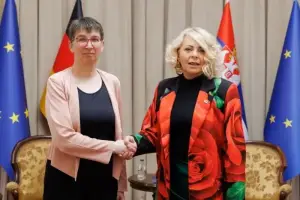 Belgrade, 27 March 2026
Continued cooperation with Germany on utility infrastructure projects
-
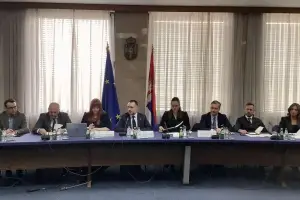 Belgrade, 26 March 2026
Activities of state institutions for opening clusters 2 and 5 examined
-
 Belgrade, 26 March 2026
Exchange of experiences with Slovakia in field of ICT