
Q:
A:
Two-day conference on Serbia’s foreign policy strategy opened
Belgrade,
28 May 2008
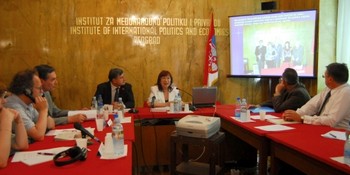
Serbian Assistant Minister of Foreign Affairs Cedomir Radojkovic said today that over the past two years, Serbia’s foreign policy priorities have been European integration and finding a compromise solution for the status of Kosovo-Metohija.
Author:
Tanjug
Opening a two-day conference on Serbia’s foreign policy strategy themed “Elements of Serbia’s foreign policy strategy" Radojkovic recalled that in the National strategy for EU accession, adopted in 2005, Serbia’s accession to the EU was defined as a priority strategic goal.
According to him, Serbia should become an EU candidate by the end of this or the beginning of next year. He said that to realise that goal, Serbia faces a challenge which no other European state has faced in its recent history – preservation of its territorial integrity and sovereignty after the unilaterally proclaimed independence of Kosovo-Metohija and its recognition by some countries. Serbia, just as any other country in the world, cannot accept a violent separation of part of its territory; the assistant minister said and added that the only solution is the continuation of negotiations and finding a compromise solution, which is in the interest of lasting stability and safety in the region. On the bilateral plan, Serbia’s vital interest is to improve relations with the powerful overseers of world policy, first of all Washington and Moscow, preserve good neighbourly relations with countries in the region, as well as with China, India, Japan and Latin American, African and Arab countries, Radojkovic added.
Serbian Assistant Minister of Foreign Affairs Milica Delevic said that the process of Serbia’s European integration was not as quick as it might have been expected judging by the support which Serbia received after 2000 changes.
She said that reasons for this were political obstacles, the challenges of transitions, relations between Serbia and Montenegro within the state-union, the issue of cooperation with the Hague tribunal, and the Kosovo status issue.
Delevic said that it is very important that Serbia finds a way to oppose the unilateral declaration of independence by Kosovo which does not jeopardise Serbia’s European future.
Director of the EU Integration Office Tanja Miscevic said that the latest decision by the EU Council of Ministers shows that Serbia could get candidate status very soon.
She stressed that this is the first time that the Council of Ministers has made such an assessment of any potential candidate, and added that the EU is aware that there are problems, but also knows that Serbia has the potential to get candidate status by the end of the year, and to make serious progress in internal reforms by then.
According to Miscevic, Serbia is making efforts to continue and accelerate the process of European integration and by 2012 the country will be able to take over all obligations stemming from EU membership.
According to him, Serbia should become an EU candidate by the end of this or the beginning of next year. He said that to realise that goal, Serbia faces a challenge which no other European state has faced in its recent history – preservation of its territorial integrity and sovereignty after the unilaterally proclaimed independence of Kosovo-Metohija and its recognition by some countries. Serbia, just as any other country in the world, cannot accept a violent separation of part of its territory; the assistant minister said and added that the only solution is the continuation of negotiations and finding a compromise solution, which is in the interest of lasting stability and safety in the region. On the bilateral plan, Serbia’s vital interest is to improve relations with the powerful overseers of world policy, first of all Washington and Moscow, preserve good neighbourly relations with countries in the region, as well as with China, India, Japan and Latin American, African and Arab countries, Radojkovic added.
Serbian Assistant Minister of Foreign Affairs Milica Delevic said that the process of Serbia’s European integration was not as quick as it might have been expected judging by the support which Serbia received after 2000 changes.
She said that reasons for this were political obstacles, the challenges of transitions, relations between Serbia and Montenegro within the state-union, the issue of cooperation with the Hague tribunal, and the Kosovo status issue.
Delevic said that it is very important that Serbia finds a way to oppose the unilateral declaration of independence by Kosovo which does not jeopardise Serbia’s European future.
Director of the EU Integration Office Tanja Miscevic said that the latest decision by the EU Council of Ministers shows that Serbia could get candidate status very soon.
She stressed that this is the first time that the Council of Ministers has made such an assessment of any potential candidate, and added that the EU is aware that there are problems, but also knows that Serbia has the potential to get candidate status by the end of the year, and to make serious progress in internal reforms by then.
According to Miscevic, Serbia is making efforts to continue and accelerate the process of European integration and by 2012 the country will be able to take over all obligations stemming from EU membership.
-
 Belgrade/Wuhan, 15 June 2026
Youth policy among Serbia's state priorities
-
 Belgrade/London, 14 June 2026
Serbia continues to strengthen cooperation with its diaspora
-
 Belgrade, 12 June 2026
Venice Commission confirms that Serbia improved set of judicial laws
-
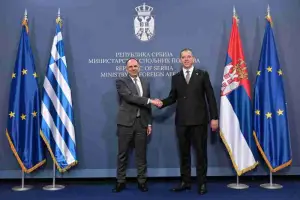 Belgrade, 12 June 2026
Serbia, Greece committed to region’s European perspective, stability
-
 Belgrade, 12 June 2026
Inclusion in European roaming area to bring concrete benefits for individuals, businesses
-
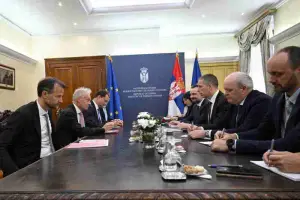 Belgrade, 11 June 2026
Serbia dedicated to building, advancing relations with European partners
-
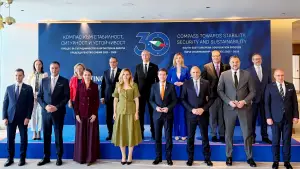 Belgrade/Sofia, 10 June 2026
Serbia committed to strengthening regional cooperation within SEECP
-
 Belgrade, 10 June 2026
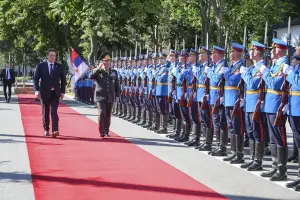
Advancing cooperation with Azerbaijan in field of defence
-
 Belgrade, 9 June 2026
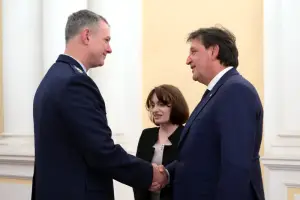
Serbia remains predictable, reliable partner committed to military neutrality
-
 Belgrade, 9 June 2026
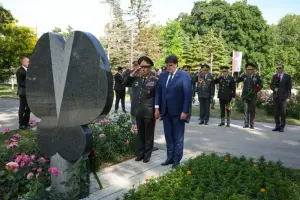
Serbian, Azerbaijani defence ministers lay wreaths at memorials in Belgrade