
Q:
A:
Agreement with EU in Serbia’s national interest
Belgrade,
16 January 2008
Serbian Deputy Prime Minister Bozidar Djelic said today that the Stabilisation and Association Agreement (SAA) with the EU serves the highest national interests of Serbia and voiced hope that the agreement will be signed on January 28.
Djelic said in an interview for the Radio-TV B92 that the SAA will strengthen Serbian economy and is completely in accordance with Serbia’s policy on Kosovo-Metohija.
He expressed expectation that the agreement will be signed the moment Serbia gets an invitation and added that there are a few countries which have not forgotten the so called “Hague condition”, implying full cooperation with the Hague Tribunal.
Djelic said that at the moment it is important for Serbian citizens that the EU also sends a signal that it is ready to work with us.
The Serbian Deputy Prime Minister said that there are obvious indications that the process of visa liberalisation could be accelerated, and added that an EU mission will arrive in Serbia in the period between March 10 to 14 regarding the matter.
Djelic recalled that on January 19 at Brdo near Kranj a meeting between foreign ministers of the European members of the Contact Group for Kosovo-Metohija and EU top officials will take place. He said that most probably the decision to send an EU mission to Kosovo-Metohija will not be brought since it is obvious that there is no consensus within the EU regarding the legal basis for such a mission.
Djelic reiterated Serbia’s stand that the decision to send such a mission to Kosovo-Metohija must be approved through a new resolution in the Security Council.
He said that the working group responsible for the agreement on cooperation with Russia in the energy sector will respond to the Russian offer in accordance with our national interest.
According to Djelic, it is in Serbia’s interest to secure stable gas and oil supply, which is also of strategic importance.
Djelic said that the gas pipe line is a Russian-European project and that the "Southern Stream" is built because Gazprom, which is one of the four largest gas companies in the world and the Italian side reached an agreement on its construction.
He underlined that Russia's main market is the European Union and that is why when fighting for a better European perspective, Serbia is fighting at the same time for better relations with the Russian Federation, with which it has common interests.
Gazprom and the Italian side have two options - after introducing the gas pipeline to Bulgaria, it can go through Romania and Hungary, or through Serbia and Croatia, Djelic explained and added that that is the most important gas pipeline that will be built in the next ten years.
The Serbian Deputy Prime Minister said that negotiations are difficult at the moment and that they are conducted in Bulgaria as well, so Russian President Vladimir Putin arrives to Sofia tomorrow.
He said that the Stabilisation and Association Agreement with the EU stipulates that by 2010 Serbia has to liberalise trade in oil derivatives, which means that investments must be made in Pancevo and Novi Sad in the next three years and Serbia's refineries must be equipped for competing on the market.
He expressed expectation that the agreement will be signed the moment Serbia gets an invitation and added that there are a few countries which have not forgotten the so called “Hague condition”, implying full cooperation with the Hague Tribunal.
Djelic said that at the moment it is important for Serbian citizens that the EU also sends a signal that it is ready to work with us.
The Serbian Deputy Prime Minister said that there are obvious indications that the process of visa liberalisation could be accelerated, and added that an EU mission will arrive in Serbia in the period between March 10 to 14 regarding the matter.
Djelic recalled that on January 19 at Brdo near Kranj a meeting between foreign ministers of the European members of the Contact Group for Kosovo-Metohija and EU top officials will take place. He said that most probably the decision to send an EU mission to Kosovo-Metohija will not be brought since it is obvious that there is no consensus within the EU regarding the legal basis for such a mission.
Djelic reiterated Serbia’s stand that the decision to send such a mission to Kosovo-Metohija must be approved through a new resolution in the Security Council.
He said that the working group responsible for the agreement on cooperation with Russia in the energy sector will respond to the Russian offer in accordance with our national interest.
According to Djelic, it is in Serbia’s interest to secure stable gas and oil supply, which is also of strategic importance.
Djelic said that the gas pipe line is a Russian-European project and that the "Southern Stream" is built because Gazprom, which is one of the four largest gas companies in the world and the Italian side reached an agreement on its construction.
He underlined that Russia's main market is the European Union and that is why when fighting for a better European perspective, Serbia is fighting at the same time for better relations with the Russian Federation, with which it has common interests.
Gazprom and the Italian side have two options - after introducing the gas pipeline to Bulgaria, it can go through Romania and Hungary, or through Serbia and Croatia, Djelic explained and added that that is the most important gas pipeline that will be built in the next ten years.
The Serbian Deputy Prime Minister said that negotiations are difficult at the moment and that they are conducted in Bulgaria as well, so Russian President Vladimir Putin arrives to Sofia tomorrow.
He said that the Stabilisation and Association Agreement with the EU stipulates that by 2010 Serbia has to liberalise trade in oil derivatives, which means that investments must be made in Pancevo and Novi Sad in the next three years and Serbia's refineries must be equipped for competing on the market.
-
 Belgrade, 3 June 2026
Bizerba continues to develop production in Serbia
-
 Belgrade, 2 June 2026
Small entrepreneurs driving force of domestic economy
-
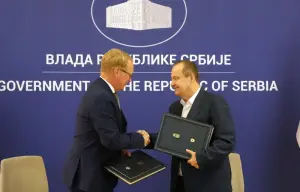 Belgrade, 1 June 2026
Serbia joins Frontex Partnership Academies Network
-
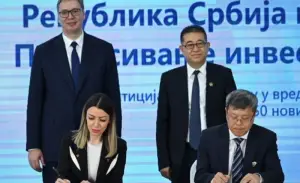 Belgrade/Shanghai, 28 May 2026
Commercial contracts signed with leading Chinese companies
-
 Belgrade/Jiaxing, 27 May 2026
Serbia entering new phase of technological, industrial development
-
 Belgrade, 27 May 2026
Dačić extends Kurban Bayram greetings
-
 Belgrade/Jinan, 26 May 2026
Strengthening international standing, economy through cooperation with China
-
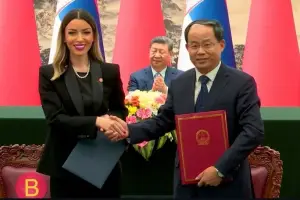 Belgrade/Beijing, 25 May 2026
Opening new opportunities to strengthen economic cooperation with China
-
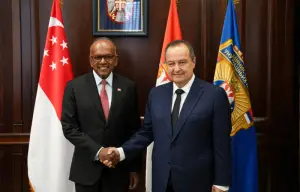 Belgrade, 25 May 2026
Serbia committed to developing cooperation with Singapore in field of security
-
 Belgrade, 23 May 2026
Dačić sends telegram of condolences over tragedy in mine in China