
Q:
A:
Government prepares sustainable growth strategy for balanced development
Belgrade,
10 January 2008
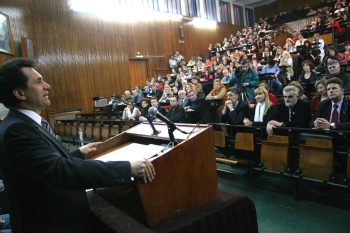
Serbian Deputy Prime Minister Bozidar Djelic said today that the Serbian government is preparing a sustainable growth strategy which will make it possible to balance economic, social and ecological goals of development.
Author:
Fonet
Speaking at a lecture on “Sustainable Growth”, within the framework of the public debate on the Serbian’ government’s strategy for sustainable development, at the Faculty of Technology and Metallurgy in Belgrade, Djelic stressed that the strategy is based upon three pillars – ecology, know-how and social policy.
He said that Serbia invests four times less in sustainable growth than countries which entered the EU during the previous years.
Today, Serbia recycles only 12% of waste, whereas EU recycles 60%, and Western countries up to 90%. However, Serbia has made a step forward, since earlier only 3% of waste was recycled, said Djelic.
He said that recycling is also an economic opportunity, the worth of which is estimated at €100 million per year.
According the Serbian government expects a large number of ideas to emerge from this faculty, and among them also a plan for using wind energy, as a renewable energy source in Serbia.
He announced that a new ecological plant will open in Knjazevac Dzervin as an example to other companies in Serbia.
Djelic said that sustainable development means also creating a societz where there will be no large differences and inequalities among people.
He presented the draft of the Serbian strategy of sustainable development as part of the campaign on sustainable progress, whose aim is to include citizens in the creation of the final text of the strategy of sustainable development through public discussion.
After the public discussion, organised in 19 Serbian cities and presentation of the strategy at the Sixth ministerial conference "Environment for Europe", the campaign will continue with presentation of this document at Serbian universities and follow-up discussions on the topic.
By adopting this strategy Serbia is showing a clear response how to adjust economic development, social issues and environemntal issues.
The project of preparation of the Strategy has been implemented since 2005 through cooperation of the Cabinet of the Deputy Prime Minister, UNDP and the Swedish International Development Agency (SIDA). Its aim is that the Strategy creates a framework for Serbia's development to 2017.
He said that Serbia invests four times less in sustainable growth than countries which entered the EU during the previous years.
Today, Serbia recycles only 12% of waste, whereas EU recycles 60%, and Western countries up to 90%. However, Serbia has made a step forward, since earlier only 3% of waste was recycled, said Djelic.
He said that recycling is also an economic opportunity, the worth of which is estimated at €100 million per year.
According the Serbian government expects a large number of ideas to emerge from this faculty, and among them also a plan for using wind energy, as a renewable energy source in Serbia.
He announced that a new ecological plant will open in Knjazevac Dzervin as an example to other companies in Serbia.
Djelic said that sustainable development means also creating a societz where there will be no large differences and inequalities among people.
He presented the draft of the Serbian strategy of sustainable development as part of the campaign on sustainable progress, whose aim is to include citizens in the creation of the final text of the strategy of sustainable development through public discussion.
After the public discussion, organised in 19 Serbian cities and presentation of the strategy at the Sixth ministerial conference "Environment for Europe", the campaign will continue with presentation of this document at Serbian universities and follow-up discussions on the topic.
By adopting this strategy Serbia is showing a clear response how to adjust economic development, social issues and environemntal issues.
The project of preparation of the Strategy has been implemented since 2005 through cooperation of the Cabinet of the Deputy Prime Minister, UNDP and the Swedish International Development Agency (SIDA). Its aim is that the Strategy creates a framework for Serbia's development to 2017.
-
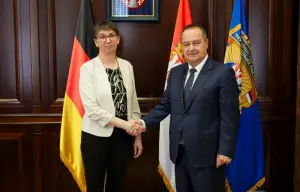 Belgrade, 20 July 2026
Cooperation in field of interior affairs important segment of relations with Germany
-
 Belgrade, 16 July 2026
Expo 2027 opportunity to further strengthen international partnerships
-
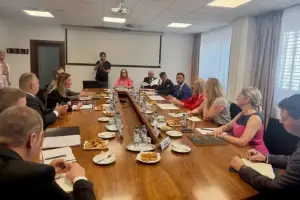 Belgrade/Bratislava, 16 July 2026
Serbia, Slovakia continue to strengthen political, economic cooperation
-
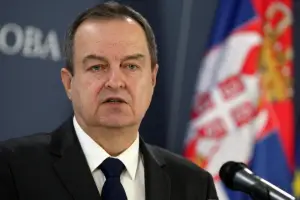 Belgrade, 14 July 2026
Serbia bilaterally resolves problems arising from EES implementation
-
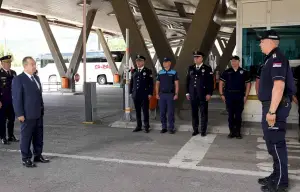 Gradina/Kalotina, 9 July 2026
Improving border cooperation between Serbia, Bulgaria
-
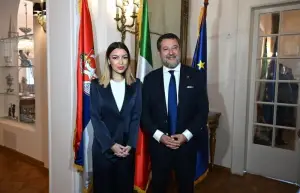 Belgrade, 7 July 2026
Further strengthening economic cooperation between Serbia, Italy
-
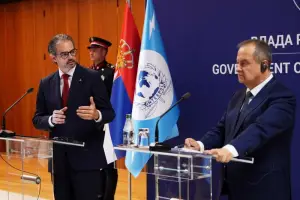 Belgrade, 6 July 2026
Serbia serious, responsible partner in fight against crime
-
 Kać, 3 July 2026
Additional foreign investment confirms confidence in Serbia
-
 Belgrade, 3 July 2026
Serbia, Hungary reliable partners in maintaining security
-
 Belgrade/Brussels, 3 July 2026
Serbia committed to further developing partnership relations with EU