
Q:
A:
Judicial reforms for independent judiciary, control of corruption
Belgrade,
14 March 2007
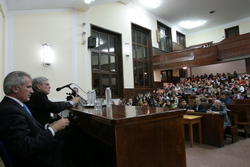
Serbian Minister of Justice Zoran Stojkovic said this evening that the judicial reforms which have been adopted will lead to an independent judiciary, and put a stop to corruption and political influence.
Author:
Tanjug
Speaking at a seminar held at the Faculty of Law in Belgrade, Stojkovic said that the introduction of the High Judicial Council, which will decide on the selection, promotion and dispensation of judicial officers, will lead to an independent judiciary.
According to Stojkovic, the establishment of a judicial academy will also contribute to the control of corruption.
Candidates, who finish their studies at the Faculty of Law, will take an exam to enter the academy, which means that knowledge and not just the diploma will be of importance, explained Stojkovic.
The academy, said Stojkovic, would prepare successful candidates for work at the faculties and in courts, and acquaint them with the practical aspects of law, and once having finished study at the academy, candidates would take an exam which would rank them, while the High Judicial Council will recommend candidates for various positions in the judiciary from that list.
Stojkovic said that every court procedure must be transparent and sentences will be made public through a website.
He said that the Strategy for Judicial Reform was prepared solidly through a period of two years, in which emphasis was put on the faculties, and stressed the importance of linking faculties with the judicial academy.
The state university faculties must carry out this work said Stojkovic and added that besides the Strategy for Judicial Reform, the Strategy for fighting corruption was also adopted.
Answering the questions of students, the Minister stressed that corruption does not refer just to bribery, rather it has a wider meaning, and abuse of office is also corruption and preventive measures are required to deal with this kind of crime.
Stojkovic stressed that corruption can be found everywhere including the faculties, but as we root out corruption we must take care not to discredit institutions.
He recalled that the Strategy for Judicial Reform, which was adopted by Serbian parliament and which is part of the new Constitution, was accepted in entirety by the EU and was positively assessed by the Venetian Commission.
Dean of the Faculty Mirko Vasiljevic demanded that the government provide transparent data regarding the precise number of doctorate degrees awarded during the previous ten years, the names of those who were in committees and the subjects of the doctoral theses.
According to Stojkovic, the establishment of a judicial academy will also contribute to the control of corruption.
Candidates, who finish their studies at the Faculty of Law, will take an exam to enter the academy, which means that knowledge and not just the diploma will be of importance, explained Stojkovic.
The academy, said Stojkovic, would prepare successful candidates for work at the faculties and in courts, and acquaint them with the practical aspects of law, and once having finished study at the academy, candidates would take an exam which would rank them, while the High Judicial Council will recommend candidates for various positions in the judiciary from that list.
Stojkovic said that every court procedure must be transparent and sentences will be made public through a website.
He said that the Strategy for Judicial Reform was prepared solidly through a period of two years, in which emphasis was put on the faculties, and stressed the importance of linking faculties with the judicial academy.
The state university faculties must carry out this work said Stojkovic and added that besides the Strategy for Judicial Reform, the Strategy for fighting corruption was also adopted.
Answering the questions of students, the Minister stressed that corruption does not refer just to bribery, rather it has a wider meaning, and abuse of office is also corruption and preventive measures are required to deal with this kind of crime.
Stojkovic stressed that corruption can be found everywhere including the faculties, but as we root out corruption we must take care not to discredit institutions.
He recalled that the Strategy for Judicial Reform, which was adopted by Serbian parliament and which is part of the new Constitution, was accepted in entirety by the EU and was positively assessed by the Venetian Commission.
Dean of the Faculty Mirko Vasiljevic demanded that the government provide transparent data regarding the precise number of doctorate degrees awarded during the previous ten years, the names of those who were in committees and the subjects of the doctoral theses.
-
 Belgrade/Brasília, 26 June 2026
Serbia, Brazil committed to strengthening cooperation across numerous fields
-
 Kraljevo/Čačak, 26 June 2026
Section of Adrani-Preljina motorway ceremonially opened
-
 Belgrade/Nicosia, 26 June 2026
Exhibition "Applied Nostalgia: Belgrade-Nicosia" opens in Cyprus
-
 Belgrade/Gdańsk, 25 June 2026
Serbia’s contribution to mitigating consequences of conflict in Ukraine
-
 Belgrade/Panama City, 24 June 2026
Serbia builds bridges of cooperation with OAS member states
-
 Belgrade/Panama City, 24 June 2026
Strengthening cooperation with Uruguay in areas of mutual interest
-
 Belgrade/Skopje, 24 June 2026
Exchange of experiences with North Macedonia in field of modernising public administration
-
 Belgrade, 24 June 2026
Support for preserving national identity of Ukrainian community in Serbia
-
 Belgrade/Minsk, 23 June 2026
Incentive to further strengthen cooperation with Belarus
-
 Belgrade, 23 June 2026
Great importance of political dialogue, strategic partnership with France