Q:
A:
Serbia pulls in $4bn in foreign direct investment this year
Belgrade,
23 November 2006
Serbian Minister of Trade, Tourism and Services Bojan Dimitrijevic said today that the Strategy for Serbian trade development implemented by this ministry is based on the creation of new trade institutions, integration of domestic corporations into the European Union, strengthening of competition and arrival of foreign companies and corporations.
Speaking at a session of the trade committee of the Serbian Chamber of Commerce, Dimitrijevic explained that this strategy includes liberalisation of prices, completion of privatisation, development of e-trade, adoption of a law on consumer protection, as well as the adoption of a law on trade, as the formal-legal foundation of the Strategy.
Speaking about macro economic indicators, the Minister said that Serbia has pulled in $4bn in foreign direct investment this year owing to the privatisation of large companies and the sale of the Mobtel mobile operator. A 7% growth of GDP is also expected.
He said that the Ministry of Trade, Tourism and Services will insist on the implementation of the Law on protection of competition, suppression of grey economy by efficient work of inspection services and introduction of fiscal cash registers for tax drivers, lawyers and tourist agencies.
According to him, it is necessary to speed up the process of privatisation, encourage the arrival of foreign firms and corporations and their investment in the local economy, and reduce the import of low-quality goods.
Dimitrijevic said that Serbia makes up for 33.9% of the total income of the Serbian economy, which shows a growth in relation to last year. The imports increased by 26% and exports by 40%.
He said that there are no monopolists in local trade, but that there are dominant companies that control 25% of the market, while those who control 50% of the local market can be considered semi-monopolists.
The fight against monopoly can be conducted by loyal competition and making strong foreign companies come to the Serbian market, the Minister explained and added that for such things there are no legal obstacles, but that the procedure for obtaining permits and building land for construction of new facilities has been made more difficult.
Speaking about macro economic indicators, the Minister said that Serbia has pulled in $4bn in foreign direct investment this year owing to the privatisation of large companies and the sale of the Mobtel mobile operator. A 7% growth of GDP is also expected.
He said that the Ministry of Trade, Tourism and Services will insist on the implementation of the Law on protection of competition, suppression of grey economy by efficient work of inspection services and introduction of fiscal cash registers for tax drivers, lawyers and tourist agencies.
According to him, it is necessary to speed up the process of privatisation, encourage the arrival of foreign firms and corporations and their investment in the local economy, and reduce the import of low-quality goods.
Dimitrijevic said that Serbia makes up for 33.9% of the total income of the Serbian economy, which shows a growth in relation to last year. The imports increased by 26% and exports by 40%.
He said that there are no monopolists in local trade, but that there are dominant companies that control 25% of the market, while those who control 50% of the local market can be considered semi-monopolists.
The fight against monopoly can be conducted by loyal competition and making strong foreign companies come to the Serbian market, the Minister explained and added that for such things there are no legal obstacles, but that the procedure for obtaining permits and building land for construction of new facilities has been made more difficult.
-
 Belgrade, 2 July 2026
Great potential for strengthening cooperation with Slovenia in agriculture
-
 Belgrade, 1 July 2026
Joint infrastructure projects of strategic importance for Serbia, Republika Srpska
-
 Belgrade, 30 June 2026
Scientific diplomacy one of strategic instruments of Serbian foreign policy
-
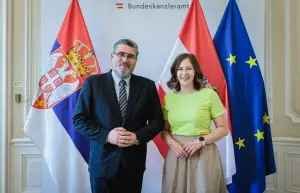 Belgrade/Vienna, 30 June 2026
Continuous Austrian support for Serbia’s European integration
-
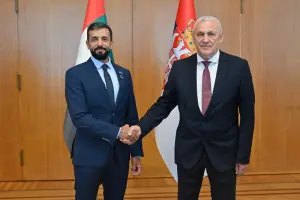 Belgrade, 30 June 2026
Deepening scientific, technological cooperation between Serbia, UAE
-
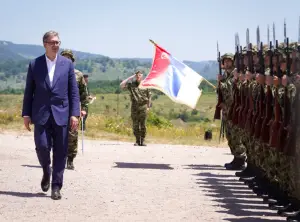 Pasuljanske Livade, 28 June 2026
Successful live-fire exercise conducted using SAF combat equipment, weapons systems
-
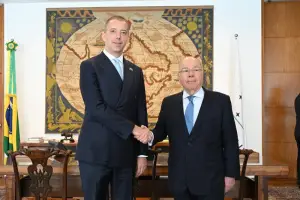 Belgrade/Brasília, 26 June 2026
Serbia, Brazil committed to strengthening cooperation across numerous fields
-
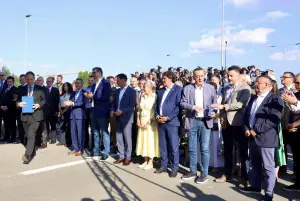 Kraljevo/Čačak, 26 June 2026
Section of Adrani-Preljina motorway ceremonially opened
-
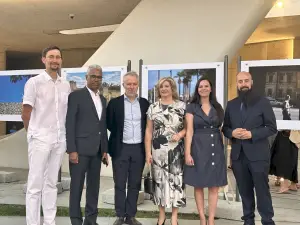 Belgrade/Nicosia, 26 June 2026
Exhibition "Applied Nostalgia: Belgrade-Nicosia" opens in Cyprus