
Q:
A:
Amendments to Law on criminal proceedings to result in more efficient courts
Belgrade,
23 November 2006
Serbian Minister of Justice Zoran Stojkovic said today that amendments to the Law on criminal proceedings referring to organised crime and war crimes would improve legal framework in these fields as well as more efficient judiciary.
Author:
Tanjug
At a roundtable on the draft law on state authorities in the procedure for crimes against international humanitarian law and the draft law on state authorities in the procedure for organised crime and other especially complex crimes, Stojkovic said that the special department of the Belgrade District Court cannot pass court rulings fast and efficiently for all organised crime cases, which is why it is necessary to create a network of prosecutions covering the whole of Serbia.
According to Stojkovic, the Special War Crimes Court is functioning well noting that with the close-down of the Hague tribunal a larger number of cases will be ceded to Serbian courts.
Stojkovic also said that the draft law on war crimes envisions settlement which was not envisioned in the Law on criminal proceedings.
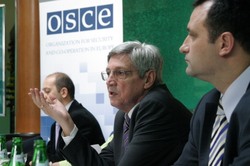
Head of the Rule of Law/Human Rights Department of the OSCE Mission to Serbia Ruth van Rhijn said that the two draft laws introduce novelties and offer certain authorisations for a more efficient fight against organised crime and war crimes.
According to her, Serbia has made a progress in the fight against organised crime in the past few years and added that after the Hague tribunal is closed down, domestic courts will take over a large number of cases, which will require their greater responsibility.
The roundtable, organised by OSCE and the Secretariat for implementation of the strategy for judiciary reform, gathered judges of the Supreme Court, judges and attorneys of the Belgrade District Court, Council for War Crimes and Organised Crime, representatives of the Faculty of Law and OSCE Mission in Serbia.
According to Stojkovic, the Special War Crimes Court is functioning well noting that with the close-down of the Hague tribunal a larger number of cases will be ceded to Serbian courts.
Stojkovic also said that the draft law on war crimes envisions settlement which was not envisioned in the Law on criminal proceedings.
Head of the Rule of Law/Human Rights Department of the OSCE Mission to Serbia Ruth van Rhijn said that the two draft laws introduce novelties and offer certain authorisations for a more efficient fight against organised crime and war crimes.
According to her, Serbia has made a progress in the fight against organised crime in the past few years and added that after the Hague tribunal is closed down, domestic courts will take over a large number of cases, which will require their greater responsibility.
The roundtable, organised by OSCE and the Secretariat for implementation of the strategy for judiciary reform, gathered judges of the Supreme Court, judges and attorneys of the Belgrade District Court, Council for War Crimes and Organised Crime, representatives of the Faculty of Law and OSCE Mission in Serbia.
-
 Belgrade, 2 July 2026
Great potential for strengthening cooperation with Slovenia in agriculture
-
 Belgrade, 1 July 2026
Joint infrastructure projects of strategic importance for Serbia, Republika Srpska
-
 Belgrade, 30 June 2026
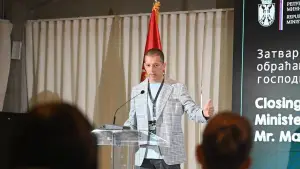
Scientific diplomacy one of strategic instruments of Serbian foreign policy
-
 Belgrade/Vienna, 30 June 2026
Continuous Austrian support for Serbia’s European integration
-
 Belgrade, 30 June 2026
Deepening scientific, technological cooperation between Serbia, UAE
-
 Pasuljanske Livade, 28 June 2026
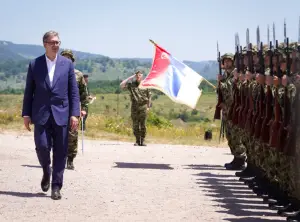
Successful live-fire exercise conducted using SAF combat equipment, weapons systems
-
 Belgrade/Brasília, 26 June 2026
Serbia, Brazil committed to strengthening cooperation across numerous fields
-
 Kraljevo/Čačak, 26 June 2026
Section of Adrani-Preljina motorway ceremonially opened
-
 Belgrade/Nicosia, 26 June 2026
Exhibition "Applied Nostalgia: Belgrade-Nicosia" opens in Cyprus