Q:
A:
SMEs get €160m in 2006, 2007
Belgrade,
16 November 2006
Serbian Minister of Economy Predrag Bubalo stated today that as part of the National Investment Plan small and medium-sized enterprises (SMEs) received €160 million under highly favourable conditions for the years 2006 and 2007. This considerably exceeds last year's €50 million.
Author:
Fonet
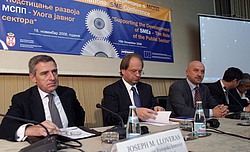
At the opening of the 4th international conference on SMEs themed "Stimulating the Growth of SMEs and Entrepreneurship – the Role of the Public Sector", Bubalo said that these funds were approved primarily for setting up businesses and that the government's projections include the opening of 10,000 new companies and 20,000 new entrepreneurships. However, this goal has already been surpassed when10,500 new companies were opened and around 20,000 new entrepreneurships created in 2005, he added.
This year we will achieve even more in this sector since 9,975 new companies have already been opened up until November, said the Minister. He also voiced expectations that by December 31 this number will amount to around 11,000.
He said that a historical step regarding financial support to SMEs was made when the Law on the development fund was amended to forbid giving funds to public companies awaiting privatisation. Thanks to this move all funds were redirected to SMEs, added Bubalo.
The balance between the newly-founded and closed companies in early November stood at 17,500 on the positive side of the scale, which confirms that plans in this sector will be realised, explained Bubalo.
Head of the European Commission delegation to Serbia Josep Lloveras recalled that in last week's report on Serbia the organisation pointed out that the country has made noticeable progress regarding the implementation of market economy principles, though other issues remain that demand additional effort
According to Lloveras, these issues include support to macroeconomic stability, tax system consolidation, fight against inflation, attracting a larger amount of greenfield investments, but also improving the SME sector.
Lloveras pointed out that when it comes to EU integration, the focus is usually on political issues and the implementation of the EU's legal heritage, however it should be noted that modern, performative and competitive economy is an extremely significant element in the EU integration process.
The conference was organised by the Ministry of Economy together with the European Agency for Reconstruction's EDEP project, the international Labour Organisation and the Norwegian government's ENTRANSE project.
This year we will achieve even more in this sector since 9,975 new companies have already been opened up until November, said the Minister. He also voiced expectations that by December 31 this number will amount to around 11,000.
He said that a historical step regarding financial support to SMEs was made when the Law on the development fund was amended to forbid giving funds to public companies awaiting privatisation. Thanks to this move all funds were redirected to SMEs, added Bubalo.
The balance between the newly-founded and closed companies in early November stood at 17,500 on the positive side of the scale, which confirms that plans in this sector will be realised, explained Bubalo.
Head of the European Commission delegation to Serbia Josep Lloveras recalled that in last week's report on Serbia the organisation pointed out that the country has made noticeable progress regarding the implementation of market economy principles, though other issues remain that demand additional effort
According to Lloveras, these issues include support to macroeconomic stability, tax system consolidation, fight against inflation, attracting a larger amount of greenfield investments, but also improving the SME sector.
Lloveras pointed out that when it comes to EU integration, the focus is usually on political issues and the implementation of the EU's legal heritage, however it should be noted that modern, performative and competitive economy is an extremely significant element in the EU integration process.
The conference was organised by the Ministry of Economy together with the European Agency for Reconstruction's EDEP project, the international Labour Organisation and the Norwegian government's ENTRANSE project.
-
 Belgrade, 2 July 2026
Great potential for strengthening cooperation with Slovenia in agriculture
-
 Belgrade, 1 July 2026
Joint infrastructure projects of strategic importance for Serbia, Republika Srpska
-
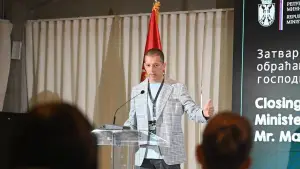 Belgrade, 30 June 2026
Scientific diplomacy one of strategic instruments of Serbian foreign policy
-
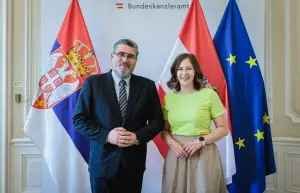 Belgrade/Vienna, 30 June 2026
Continuous Austrian support for Serbia’s European integration
-
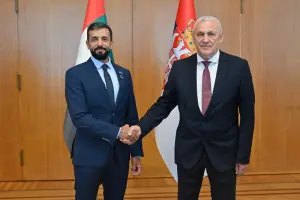 Belgrade, 30 June 2026
Deepening scientific, technological cooperation between Serbia, UAE
-
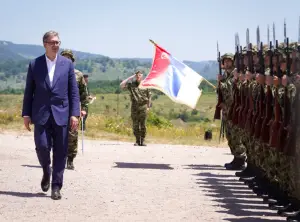 Pasuljanske Livade, 28 June 2026
Successful live-fire exercise conducted using SAF combat equipment, weapons systems
-
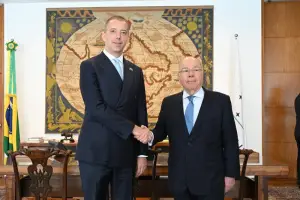 Belgrade/Brasília, 26 June 2026
Serbia, Brazil committed to strengthening cooperation across numerous fields
-
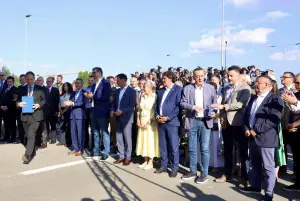 Kraljevo/Čačak, 26 June 2026
Section of Adrani-Preljina motorway ceremonially opened
-
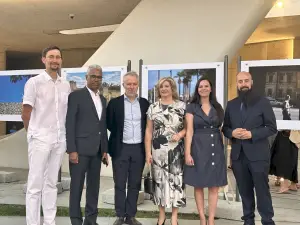 Belgrade/Nicosia, 26 June 2026
Exhibition "Applied Nostalgia: Belgrade-Nicosia" opens in Cyprus