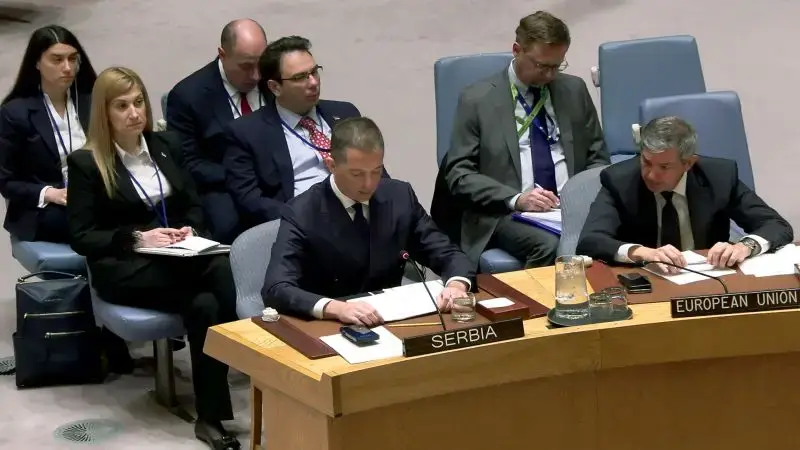
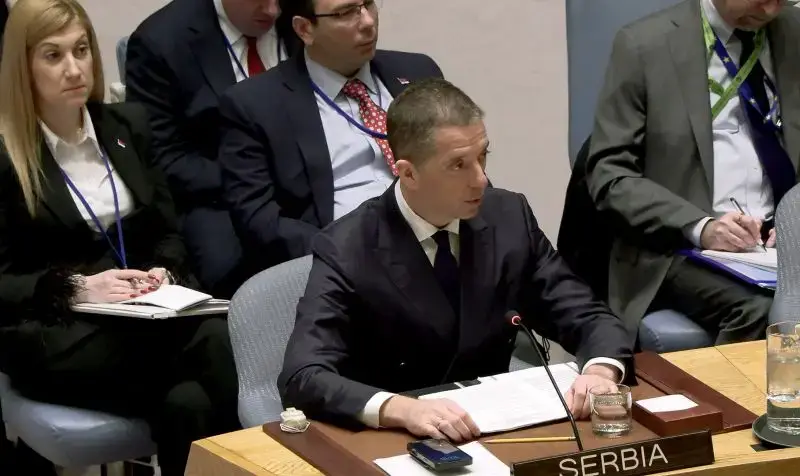
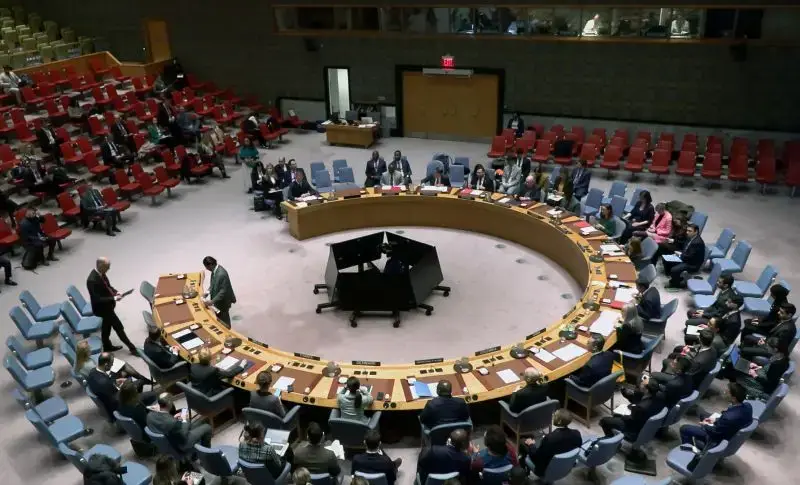
Minister of Foreign Affairs Marko Đurić stated today, at the session of the United Nations Security Council in New York, that Serbia remains committed to dialogue, peace, international law and the full implementation of all agreements reached.

Q:
A:
Serbia remains committed to dialogue, peace, respect for international law
Belgrade/New York,
9 April 2026
At the session, at which the Report of the UN Secretary-General on the work of UNMIK for the period from September 2025 to March 2026 was discussed, Đurić emphasised that our country is ready to cooperate constructively with all partners to find a comprehensive, mutually acceptable and lasting solution that respects the rights and security of all communities.
He pointed out that the oppression of a community does not happen overnight, but rather takes place in recognisable phases, which clearly illustrate the pattern of actions carried out by Albin Kurti.
The first phase, he said, is that identity becomes a source of insecurity, with the identity of Serbs in Kosovo and Metohija being used as a basis for restricting their rights, their movement and targeting their homes, property and religious sites.
According to him, in 2025 alone, 137 ethnically motivated incidents were recorded, and since the beginning of this year, new arrests and attacks have continued.
The head of Serbian diplomacy said that attempts to enter social, healthcare and educational institutions are particularly worrying, as they directly threaten the basic functions necessary for the survival of the community.
At the same time, he warned, a series of coordinated measures have affected the daily lives of Serbs, such as the unilateral ban on the Serbian dinar and systematic pressure on Serbian institutions in healthcare, education and social services.
The arrests also raise serious concerns about due process and proportionality, while the seizure of land in the north for mono-ethnic special police bases has often been carried out without transparency and outside the agreed framework, Đurić pointed out.
Of particular concern is that the Report does not mention the silent but persistent exodus of Serbs, the Minister said, noting that in a very short period of time, approximately 20% of the Serb population left Kosovo and Metohija due to pressure.
The second phase is legal marginalisation, which is reflected in pressures through policies and administrative decisions, he explained, recalling that legislative initiatives, such as the draft law on foreigners, have caused deep concern among Serbs in Kosovo and Metohija.
Đurić pointed out that more than 13 years have passed since the signing of the First Basic Brussels Agreement, and it has still not been implemented, assessing that this is not just a matter of time, but a matter of credibility, trust and respect for the obligations that have been formally undertaken.
He stressed that the third phase includes attacks on culture, religion and heritage, warning that the desecration of religious sites and cemeteries is not just vandalism, but a direct attack on identity, dignity and basic human rights.
The fourth phase involves increasing security pressures and intimidation, the minister said, and pointed out that the strengthening of the so-called Kosovo Security Forces, accompanied by the acquisition of modern weapons, cannot be seen as a neutral process.
Such developments, especially when carried out without transparency and without full respect for international obligations, undermine efforts to maintain stability and call into question the credibility of existing security mechanisms, Đurić stressed.
Accordingly, he underlined that KFOR must remain the only legitimate and credible security presence on the ground, fully in line with its mandate.
-
 Author: Ministry of Foreign Affairs
 -
 Author: Ministry of Foreign Affairs
 -
 Author: Ministry of Foreign Affairs
-
 Belgrade, 8 April 2026
Serbia remains firmly committed to strengthening cooperation in region
-
 Belgrade, 7 April 2026
Serbia’s infrastructure, economic development through partnership with China
-
 Belgrade, 6 April 2026
Anniversary of 1941 bombing of Belgrade marked
-
 Belgrade, 2 April 2026
Serbian Army remains committed to UNIFIL tasks
-
 Belgrade, 2 April 2026
Switzerland’s financial support for reform processes in Serbia
-
 Belgrade, 30 March 2026
Cooperation with Russia, Belarus in areas of mutual interest
-
 Belgrade, 27 March 2026
World Bank support for implementation of priority energy projects
-
 Belgrade, 27 March 2026
Continued cooperation with Germany on utility infrastructure projects
-
 Belgrade, 26 March 2026
Activities of state institutions for opening clusters 2 and 5 examined
-
 Belgrade, 26 March 2026
Exchange of experiences with Slovakia in field of ICT