Q:
A:
Serbia might become EU country candidate next year
Belgrade/Brussels,
4 September 2006
Serbian Minister of Finance Mladjan Dinkic said today in Brussels that he is encouraged by the impression he got during talks today with EU’s top officials that mainly focused on whether Serbia could become an EU country candidate next year.
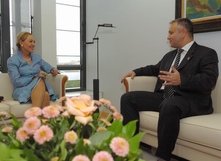
Benita Ferrero-Waldner, left, and Mladjan Dinkic
Author:
Fonet
After meeting with EU High Representative for the Common Foreign and Security Policy Javier Solana, European Commissioner for Economic and Monetary Affairs Joaquin Almunia and European Commissioner for External Politics and European Neighbourhood Policy Benita Ferrero-Waldner, Dinkic said that before becoming a country candidate, Serbia would have to sign a Stabilisation and Association Agreement (SAA), which is why it is necessary to complete cooperation with the Hague tribunal and to show concrete results in that respect by implementing the Action Plan for cooperation with the tribunal.
The Serbian Minister of Finance said that he got support from the EU officials for Belgrade’s negotiations with the Paris Club of creditors for a write-off of the Serbian debt, noting that Germany will play a major role in these negotiations and that the Serbian government will conduct separate bilateral negotiations with EU members.
He also said that he handed over a letter from Serbian Prime Minister Vojislav Kostunica to Solana where Serbia expresses readiness to secure an electricity supply for the Serbian people in Kosovo-Metohija and thus help resolve a potential humanitarian catastrophe in the province during the upcoming winter season, considering the problems Pristina faces with its electricity supply.
According to Dinkic, the talks with Almunia focused on possibility of increasing pre-accession funds for Serbia.
I presented Serbia’s estimates that the country needs a minimum of €250 million in 2007, with the figure increasing to €500 million in 2011, Dinkic said adding that he thinks the EU is ready to consider this.
Dinkic said that the talks also concerned the abolition of visas for Serbian citizens, which would, according to him, depend on the country’s ongoing EU candidacy status.
He explained that the moment Serbia becomes candidate for EU membership, there are realistic chances to abolish visas for all Serbian citizens, whereas by that time the visa regime will be gradually relaxed for scientists and young people.
The Minister pointed to the importance of the announced intensive cooperation between Serbia and the EU in the field of education, which will begin in late October with a visit of EU Commissioner for Education Jan Figel to Serbia.
Dinkic said that his talks with Benita Ferrero-Waldner were very good since she understands Serbia's importance for stability in the region very well.
All EU collocutors agree that it is necessary to help Serbia, and we must understand that we have to do everything to help ourselves, Dinkic said.
According to Dinkic, EU officials welcomed the Serbian government's latest decision to offer assistance to peace missions in Lebanon and Afghanistan since that is one of Europe's crucial priorities at this moment.
Dinkic said that the Serbian Ministry of Finance today submitted to UNOSEK the documentation on a part of Kosovo's foreign debt and that he informed EU High Representative Javier Solana about that today in Brussels.
He pointed out that the documentation confirms that some $1.70 billion of Serbia's foreign debt has been "allocated" to the territory of Kosovo-Metohija. That part of debt is currently serviced by Serbia and so far the government has paid some $170 million to cover interests from 2001, the Minister said and added ethnic Albanians should now take over the servicing of that debt because they are collecting taxes on the territory to which this debt applies.
I refer to UNOSEK and UN. Serbia's payment balance should be relieved for that sum, so that Serbian taxpayers are not forced to pay debt for a territory from which Serbia has no income at all, Dinkic stressed.
The Serbian Minister of Finance said that he got support from the EU officials for Belgrade’s negotiations with the Paris Club of creditors for a write-off of the Serbian debt, noting that Germany will play a major role in these negotiations and that the Serbian government will conduct separate bilateral negotiations with EU members.
He also said that he handed over a letter from Serbian Prime Minister Vojislav Kostunica to Solana where Serbia expresses readiness to secure an electricity supply for the Serbian people in Kosovo-Metohija and thus help resolve a potential humanitarian catastrophe in the province during the upcoming winter season, considering the problems Pristina faces with its electricity supply.
According to Dinkic, the talks with Almunia focused on possibility of increasing pre-accession funds for Serbia.
I presented Serbia’s estimates that the country needs a minimum of €250 million in 2007, with the figure increasing to €500 million in 2011, Dinkic said adding that he thinks the EU is ready to consider this.
Dinkic said that the talks also concerned the abolition of visas for Serbian citizens, which would, according to him, depend on the country’s ongoing EU candidacy status.
He explained that the moment Serbia becomes candidate for EU membership, there are realistic chances to abolish visas for all Serbian citizens, whereas by that time the visa regime will be gradually relaxed for scientists and young people.
The Minister pointed to the importance of the announced intensive cooperation between Serbia and the EU in the field of education, which will begin in late October with a visit of EU Commissioner for Education Jan Figel to Serbia.
Dinkic said that his talks with Benita Ferrero-Waldner were very good since she understands Serbia's importance for stability in the region very well.
All EU collocutors agree that it is necessary to help Serbia, and we must understand that we have to do everything to help ourselves, Dinkic said.
According to Dinkic, EU officials welcomed the Serbian government's latest decision to offer assistance to peace missions in Lebanon and Afghanistan since that is one of Europe's crucial priorities at this moment.
Dinkic said that the Serbian Ministry of Finance today submitted to UNOSEK the documentation on a part of Kosovo's foreign debt and that he informed EU High Representative Javier Solana about that today in Brussels.
He pointed out that the documentation confirms that some $1.70 billion of Serbia's foreign debt has been "allocated" to the territory of Kosovo-Metohija. That part of debt is currently serviced by Serbia and so far the government has paid some $170 million to cover interests from 2001, the Minister said and added ethnic Albanians should now take over the servicing of that debt because they are collecting taxes on the territory to which this debt applies.
I refer to UNOSEK and UN. Serbia's payment balance should be relieved for that sum, so that Serbian taxpayers are not forced to pay debt for a territory from which Serbia has no income at all, Dinkic stressed.
-
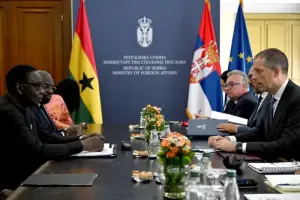 Belgrade, 6 July 2026
Serbia committed to strengthening economic, political ties with Ghana
-
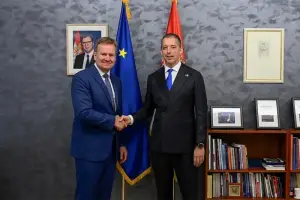 Belgrade/Brussels, 3 July 2026
Belgrade committed to continuing constructive dialogue with Priština
-
 Belgrade/Brussels, 3 July 2026
Serbia’s European integration guarantees regional stability
-
.webp) Belgrade, 3 July 2026
Belgrade, 3 July 2026Continued strengthening of Serbia-Spain defence cooperation
-
 Belgrade, 2 July 2026
Great potential for strengthening cooperation with Slovenia in agriculture
-
 Belgrade, 1 July 2026
Joint infrastructure projects of strategic importance for Serbia, Republika Srpska
-
 Belgrade, 30 June 2026
Scientific diplomacy one of strategic instruments of Serbian foreign policy
-
 Belgrade/Vienna, 30 June 2026
Continuous Austrian support for Serbia’s European integration
-
 Belgrade, 30 June 2026
Deepening scientific, technological cooperation between Serbia, UAE