Q:
A:
23rd Conference of Danubian Countries on Hydrological Forecasting opens
Belgrade,
28 August 2006
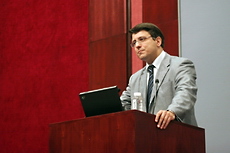
Serbian Minister of Science and Environmental Protection and president of the conference organisation board Aleksandar Popovic opened today in Belgrade's Sava Centre the 23rd Conference of Danubian Countries on Hydrological Forecasting and Hydrological Bases of Water Management, which takes place every second year in one of the Danube countries.
Author:
Tanjug
Popovic said that the conference is one of the greatest scientific gatherings this year in Serbia and stressed the importance of Serbia's cooperation with UNESCO regarding this sector.
Secretary of UNESCO International Hydrological Programme (IHP) Andras Szollosi-Nagy said that around 1.2 billion people worldwide do not have clean drinking water and the reduction in the amount of drinking water throughout the world will remain a major problem in the 21st century.
He said mankind will face a shortage of drinking water this century, since reserves of drinking water have been rapidly decreasing in the past 35 years.
According to Szollosi-Nagy, to solve this problem, which is one of the top five on UNESCO's list, the organisation needs decades of research, apart from political willingness and financial support.
Director of the Serbian Hydrometeorogical Service Jovanka Andrejevic said that this will present a problem for future generations as well and voiced expectations that the conference will help strengthen international cooperation in water management.
She said the first water research in Serbia was carried out in the 19th century on the Danube near the Petrovaradin Fort in Novi Sad. Since then, the Hydrometeorogical Service has become a modern and developed service.
During the conference, the participants will be acquainted with results of research in all sectors of hydrology and water management and 200 renowned experts from 20 countries are expected to take part.
The conference will last until August 31 and the participants will also visit the Djerdap hydroelectric power plant.
Secretary of UNESCO International Hydrological Programme (IHP) Andras Szollosi-Nagy said that around 1.2 billion people worldwide do not have clean drinking water and the reduction in the amount of drinking water throughout the world will remain a major problem in the 21st century.
He said mankind will face a shortage of drinking water this century, since reserves of drinking water have been rapidly decreasing in the past 35 years.
According to Szollosi-Nagy, to solve this problem, which is one of the top five on UNESCO's list, the organisation needs decades of research, apart from political willingness and financial support.
Director of the Serbian Hydrometeorogical Service Jovanka Andrejevic said that this will present a problem for future generations as well and voiced expectations that the conference will help strengthen international cooperation in water management.
She said the first water research in Serbia was carried out in the 19th century on the Danube near the Petrovaradin Fort in Novi Sad. Since then, the Hydrometeorogical Service has become a modern and developed service.
During the conference, the participants will be acquainted with results of research in all sectors of hydrology and water management and 200 renowned experts from 20 countries are expected to take part.
The conference will last until August 31 and the participants will also visit the Djerdap hydroelectric power plant.
-
 Belgrade, 6 July 2026
Serbia committed to strengthening economic, political ties with Ghana
-
 Belgrade/Brussels, 3 July 2026
Belgrade committed to continuing constructive dialogue with Priština
-
 Belgrade/Brussels, 3 July 2026
Serbia’s European integration guarantees regional stability
-
.webp) Belgrade, 3 July 2026
Belgrade, 3 July 2026Continued strengthening of Serbia-Spain defence cooperation
-
 Belgrade, 2 July 2026
Great potential for strengthening cooperation with Slovenia in agriculture
-
 Belgrade, 1 July 2026
Joint infrastructure projects of strategic importance for Serbia, Republika Srpska
-
 Belgrade, 30 June 2026
Scientific diplomacy one of strategic instruments of Serbian foreign policy
-
 Belgrade/Vienna, 30 June 2026
Continuous Austrian support for Serbia’s European integration
-
 Belgrade, 30 June 2026
Deepening scientific, technological cooperation between Serbia, UAE